My PhD research Vanished Comforts: Setting the Context for Furniture and Furnishings in Scotland, 1500-1650, was an AHRC-funded project involving National Museums Scotland and the University of Dundee, running from 2012 to 2016.
The purpose of the research was to imagine and understand the use and purpose of rooms and planning in Scottish homes and castles in this period, from the surviving objects and buildings, archival records, and narratives with a spatial component.
It isn’t always easy to match objects with spaces, archival sources like inventories, or with stories and narratives. Early modern letter writers rarely discuss objects or possessions, and mention architectural space infrequently. When they do it can be to indicate the position of an important person, or note that they shared a space with such a person. This architectural space is concerned with hierarchical relationships, and is reflected in the spaces found in Scottish buildings, the entrance, stair, hall, and chamber, and the alternative dining rooms and drawing chambers which appear in the early seventeenth century.[1]
Alexander Seton, Earl of Dunfermline (d. 1622) Lord Chancellor of Scotland 1604-1622 built at Pinkie House, Delgety, and Fyvie Castle, and decorated his lodgings in Edinburgh at Riddle’s Court and Moubray House with plaster ceilings.[2] These ceilings include the emblems of the nations of Britain. At Pinkie his gallery was painted with a selection of emblems representing stoic virtues, and he once represented himself as tempted to be “over – stoic” to King James [3]. But there is no reference to these works, or emblems, or even classical learning in his surviving business letters, except a few Latin tags.
In just one letter Seton is preoccupied with an object, writing on 30 June 1614 at length about a purse to hold the great seal of Scotland, after news of a battle with pirates off Orkney, the business of the inheritance of the Francis earl of Bothwell’s son, and the disappointing summer, as yet ‘extraordinari cauld’.
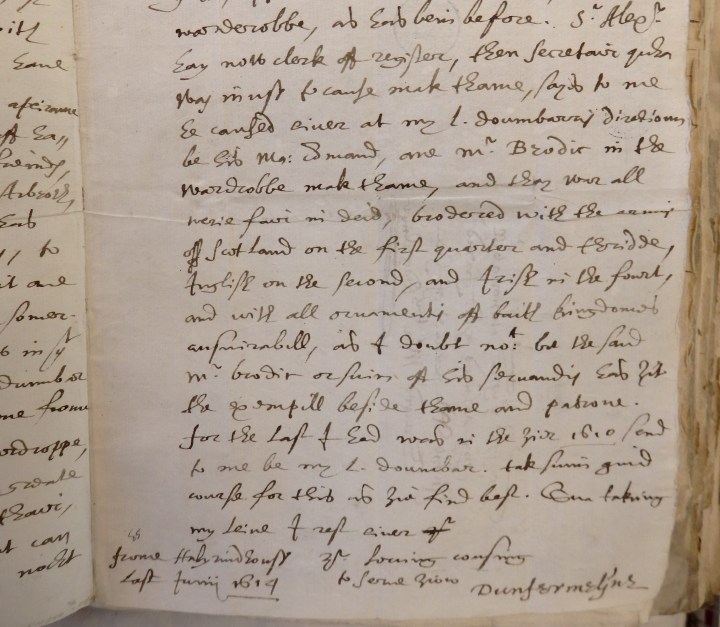
Alexander Seton to John Murray, 30 June 1614, (National Library of Scotland)[4]
Seton hopes that John Murray of the Bedchamber (later earl of Annandale) can get the Master of the Wardrobe’ embroiderer to make a new a purse for the great seal. The word he uses is ‘poolke’ – a word for a pocket. His purses once ‘verie magnific and honest’ were now ‘worne aulde and nocht sa cuimelie as neid war’ and apparently, they ‘can nocht gottin maid heir’.
Murray was to get the king’s command for the Master Embroiderer, a process previously managed by the deceased George Home earl of Dunbar. The purse would be:
‘verie fair in deid, brodered with the armis off Scotland on the first quarter and thridde, Inglish on the second, and Irish in the fourt, and with all ornamentis off baith kingdoms answerabill, as I doubt nocht but the said Mr Brodir of suim off his servandis has yit the exampill beside thame and patrone’ [5]
This shows that Seton took some care in matters of public display, as he certainly made efforts to project his image in his own houses Was it really true that there were no embroiderer’s in Edinburgh for this work in 1614, or did Seton know he could get a purse at the king’s expense from London?
The letter is sealed with Seton’s own device of a crowned star and crescent, still to be seen in plaster and stone. We can draw some parallels between the ornaments of the kingdoms and the embroiderer’s patterns, and the same motifs still to be seen in Seton’s buildings, and wonder if the emblems seen there were intended to connect the idea of government by letter or pen, as the purse surely was.

Alexander Seton’s own heraldic badge at Moubray House, Edinburgh.
[1] Charles Wemyss, ‘A study of aspiration and ambition : the Scottish Treasury Commission and its impact upon the development of Scottish country house architecture 1667-1682’, University of Dundee PhD, 2008.
[2] William Napier, ‘Kinship and politics in the art of plaster decoration’, University of Dundee PhD, 2012.
[3] Michael Bath, ‘Philostratus Comes To Scotland: A New Source for the Pictures at Pinkie’ Northern Renaissance, Issue 5 (2013).
[4] National Library of Scotland, Adv. 33.1.1, vol.5, no.45, Dunfermline to Murray, 30 June 1614
[5] Published in Letters and State Papers during the Reign of James VI, (1838), 218-9.
 Objects and the archive