James VI explored various opportunities to maintain his via media in Scotland and secure his accession to the throne of England. When Anne of Denmark’s 19 year old brother Ulric, Duke of Holstein, visited Scotland in 1598 it was intended he would depart with a Scottish embassy to Denmark and the Holy Roman Empire. The embassy was instructed to secure support for James’s title after the death of Elizabeth with promises of military aid against Spanish intervention in England. This aspect of the duke’s visit was generally known in Antwerp before the Duke left Scotland, and by the end of year, Elizabeth was furious with James VI for the impertinence of his ambassadors.
Holstein was banqueted at Baillie MacMorran’s house in Riddle’s Court, Edinburgh, by the king and by the burgh on Tuesday 2 May 1598. A surviving painted ceiling has a motif of the imperial eagle linked with thistles, which be an emblem of this diplomatic project. The connection between the duke’s visit and the subsequent embassy have been overlooked, and more attention placed on the reports of drunkenness and extravagance.
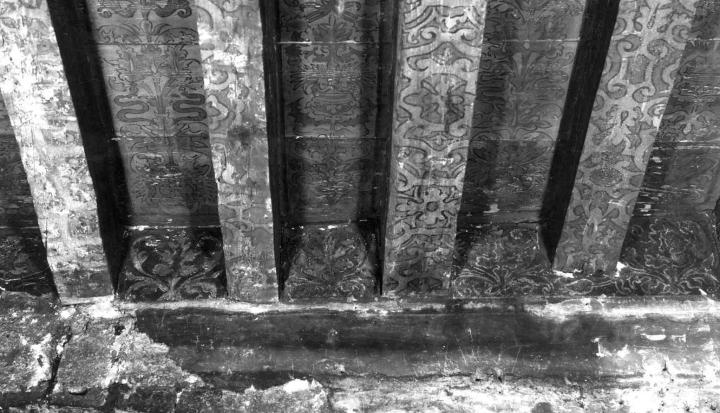 The painted ceiling in Riddle’s court (HES)
The travels of Ulrik, Duke of Holstein to France England and Scotland
Anne of Denmark’s younger brother was born in 1578. Ulrik shared the title of duke of Holstein with Christian IV and his younger brother Johan of Schleswig-Holstein. The Holstein territory was divided into two dukedoms; Anne’s brother-in-law, also Ulrik, was duke of Holstein-Gottorp. In February 1597 Ulric became co-adjutor of the bishopric of Schwerin – a representative of the Holy Roman Empire. After his university education at Helmstadt, Rostock and Leipzig, he travelled with his tutor or master household, Albert Skeel, in France, England and Scotland, returning to Denmark for the corontion of his brother’s queen, Anne Catherine of Brandenburg.
On his arrival in Edinburgh, Ulric, Duke of Holstein made himself known to David Cunningham of Robertland on 14 March 1598. George Nicolson, the English agent in Scotland reported that he had travelled incognito through England. The duke presumably travelled like a private student with his tutor, an example of such a student itinerary was published by Martin Zeiller in 1634, and similar travels were recorded in numerous student album amicoricum. Robertland sent the news to Anne of Denmark and the duke came to supper at Holyroodhouse conveyed by the earls of Mar and Cassilis. Robertland had been exiled at the Danish court for four years after the murder of the earl of Eglinton in 1586. He was permitted to return to Scotland during the marriage trip of James VI. Anne’s ladies-in-waiting secured his rehabilitation by James on 27 November 1589 in Oslo.

Ulrik of Denmark, (Husum Slot, wikipedia)
William Schaw, royal master of work, was given a budget to escort the Duke of Holstein in Scotland. Schaw had travelled to Denmark with James VI and returned in advance to supervise the decoration of Holyrood Palace and St Giles Kirk in 1590. Schaw’s epitaph at Dunfermline Abbey describes him as ‘master of ceremony’ and he had been a companion of the Danish ambassadors in 1585. Now he devised a progress to Fife for Holstein and Ludovic, Duke of Lennox, visiting Ravenscraig Castle, Balcomie, Pittenween, Anstruther, St. Andrews, Leuchars, Dundee, Foulis, Stirling and Linlithgow.
On Wednesday 5 April 1598 they arrived at Perth, were given a banquet by the town and conveyed with an hundred riders to John Murray of Tullibardine at Aberuthven. Schaw and the duke made the usual trip to the Bass Rock to see the legendary solan geese. During the duke’s Scottish progress cannon salutes were fired in Edinburgh, Leith and Stirling, supervised by James Murray, the master wright who would become master of works in 1607. A similar itinerary in 1609 made by an anonymous ‘count of the Holy Roman Empire’ lacks the royal sponsored ceremonial but takes in the same sights in Scotland and the staging posts in England that Ulric must have used in his incognito journey from Dover.
Ulric stayed longer in Scotland than first planned following a letter from the Danish court arranging for him to attend the coronation of Anne Catherine of Brandenburg, queen of Denmark on 1 June. There was disapproving comment on the Duke of Holstein’s visit from English observers and the English courtier Roger Aston. It was seen as likely to serve to further alienate Anne and her party from English interest, and the drunkenness and expense of the entertainment were noted. George Nicholson, the resident English agent reported the visit cost James 10,000 marks sterling, Roger Aston estimated a lower figure of £4000.
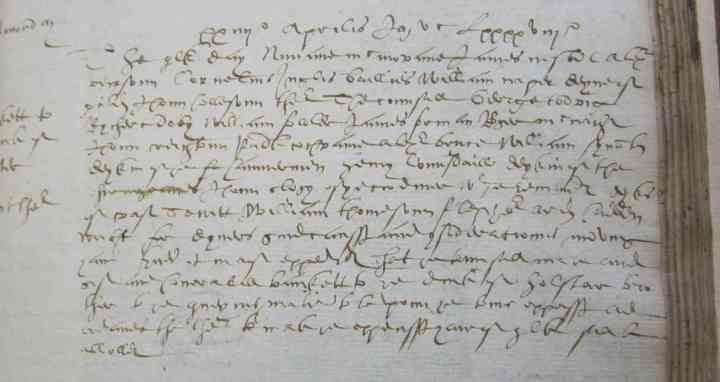
Resolution of 24 April 1598, (Edinburgh City Archives, Treasurer’s Account)
The town coucil resolved on 24 April, ‘for diverse good causes and considerations’, to give an ‘honourable’ banquet for the duke at their expense. Ulric was banqueted twice at Ninian MacMorran’s house on Edinburgh’s Lawnmarket at the end of April 1598. The minutes and the town treasurer’s accounts recorded the resolution of 24 March to hold the banquet and its final expense of £1103-17-3d. Ninian’s older brother, John, had been permitted to extend his house onto the site of the town’s former Over-Bow gate in 1590. John MacMorran, who built the house at Riddle’s Court and was shot by schoolchildren on 15 September 1596, had been one of the wealthiest ship-owners in Edinburgh with an interest of £4000 shared in nine vessels. His house was one of finest and best appointed in Edinburgh. Ulric may have been lodged there; his first banquet was at the expense of the king on Sunday 30 April, the second banquet on Tuesday 2 May paid for by the council of Edinburgh with the king and queen as guests.
Some expenditure on the royal banquet was noted in the king’s household book kept by George Hume of Wedderburn;
“Extraordinar oncosts: Item disbursed by James Schaw at the Master Household’s command for drinksilver to those that brought presentis to his majesties banquet and for board-cloths to the court kitchen, for hired vessels, for [?] to the drummers in drinksilver at the banquet, for mending of the court kitchen vessels and other small disbursements disbursed by him to the [?] officers in consideration of the said James’s travails and expenses made by him the said space extends to £108-10s-8d.”
Three barrels of Bordeaux wine were taken from the king’s cellar to the banquet to accompany venison and kale pies baked by John Ronald, the patissar or pastry-cook. The account of the expenditure on the town’s banquet includes the employment of the king and queen’s master cooks, each receiving £10.
Security at the banquet was provided with a new wooden fore-gate for MacMorran’s house, manned during the event. Timber was brought from Leith for temporary bakehouses, and to the ‘Banquet House’ which presumably was the room in the MacMorran house where the meal was served on both occasions. There were also shelves and tables for the master cooks and the winemaster. The timber of these temporary structures was returned to Leith after the event. Ninian MacMorran was paid 43s 6d for workmen who cleaned his house and brought tapestries to hang the rooms. During the banquet the town’s officer George Geddes fell and injured himself, and the council paid £7-13s-4d for his care. He may have been the usher on the door.
Despite the duke’s seeming lack of diplomatic purpose the town would regarded him not only as the queen’s brother but as representative of the Hanse ports, and so were prepared to lay out this great expense to entertain him. John MacMorran, who built the house at Riddle’s Court and was shot by schoolchildren on 15 September 1596, had been one of the wealthiest ship-owners in Edinburgh with an interest of £4000 shared in nine vessels. His house was one of finest and best appointed in Edinburgh.
Ulric left Scotland on 3 June 1598, accompanied by Colonel Stewart, his ship borrowed from a merchant in Dundee and victualled at the expense of the royal master household, with a sixty shot salute from the bulwark of Leith. The town gave a tun of Bordeaux wine worth £267 for the ship and the Provost Henry Nisbet attended his embarkation. English letters and the chronicle histories do not mention any diplomatic purpose of the duke’s visit, except George Nicolson’s letter to Lord Burghley which describes the duke’s itinerary. Nicolson wrote that David Cunningham, bishop of Aberdeen, would depart with the duke around 20 April in embassy to Denmark and Germany. Nicolson knew the mission concerned gaining support for James VI title to the English throne, and what aid might be given in time of need. The duke was delayed in Scotland by his new invitation to the Danish coronation, the bishop longer by waiting on tax receipts for his expenses, and they did not travel together.
A letter from John Petit at Antwerp to Thomas Phelippes (Peter Halin) of 4 Jun 1598 is more direct, with the rumour, a ‘Scottish brag,’ that the Danish king’s brother, a lusty young fellow, is to bring men from Denmark to do wonders in England; ‘so great a smoke cannot be without fire.’ The duke had only just left Scotland when Petit wrote this letter so his information was fresh if it was founded on knowledge of the planned embassy. Petit sent the same story in April 1599 attributed to Scottish scholars travelling to Louvain, and again in August outlining his understanding of James’s foreign missions. In October he wrote of warlike preparations that James’s ‘brother-in-law of Denmark has broken the ice already.’ Petit’s letters have been discussed as part of the political background and reception for Shakespeare’s Hamlet. At least their warning of Danish soldiery in Scottish service in 1598-99 was well grounded.
The painted ceiling on the first floor of Riddle’s Court on Edinburgh’s Lawnmarket has thirteen painted beams with twelve bays painted bays. These bays have a repeated motif of crowned double eagle, the arms of the Holy Roman Empire, cradled by a spray of thistles, and another motif with a cherub’s head. It seems likely to have been painted for Ulric’s visit, or perhaps to commemorate it. Holstein was notionally part of the empire, and Ulric was co-adjutor of the bishopric of Schwerin. The eagle and thistle motif seems unambiguously to declare alliance between Scotland and the empire. Perhaps the ceiling was part of a suite of decoration, demonstrating careful preparation for Holstein’s visit, and after Ulric left, George Nicolson wrote to Robert Cecil that another of Holstein’s brethren was expected.
The burgh accounts and the royal exchequer accounts do not include reference to painted decoration of the room and it is unclear if the town or the court, under William Schaw’s direction, would have paid the painter. Shelves for a cupboard are recorded and as well as silver plate these may have been used to display sugar sculptures made by Jacques de Bousie, a French specialist resident in Edinburgh. The cost of the sugar work was £184. (Prices are in Scots money).
Although the town resolved to hold a banquet at MacMorran’s house only on 24 April, the venue may have been fixed earlier for the royal banquet, allowing more time for any painted decoration. George Nicolson only heard of the duke’s arrival in Edinburgh on 14 March but the visit was probably planned well in advance by the Scottish court.
Mission to Denmark and the Holy Roman Empire in 1598
Two months after Ulric’s departure, James VI sent the delayed embassy to Denmark and selected electors of the Holy Roman Empire without including the emperor Rudolph II in Prague. Apart from James VI, alternative candidates for the throne of England after Elizabeth were; Lord Beauchamp, Arbella Stewart, the earl of Huntingdon, and the Infanta Isabella. It seems that anticipation of Spanish support for the Infanta in England was James’s primary concern. This motivation continued, and after the fall of Essex, Henry Cuffe claimed the Earl of Mar’s diplomatic instructions for his embassy to England in February 1601 contained nine points demonstrating English efforts to advance the Infanta’s claim.
The Scottish embassy to Denmark was delayed after Ulric’s departure, waiting on funding. David Cunningham, Bishop of Aberdeen and Master Peter Young of Seton were sent to Christian IV at Copenhagen. Young, one of James’s former tutors was a veteran of diplomacy with Denmark. Their mission was to elicit support for James’s accession to the throne of England. James feared that other claimants might gain a foothold in England after the death of the queen. The ambassador’s instructions mention military help against Spain in the event of a military crisis. After meeting Christian they would travel into Saxony to make individual approaches to electors of Holy Roman Empire, explicitly asking for military support in England if the contingency arose.
A parallel mission to Florence was entrusted to Sir Michael Balfour of Burleigh on 30 May 1598. Balfour of Burleigh also started his mission in Denmark, travelling overland to Italy through Germany. In London in April 1598, Edward Bruce, Commendator of Kinloss, apologised for James speaking publicly of his rights against books that favoured the Spanish claim. An Irishman Walter Quin and Adrian Damman, representative of the estates of Holland made a Latin book in February to be printed and distributed to foreign princes, Alexander Dickson was writing a refutation of Parson’s book, and James had his own tract the Basilkon Doron published in 1599, setting out his credentials for kingship as advice for his heir Henry.
George Nicolson heard on 25 July that James would try to recall the mission to the empire, on the advice of Colonel Stewart who had returned from conveying Holstein to Denmark, but Young and Cunningham continued into Lower Saxony. The Scottish embassy to Denmark and the empire was not recorded in contemporary histories or much noticed in English state papers although there is a contemporary Latin copy of the instructions. Roger Aston told Robert Cecil that 20,000 marks were allocated to the embassy in June; ‘all men were against their employment.’ However, copies of the official correspondence survived in the collection known as the Warrender Papers. The papers were used by Archbishop Spottiswoode for his History of the Church and State of Scotland, (1655), and he may have obtained them from the Scottish state archives. Young’s biographer Thomas Smith discussed the embassy. In the eighteenth century, William Robertson had access to the papers and wrote that the princes of Germany acknowledged the equity of James’s claim though any aid afforded was ‘distant and feeble.’ William Guthrie gave a more detailed analysis of the embassy and added that Elizabeth was equally displeased with the embassy James ‘sent to the protestant princes of Germany, and highly offended at the favourable expressions he daily threw out in favour of popery.’
The ambassadors’ instructions included the premise that all European princes, especially those kinsman and allies of James should support his claim against Spain or other competitors. The ambassador’s requests were repeated in seven heads in the written reply of Henry Julius, duke of Brunswick, with the request to support James VI if he was forced to vindicate his title by force of arms. Christian IV replied to the embassy on 3 August 1598, sending a letter of cautious and contingent support. He offered to write on James’s behalf to the princes and electors of the Holy Roman Empire that Cunningham and Young were to visit, although he had not been given their names. Individual acknowledgements were sent by Sophie, queen dowager of Denmark, Christian Frissius, chancellor of Denmark, the master of household Christopher Walkendorf (Magister Palatii), and Henry Ramel (Ramelius), counsellor of Denmark.
Next the ambassadors travelled to the courts of princes and electors of the Holy Roman Empire. Peter Young’s nineteen year old son James remained in Denmark at the house of his friend Neils Krag. Krag was a professor at the university of Copenhagen and Historiographer Royal. Later in the year Krag came to England as ambassador on Dr. Christopher Parkins’ return. Parkins and Edward, lord Zouche had arrived at Elsinore on 26 June 1598 on an embassy mostly concerned with trade issues and there seems no other evidence of interactions between the two British missions in Denmark. He returned from this embassy before 7 August 1598. Zouche had been ambassador in Scotland 1594, and taken up the cause of Francis Stewart, earl of Bothwell.
From Copenhagen, Peter Young went to Rostock and at some point in August 1598 argued with David Chrytraeus over his published condemnation Mary, Queen of Scots. According to Thomas Smith’s life of Peter Young, Chrytraeus sent a retraction on to Jacob Bording and Joachim Bassevitz rejecting his errors founded on Buchanan, presumably sent with Young and Cunningham. Young, says Smith, brought Chrytraeus’s corrected life of Mary back to Scotland.
By 20 August they had seen the Ulric, duke of Mecklenburg at Gustrow who gave a written reply. His chancellor Jacobus Bordingus (Jacob Bording) sent an acknowledgement to James VI. On 1 September, the chancellor of the margrave of Brandenburg, Johan a Löben, made a summary of the response of Joachim Frederick. On 9 September 1598, Frederick William, duke and administrator of the electorate of Saxony, replied directly to James VI from Moritzburgh. Maurice, landgrave of Hesse replied on 25 September from Cassel. (Philip II of Spain died on 13 September 1598.)
On 1 October, Henry Julius, bishop postulate of Halberstadt, duke of Brunswick and Lunenburg, replied from Gröningen, his wife Elizabeth added a note referring to her convalescence from a long illness. John Adolph, bishop-administrator of Lübeck, duke of Schlewig & Holstein-Gottorp replied from Gottrop on 7 October. He was the brother-in-law of Anne of Denmark. Joachim Bassewitz, lord of Levitzow, who had attended Prince Henry’s baptism at Stirling in 1594, and was counsellor to the duke of Mecklenburg, replied from his castle of Doberan on the 8 October. By the 28 October the ambassadors had returned to Christian IV at Kronenburg. Young and Cunningham anchored off Inchkeith on 5 November 1598, and landed at Leith the next day.
The electors were cautious in response to James’s requests, while acknowledging the justice of his claim to the English throne, they deferred to their position as subjects of the Empire, Rudolph II. Several responded they could not reply as individual princes and hoped that the need for military support would not arise. A Scottish embassy to convention of elector’s representatives was proposed. James VI was probably satisfied with the positive responses he received and may have felt that no further diplomatic action in the Empire was required or desirable.
Elizabeth’s response
The mission was predicated on the belief that Elizabeth’s reign was nearing its end. Although the Scottish papers as calendared in the Warrender Papers do not make specific reference to Elizabeth’s age or state of health, the copy of the ambassadors instructions found amongst the English state papers includes the phrase;
Et quum iam ingravescentis aetatis sit ipsa Regina atque valetudinaris, …
And with the Queen herself now of worsening age and ailing, …
At the end of the year, Elizabeth’s ambassadors Parkins and Zouche told her that the Scottish ambassadors had misrepresented her age and state of health to the king of Denmark. The report also came back from merchants in Germany. David Foulis in London was constrained to confirm that their instructions had contained such a proposition. Elizabeth wrote angrily to George Nicolson in Scotland, picking up the clause in the ambassador’s instructions, to complain of their ‘lewd reports of our valetudinary state.’ Robert Cecil reassured Nicolson that Elizabeth had conceived a ‘mere unkindness’ for ‘as she is a lady of power and stoutness, so she is as sensible of unkindness.’
A week later Elizabeth took up the topic with Niels Krag. Krag’s mission to England concerned shipping cases and fisheries. Yet after Neils Krag saw the earl of Essex dance with Elizabeth on 6 January 1599, she told him he should mention to Scottish envoys that she was not so infirm that it was time to renounce her kingdom;
“Invita a comite Essexiae ad saltandum, prius se mihi joco quodam excusavit: postea, eum secuta saltavit admodum artificiose. Dixit, hoc se mei gratia fecisse quod multis annis intermississet, jussitque, me renunciare Rego meo, non ita invaliditum, quin saltare adhuc posset, et alia facere, quae vegeti corporis. Addidit: scis, quid velim – Scoticos legatos perstringens:”
She was invited by the earl of Essex to dance, first excusing herself to me with a joke: then, she danced in a high style following him. She said, “You might congratulate me because many years had passed, and though asked to renounce my kingdom, someone not yet so infirm that could still dance like this, and do other things, despite my wasted body.” She added: ‘Mark this; I would have you reprove the Scots envoys.”
Although Neils Krag had spoken to the Scots David Foulis and Sir Hugh Carmichael in London, Elizabeth was referring to the activities of Young and Cunningham as envoys in Denmark. Foulis was in commission on the Valentine Thomas affair, Carmichael returning from France.
Nicolson took up Elizabeth’s complaints with James during an audience on Wednesday 13 January 1599. James contended that the offence was due to the slipping of one word in Foulis’s account of the instructions. There was already a current anecdote of Elizabeth’s frivolous or angry response to Danish ambassadors in connection with the succession. Elizabeth was said to have made a retort to Arnold Whitfield (Arild Huitfeldt) and Christian Barnekov after they broached the subject of James’s hopes, when returning Frederick II’s Order of the Garter at Theobalds on her birthday in 1597. Elizabeth closed their audience by claiming to be newly born and unable to understand their high discourse. Their mission too was chiefly concerned shipping matters but with a secondary purpose to offer Christian IV’s mediation in the Anglo-Spanish war
Fear of a Scottish invasion plan involving Danish soldiers continued in 1599. In July, after the abduction of Edmund Ashfield from Scotland, the attorney general Edward Coke proposed to interrogate one Weyman (Waineman), who had lodged in Edinburgh with Ashfield, on such Scottish plans, believing that proposals to publish a book on James’s title were a certain presage of war. It was believed that James aided war in Ireland by having supplies of gunpowder from Denmark or Brunswick delivered to the earl of Tyrone through Scotland.
Conclusion
The painted ceiling with its motif of the Imperial eagle and Scottish thistles represents the first stage of James VI diplomatic effort to assure himself the support of the empire in 1598. Ulric, condominal duke of Holstein, the young brother of his queen was one of the more junior representatives of the empire as co-adjutor of Schwerin. The motif painted at Riddle’s Court may be seen as an impersonal impresa or emblem of the subsequent diplomatic mission and perhaps envisaged as an ensign of James’s army had the death of Elizabeth led to war in England.
Although the electors were cautious, James could have pressed for more explicit commitment to his cause at a convention of the Empire. As this move may have been unsuccessful and certainly counter-productive to parallel diplomacy in England, James took no further action. James, it seems, was pleased with the ‘slender answer’ obtained from the princes, but already acutely conscious of the embarrassment caused by the disclosure of his mission to the English court.
The Riddle’s Court ceiling itself, decorated for Ulric’s visit with the conjoined emblem of Scotland and the empire is a remarkable survival of usually ephemeral festival architecture, as much a memorial to princely ambition as to the good sense of the electors of Saxony.
Michael Pearce.
A version of this post was published in History Scotland magazine, 2012, edited by Alasdair Ross.
Link to a version with footnotes and details of the banquet and food.
 Objects and the archive