An English diplomat Thomas Randolph wrote that the merry men of Edinburgh had a joke, that Inchkeith Island in the Forth, between Edinburgh and Fife, ought to be called the Isle des Femmes, because there were so many women on it. Usually called the Island of Horses, Mary of Guise, queen regent of Scotland preferred the name God’s Isle, and accounts for fortification of the island in 1555 call it both the Isle aux Chevaux and Isle Dieu.
The account details men, women, and horses on the island as part of a large workforce building and maintaining a fortress intended to defend the Forth with artillery. The names of the workforce are recorded.
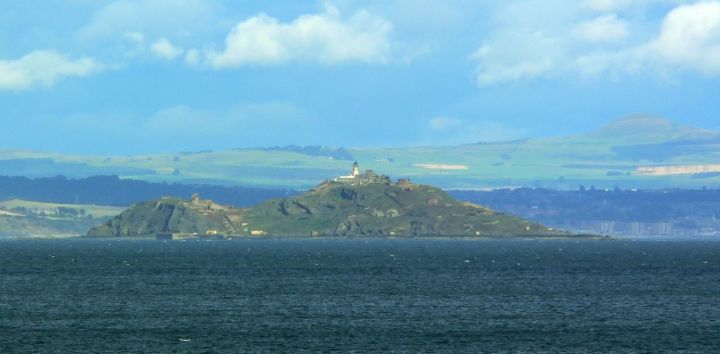
The fortifications at Inchkeith were devised by Lorenzo Pomarelli, an Italian architect and military engineer from Siena who was paid 150 livres tournois for his contribution on 22 October 1555. Later, in 1573, Pomarelli wrote that he had spent six years in Scotland, presumably working for Mary of Guise, Queen Regent, between 1554 and 1560. Some writers have assumed that he worked for Mary, Queen of Scots (from 1561 to 1567), but his name appears only in the records for 1555.
The weekly account for building work on Inchkeith was made by the chief supervisors on the island, Jehan Alain Farques and Jehan Francoys, and signed off by a soldier called Claude Heliot, who was at this time ‘extraordinary comptroller for war’ and later employed in the artillery works at Edinburgh Castle. Claude Heliot was in charge of work and workers on the island, see National Records of Scotland E34/21 (3) f.34r..
The summary account for the project, known as the Estat, is addressed to Guise’s household comptrollers, Bartholmew de Villemore and Astier. The total spend in the 1555 season was 6,453 livres tournois 9 solz, with 5,955 livres on the building work, and Pomarelli’s fee of 150 livres. 333 livres were given to John Stewart Prior of Coldingham, a brother of Mary Queen of Scots, perhaps to be spent at on fortification at Coldingham and at St Abbs. Master Black of Leith was compensated for the loss of his boat, sunk in Forth with a load of stone, par fortune de temps.
Some of the income came from tax payments for fortifications received in Leith by sir William MacDowall, royal master of works, and the appointed collectors were John and Richard Maitland of Lethington – a contribution from Aberdeen was recorded in the town’s records. Pomarelli’s name only appear in the Estat, not in the weekly building account, a reminder that early modern architects and military engineers can be almost invisible even in such apparently detailed records.

Estat for ‘L’Isle Dieu autrement L’Isle aux Chevaulx’, NRS E34/21 (2).
From 20 June to 25 October 1555, weekly wages for masons, quarrymen, labourers, women, the horse-men, and the overseers were recorded, followed by payments to boatmen, the shore labourers loading boats with sand, lime and stone at Prestonpans and Kinghorn, to lime burners at Fisherrow, Skateraw (near Torness), and Cousland – Cosselan, for wood and coal for the limeburners, coal to a smith, and for other weekly purchases. Some quarriers and labourers worked at the pier of Preston Dacqueton – Aitchison’s Haven near Prestonpans – the harbour used by the English army in 1560 to unload their heavy guns. Labourers working at Aitcheson’s Haven loaded larger stones onto boats. A wooden shelter was built at the harbour on the island for barrels of lime and a lodge for the workers at the fort.
A dozen sheets of paper were bought for the master masons to make their patterns – pour achapt de douze feilles pappir de carte a faire moullir aux maistre massons. In September rope or cord was needed to align the masonry walls – cordeau pour les massons … employer a alligner las massonerye, and that week twelve workmen were paid extra for carrying stones from the harbour on a Sunday. Ten special stones were bought to build the great gate – la grand porte – and a blacksmith in Edinburgh, the forgeur de Islebourg, made four hinges. A smith in Prestonpans and Gilbert Grey in Aberdour mended and sharpened iron tools for masons. The leading Scottish masons were David Doig, Thomas Baldrany and Archibald Green, managed by two French soldiers from the garrison of Dunbar Castle, Jehan Francois and Claude Dehors. The French were paid for their work and also pour paiment davoir vacque.
Horses on the island may have driven winches. At the end of the August the horses were used to shift a pile of sand above the tide line. One of the ‘horse-men’ or ‘horse-drivers’ was Charles Bordeaux, a soldier and gunner who later made fireworks for the baptism of James VI at Stirling Castle. One supervisor of the twenty three horses was a French craftsman called Andrew Mansioun. For more on his career see my article; ‘A French Furniture Maker in Scotland’
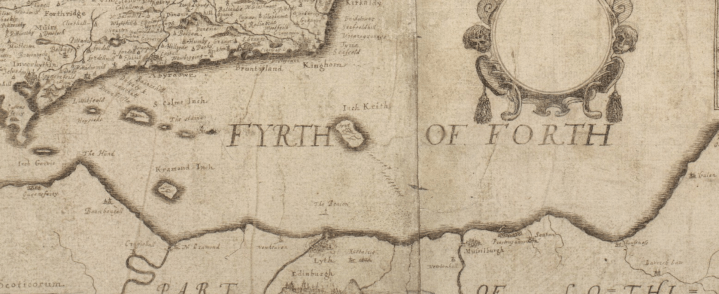
Inchkeith between Leith and Kinghorn, James Gordon, 1642 https://maps.nls.uk/rec/52
The French overseers – solliciteurs – were there ‘pour faire dilligence’ and they took a roll-call, an appelle. All the names of the workforce on the island are listed in the appelle at the end of the account. These names can be difficult to interpret because they were recorded by a French clerk as he heard them, not as they were usually written. Some of the forty five masons are recognisable from building accounts and Edinburgh craft records. There were 122 unskilled labourers called ‘manoeuvriers‘ – people whose names are unlikely to appear in any other source, who carried stones and mixed mortar. 14 buckets were bought to carry water for making mortar, carried by horses.
The labourers were paid between 22 and 16 sous per week depending on status. They came from both sides of the Forth. An Estat for the 1549 works at Inchkeith gives numbers of men recruited from towns and villages including Eyemouth, Dunfermline, Edinburgh and Canongate, Kinghorn, Musselburgh, and St Monans. For operations in July 1557 masons, quarriers, and slaters were ordered from building works at Dirleton Castle by a royal messenger, which shows a degree of compulsion in that year when Scotland was at war with England.
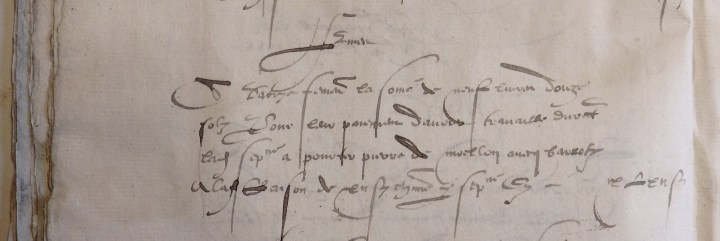
Women who carry ‘moellon’ stones, 12 sou per week (NRS E34/21 (3))
Twenty two women were employed. Usually twelve were working in any week and each was paid 12 sous per week. The account records their labour simply as ‘travaille’ or in some weeks as carrying small building stones called ‘moellon’ in ‘barrots’ – in small barrels. The women were paid for other unspecified tasks – ‘a pourter perre de moellon que aultre chose’. The ‘moellon’ stones were either pebbles or quarried on the island. At the start of the project twenty four baskets were bought for carrying the stones, but were found unsuitable and replaced by wooden barrels made in the following week.
The women’s names, as far as I can interpret them, were; Marie Greif, Kirsten Rogir, Jane Norie, Helen Lauder, Cathrin Magrenet, Bessy Roberton, Jane Bec, Maus Nocart, Marguerit Cader, Cathrin [A?], Anne Grey, Bess Simson, Anne Liberton, Gwen Phil, Helen [S?], Marie [A?], Marie Robertson, Johanne Campbell, Christabelle Mackie, Christine Acheson, Jane Dalquisson, and Marjorie Rodolphe. Marie Greif and one of the masons, John Duncan in Strathmiglo, had a son called Thomas Duncan.

Names of 22 women working on Inchkeith in 1555, (NRS E34/21 (3))
Mary of Guise had an informed interest in artillery, visiting the seiges of Haddington and Broughty Castle during the war of the Rough Wooing. She wrote to William Keith, Earl Marischal with news of the retreat of the Protestant Congregation from Edinburgh on 6 November 1559. They had been firing their great guns day and night, and left behind ‘sundry peces of artaillerie baith gret and small, thankit be god almichtie quha hes shawin his favour unto ws as said is in sa just a quarrell’. Keith, she expected, would be ‘rycht glad’ and she was of ‘mynd to be gude and gracious to thame’, (NLS MS 13500 f4).
Some of her fortifications were slighted under the terms of Treaty of Edinburgh. After the Scottish Reformation her reputation suffered further, and it seems her buildings were accordingly transformed in memory. A painted room c.1620 in an Edinburgh house featured a vignette depicting the apocalyptic vision issuing from a hellmouth at the ‘Spur’ fortification at Edinburgh Castle, a location where she was described by John Knox observing a victory at Leith. The fortified island of Inchkeith looms in the background. A copy of the painting was made when the house was demolished to build the General Assembly Hall of the Church of Scotland. Another part of the complex of buildings on the site may have been her own lodging.
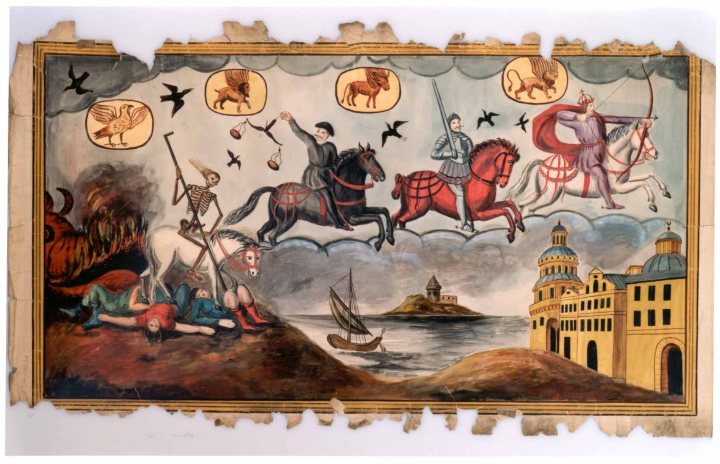
Andrew Lyons Collection, HES/RCAHMS EDD/775/28.

Sketch of the fort dated 1778, R. S. Milne, Master Masons (Edinburgh, 1893), p. 54.
Many thanks to twitter friends for help with French words and identifying Lorenzo’s name!
Lorenzo’s letter to Cardinal Alessandro Farnese, outlining his CV and mentioning his six years work as an engineer in Scotland, was printed by Amadio Ronchini, ‘Lorenzo Pomarelli’, Atti e memorie delle RR. Deputazioni di storia patria per le provincie Modenesi e Parmensi, 4 (Modena, 1868), pp. 264, 271. Ronchini recognised this was in the service of Mary of Guise, at the order of the king of France, Henri II. More recently, his career has been examined by Ciro Birra, ‘Lorenzo Pomarelli, un architetto del XVI secolo tra Siena e Napoli’, Rendiconti della Accademia di Archeologia Lettere e Belle Arti (Giannini Editore: Napoli 2016), pp. 287-302.
Several of the French soldiers’ names in the building account appear in John Kirkpatrick, ‘Muster-roll of the French garrison at Dunbar, 1553’ Miscellany of the Scottish History Society (Edinburgh, 1904), pp. 103-114.
 Objects and the archive