In July 1676 James, 2nd Marquis of Douglas recorded his use of relatively plain hangings which were now becoming unfashionable, writing to his factor about new hangings for the hall at Douglas Castle. The marquis was ashamed of the old hangings of plain sad coloured (grey or brown) cloth and requested new cloth which would be embellished with gilt leather. Plain cloth was no longer smart enough for his hall. Sad-coloured woollen cloth was made in Scotland. Some, perhaps much of the weaving was organised by wool and flax producing estates which employed weavers and spinners in urban centres. As women managed households so they were particularly involved in production of cloth from the wool and flax of their own farms. This aspect of domestic production was highlighted by the phrase ‘of my own making’ encountered in correspondence and in wills. Elite women took ownership of cloth production as part of the imagery of the good housewife as spinner with distaff, although they probably took little part in the repetitive tasks of manufacture.[1] The cloth had a sentimental value and was prized in a gift economy. In 1633 the poet William Lithgow evoked pre-Union conditions as a time when lairds ‘wore the cloth their wives wrought with their hand’.[2]

Lint and wool wheels at Aberdour Castle, c. 1645. NRS GD150/2843/1.
In October 1642 when James Stewart, Earl of Moray was expected in Aberdeenshire, Jean Ross, Lady Innes wrote to her mother Margaret, Lady Ross, describing how she was making a bed and dressing ‘a chalmer or twa’ in case he visited. She said he was ‘veri curious’ about interior decoration, an impression confirmed by his own home improvements and dealings with the merchant John Clerk of Penicuik. Lady Innes’ new bed was to be made of ‘sad green serge of our aune making’. Fringes and lace for the bed would have to be bought elsewhere.[3] It is unlikely that Jean Ross or her servants wove the green serge from their wool at Innes. She means the practice of sending wool and lint thread to outworkers to be made into cloth, perhaps at Elgin. Ross referred to ‘our own’ wool, and other women wrote of cloth of ‘my own making’.
Household inventories tell us about the spaces where servants processed fibres and spun thread. Several mention “womenhouses” where female servants did the laundry, made butter, and also processed wool and lint. At Balloch, Finlarig, Aberdour Castle and Balgonie Castle the womanhouse equipment included spinning wheels, spindles, heckles, combs and cards. The workspace was also their living quarters. The servant women at Aberdour slept in an adjacent room with three bedsteads in 1647. Somewhat lower down the social scale, nearby at Burntisland, Mawsie Thomson widow of the minister, had two servants Mawsie Simsoun and Margaret Broun who had probably spun the ‘grite quantitie of lynning yairn’ which her rampaging son-in-law found in the house in April 1620 and threw on the fire. More evidence for this kind of domestic production and the attitude of ownership comes from the Eglinton estate in Ayrshire, first mentioned in the 1596 will of Jane Hamilton, Countess of Eglinton, who bequeathed blankets made from a kinsman’s wool of ‘my awin making’.[4]
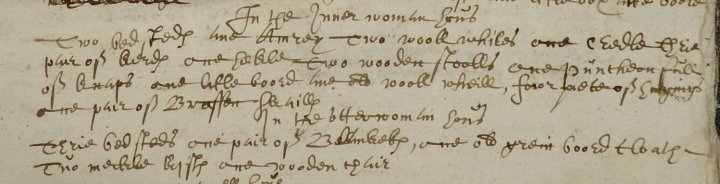
Textile processing in the woman house at Aberdour Castle 1647, NRS GD150/2843/2.
In the 1620s Anna Livingstone, Countess of Eglinton had cloth woven by her mother-in-law’s servant at Seton in Lothian.[5] She bought a new lint wheel for her servants at Eglinton which cost £4-10s in 1618, and she also set weavers working in Glasgow. According to her account for textile work in 1624, wool was sent to outworkers like John Montgomerie who produced a variety of weavings distinguished by width, weave and colour, as blankets, worset, broadcloth stemming, black and yellow linsey-worsey, sey bombasie, red worset, grey cloth, and black and yellow perpetuana. From the lint she provided, some of which her mother-in-law Margaret Montgomerie, Countess of Winton, bought in Edinburgh, John Line wove linen cloth including ‘harn boardcloths’, sheeting and napkins. The weavers were paid with money and meal.[6] Linens were also made in local centres, notably Dunfermline, and in 1615 the Earl of Sutherland wrote that a variety of linen he required was made in the north, and was not available to him in Edinburgh for immediate purchase.[7]
The diversity of weaving practice is shown in the records of the incorporation of Glasgow weavers. Statutes for taking on weaving work were set out in 1595 defining the relations between clients like the Eglintons and the weavers. Linsey-worsey, a fabric with wool weft and linen warp, first appears in the records in 1604. In 1621 apprentices were to be instructed in the wound loom, the sey bombasie loom, the plaid loom, and plaiding. These four processes were called the four points of the weaver craft. A later document mentions the weaving of ‘double coverings,’ these woven coverings were the ‘Scottish coverings’ found in inventories. Linen fabrics included the table linens called ‘dornicks’ and ‘gamheckling’ a fabric used for sheets at Hamilton Palace in 1647.[8]
Annabell Murray, Countess of Mar left clothes and cloths to her niece of her ‘own making’.[9] She, Jean Ross and the Countess of Eglinton took ownership of goods that they had some hand in producing, however slight or tangential. This pride in home production can be regarded as a traditional aspect of marriage, proverbially symbolised by the distaff, though wives may not have actually spun thread themselves. The appearance of the phrase in wills indicates that the quality of personalisation by the testator is to be valued, enhancing the value of the material as a gift, or perhaps providing the primary value as emotional material as tokens of a relationship. In 1613 Eglinton offered to make new linen as a gift to Jean Drummond, later Countess of Roxburghe, a powerful friend who interceded with Anna of Denmark for her. Drummond politely refused this gift, writing “yow have many hwsses to furnish, it war a pitie to give yow to much ado at ons.”
As clothing and furnishing fabrics, however, the woollens were increasingly relegated to practical usage rather than used as display fabrics in the main rooms of the house, superseded by imported fabrics and gilt leather. Luxury was distanced from personal production. While cloths of high complexity like silks and damasks were not woven in Scotland, luxury trimmings of woven from gold thread and silk for clothing and upholstery were made in Perth and Edinburgh and presumably elsewhere. In Edinburgh Johne Bowye’s wife wove the fringes for the canopy used at the coronation of Anna of Denmark. John Sutherland made passments according to the instructions of merchants who supplied him silk and gold thread. He was caught out in November 1599 substituting cheaper thread for silk in “fyne walting passments” for Robert Cairncross. The baillie court declared his work “false & counterfeit”. He was made to pay Cairncross the equivalent value of Cairncross’ weight of thread in fine passments at the rate they were “commonlie sauld”, the retail value of the finished product.
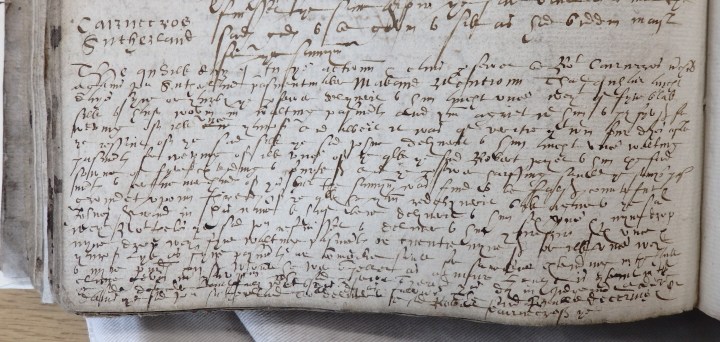
Cairncross versus Sutherland, Edinburgh City Archives, SL234/1/5.
Sutherland was in competition with suppliers in the Low Countries like Francis Blyhorst and Cornelius de Keysir of Middelburgh, who pursued Edinburgh merchants for their debts for silk and passments in the same court. Cornelius’ brother Michael de Keysir was settled in Edinburgh making paper, which he supplied to the printer Robert Waldegrave and later to his widow Marioun, who failed to pay for fifteen reams of paper in 1604. (For more on the baillie court see this post)
In the 1630s Perth was home to Nicholas Herman, a passmenterie maker from Antwerp. He worked under the patronage of the Laird of Glenorchy, who provided his house in Perth. Herman had five employees and a workshop equipped with silk trimming mills. He sold his product directly to clients. In July 1633 Herman wrote to Glenorchy that his latest order would not be ready because his men were completing fringes for the beds and chairs of the Chancellor, George Hay, Earl of Kinnoull, to whom Herman gave priority. Herman returned to Antwerp at some point in the decade, and an inventory was made of his own household goods, his workshop and tools including looms and silk trimming mills, and his stock of finished passmenterie.[10] These trimmings could be used on new or re-upholstered furniture. Quality upholstered furniture was finished and refurbished in Scotland, a detail that balances the many records of London purchases, and challenges the assumption that most such furniture was imported.
Passmenterie making was one of the few luxury trades which could be easily established in new centres of production. It would be harder to foster the weaving of complex brocade cloths or tapestries, where new manufactures would be undercut by existing trade networks with established centres. For passmenterie however, the raw materials of silk and gold threads were already supplied to Scottish merchants, and Herman would find a niche by producing exactly the kind and quality of trimming required by his clients to order, for furnishing or for clothes. Buying from the stock of ready-made trimmings imported from weaving centres in the Low Countries or France would theoretically have been cheaper, but the merchant would be vulnerable to the vicissitudes of fashion, exposed to the risk of having outdated unsaleable stock. Herman found that demand could exceed his capacity, hence his letter of apology for prioritising Kinnoull’s order before his landlord’s.
Jean Ross’ bed for the Earl of Murray combined cloth of her ‘own making’ trimmed and dressed with fringes and passmenterie made by a workshop like Herman’s. Her furnishings deliberately embodied and displayed local industry with luxury products made by specialists.
[1] A. Jones & P. Stallybrass, Renaissance Clothing and Memory (Cambridge, 2000), 104-32.
[2] W. Lithgow, Scotlands Welcome to King Charles (Edinburgh 1633), sig. B4.
[3] Fraser, Memorials of the Montgomeries, vol. 2, pp. 257-8.
[4] Fraser, Memorials of the Montgomeries, vol. 1, pp. 233-236.
[5] Fraser, Memorials of the Montgomeries, vol. 1, pp. 211-2.
[6] National Records of Scotland GD3/6/36 no. 6.
[7] Fraser, Sutherland Book, ii, 116.
[8] R. McEwan ed., Old Glasgow Weavers (Glasgow 1908), 25, 28, 48, 50.
[9] National Library of Scotland, Ch.4033, 6 January 1603.
[10] Edinburgh City Archives, SL234/1/5: NRS GD112/39/49/16, GD112/39/49/5, GD172/2052.
 Objects and the archive