London-made furniture was popular in Scotland. John Gilmour, a rising advocate who prospered and bought Craigmillar Castle at the Restoration, bought eight chairs in London in March 1636. John Campbell, younger laird of Glenorchy had a great bundle of chairs and seven bundles of chair frames shipped from London to Perth in 1657. The wills of some Edinburgh wrights reveal that they made carved chairs and beds, tables, chairs. Chests and chairs were also made in Perth, Aberdeen and elsewhere, yet London-made furniture had a evidently cachet amongst certain groups. Families with court roles and connections or those who successfully aspired to them would acquire London made or London retailed furnishing, while Parisian furnishing remained equally popular.
The merchant John Clerk settled in Paris in the 1630s as a merchant and purchasing agent, acquiring luxuries, paintings, and fancy goods for Scottish clients. Clerk’s earliest set of accounts, dating from March 1633, record the purchase in London of a large quantity of haberdashery; silk garters, ribbons, hatbands, stockings and clothing fabrics. The stock was sold in Edinburgh where demand for fine clothing was heightened in advance of the visit of Charles I to Scotland. This venture was sufficient to finance his establishment in Paris in the autumn of 1633. In the years 1647 to 1649, departing from his usual practice of acting as a buyer and commissioner of French luxury goods, Clerk bought a range of goods with his own capital, intending to meet anticipated demands from his clients, and retailed this stock to aristocratic clients from a house in Edinburgh.
Apart from merchandise, Clerk’s fortune was built on the profits of loans and bills of exchange, to the same elite patrons who bought his luxury imports. Clerk has gained scholarly attention as a picture dealer, and his success depended on his ability to engage intelligently with current tastes. Aristocrats relied on Clerk to buy books, scientific instruments, and furnishings – aspirational goods with which they hoped to improve their standing with their peers.
Clerk bought in Paris for William Kerr, 3rd Earl of Lothian (1605-75) a notable early art collector. His father Robert Kerr, Earl of Ancram, held posts in the bedchambers of Prince Henry and Prince Charles. William Kerr went on a grand tour to Florence in 1624 and from 1641 collected pictures for Newbattle House, those from Clerk were mostly portraits and small cabinet pictures. He met Clerk in Paris in September 1643, buying two paintings that Clerk showed him in his chamber. Lothian wanted the pictures for his cabinet at Newbattle, that ‘place when I am att Home intertains me most’. Clerk’s letters show that he was trusted to negotiate for Lothian’s pictures, and get them restored and varnished. Clerk communicated details of the art market, in order to maintain his confidence, reporting in 1644 that the Parisian dealer Alfonso Lopez would not reduce his prices, and assuring Lothian that two available paintings by Tintorettos had been bought for Cardinal Richelieu, a provenance advanced as a guarantee of quality.[1]
Lothian had started to order a dining-room suite in Paris in 1643, and Clerk’s partner Colonel Thomson oversaw the rest of the purchase of hangings and carpets, twelve chairs with two armchairs and six folding stools. Thomson was solicitous of detail, writing to Lothian to ask if he preferred the fabric nailed to the chairs with gilt nails, or if the covers should be loose. Thomson expressed his own preference for drop cushions.[2] Such correspondence must have been usual between buyers and agents. These letters show how the dealers represented themselves as arbiters of fashion, a confidence essential to their trade.
It was not however all high-art and decor, Lothian also had Clerk buying him boots and shoes by the dozen. In 1646 Clerk sent Lothian a rare book via John Maitland, Earl of Lauderdale. Clerk gave Lauderdale a copy too, ever anxious to increase his circle of clients and allies. Lothian, Lauderdale, and his brother-in-law the Earl of Moray would buy from the stock that Clerk imported to Edinburgh. Lauderdale wrote for the price of an ebony cabinet with silver trim and a watch. Moray and Lothian were Clerk’s principal customers, both for luxuries and loans. Clerk’s business rested on a close connection between selling luxuries and lending, and the manner in which Clerk drew on the earls’ rivalry in status helped his sales and also the more lucrative business of money lending.
In December 1649 Clerk set up his stock to show in a house in Edinburgh, much as he had shown pictures in his chamber in Paris. He made a note of furnishings indicating that these items were for sale. Clerk habitually recorded prices in livres tournois, even if they had been bought in Edinburgh or London, a livre-tournois was worth about eighteen English pence at this time, or roughly one Scottish merk. The house in Edinburgh was a kind of show-home, where these luxury furnishings and accessories were exhibited to elite customers by invitation and appointment, a social space for men and at least one woman, an interview with Clerk and his luxuries. A set of hangings was displayed in the gallery and the ‘next room’ which were furnished with the other items for sale. In his inventories Clerk gave the furniture commercial descriptions, using adjectives like ‘curious’ and detailing features like locks and accessories. Ten larger pieces had been shipped from Paris ‘by great charges bringing it home’. Most of this furniture was made of walnut: a ‘curious great walnut trie press opens with 4 great leaves and two drawers with shelves’, a ‘werie strong’ walnut chest with ‘curious’ locks and bands, a vocabulary which hints at his performance as connoisseur.
These purchases required Clerk’s input in complex commissions employing his detailed knowledge both of luxury production and the potential Scottish market. Clerk would have had to give detailed instructions on specifications, materials and finish appropriate to his market. This can be seen in his record of purchases showing that he oversaw the making of these composite items; a record of a pair of virginals giving separate prices for various finishing processes, a case of surgeon’s instruments individually priced, and a pair of pistols with their ebony furniture, mounts and making separately billed. For each process Clerk was able to specify variations in quality according to his estimation of the Scottish market. Other stock listed in Edinburgh in 1649 includes French walnut furniture, some acquired in the years 1646 and 1647. Cabinets of ebony and cedar, cypress wood boxes, and a varnished box, were all supplied by a Monsieur Despont in Paris. A spinet from Monsieur Brussels cost 295 livres (£16-5s). The rest of the stock was a bewildering range of fancy goods including several types of luxury boxes lined with marbled paper, hardwood hammers, with enamelled and silver medals of Cardinal Richelieu.
Clerk hung a suite of ‘tapestry’ in the ‘gallerie and nixt roume’, which he noted: ‘will hang a werie large roum or twa roumes off a reasonable bignes’. These were rich textiles rather than woven tapestry, bought from a Monsieur Dacquet in Rouen. There were two colours, one ‘drawing to the green’ the other ‘drawing to the blue’ with matching table covers and carpets for tables. The suite was sold to Margaret Leslie, Countess of Buccleuch for 195 livres, in November 1650, confirming that Clerk was not buying to order, but with the expectation that Scottish buyers could be found. Back in 1644 Clerk had thanked Lothian for introducing him to the Buccleuchs, writing that ‘I shall give them all sort of contentment god willing’.[3]
The Earl of Lothian bought the most expensive item from Clerk’s stock, a bed and its matching furniture, detailed in at least two of Clerk’s account books. The suite included eight chairs, a great chair, two little stools and a walnut table. It was upholstered in grey and cost 952 livres. Clerk’s profit was modest; Lothian paid 970 livres. Clerk paid for the fabric, the making and the joinery, indicating that he commissioned the suite from scratch. The bed was expensive by the standards of the day. The silk fringes and ‘crisp’ trimmings contributed more than a third of the cost. Clerk’s small mark-up could hardly have covered his expenses: it seems likely that this luxury trade, at least for the most expensive pieces was a loss-leader establishing Clerk in more lucrative financial dealings and the more profitable business of money-lending.
The Earl of Moray bought a cabinet, a standish, two walnut stools and other minor pieces. Letters between Clerk and Moray survive because of the main business between them concerning a loan of 7,000 merks. Clerk had been reluctant to lend the sum and the Earl was reluctant to repay it. Although Moray contracted debts elsewhere, this 7,000 merks is particularly well-documented, and had sad consequences.[4]
Moray wrote to Clerk asking him to come to Donibristle and give his advice on the work of English joiners who were panelling his closet in August 1649. Clerk showed his merchandise to the earl in Edinburgh, and also sent him fabric samples. The Earl’s letters illustrate something of their relationship as client and creditor and merchant and moneylender:
“As for your six stoulls I cane conceave no use I have for so manie except I had bocht the hail furniture, but for tuo of them if yow please I will take and lykwayes the square thing you speake of for playing of dyce or telling of money, I lykwayes desire that boxe that conteanes ane dussone of horne cuppes with all soirts of little naills in it, … Lykwayes let me know the lowest pryce of that little piece [a gun] the fellow of that you sold to my lord Seafort as lykwayes the lowest pryce of the staffe. Let your boye come presentlie over with the boxe with the naills with ane note of the lowest pryce of these uther particulars, and iff it be not your owne fault I think we shall aggrie.
My Inglishe joyneris are heir making my closet within ten dayes or fortnight,[5] I will advertise yow to come over that I maye have your advyse in some things, if at which tyme you shall command thes dollars yow have bene so long keeping but you must bring over as mutche money of some other kind for treulie I am now scant at this present. So expecting your boye with the boxe and naills with all diligence
I continow your assured friend MURRAY”
The earl was happy to consult with Clerk on aspects of interior decoration. This request for advice was an attempt to flatter Clerk, to bring him over the Forth to Donibristle and oblige him to lend money. The new dining room, designed by John Milne, was fitted with carved pilasters and panelling by the English joiners, was finished in cream paint with gilt touches, using gold leaf sent from London by the merchant financier Robert Inglis. Books of gold could also be bought in Edinburgh, and in July 1644 Moray sent his footman Daniel Thomson to buy leaf gold from Marion Orr, the wife of Lawrence Scott. Moray’s painter, George Crawford, had a professional recommendation from Matthew Gooderick of the London Company of Painters and Stainers.
The most intriguing feature of Donibristle at this period was the garden, very clearly emulating Henrietta Maria’s design preferences, with a fountain with a statue of Mercury, ringed with painted and gilt flower pots, the arbour and bowling alley, and the ‘boatyard’ banqueting house with its chequered marble floor and Italianate stools.
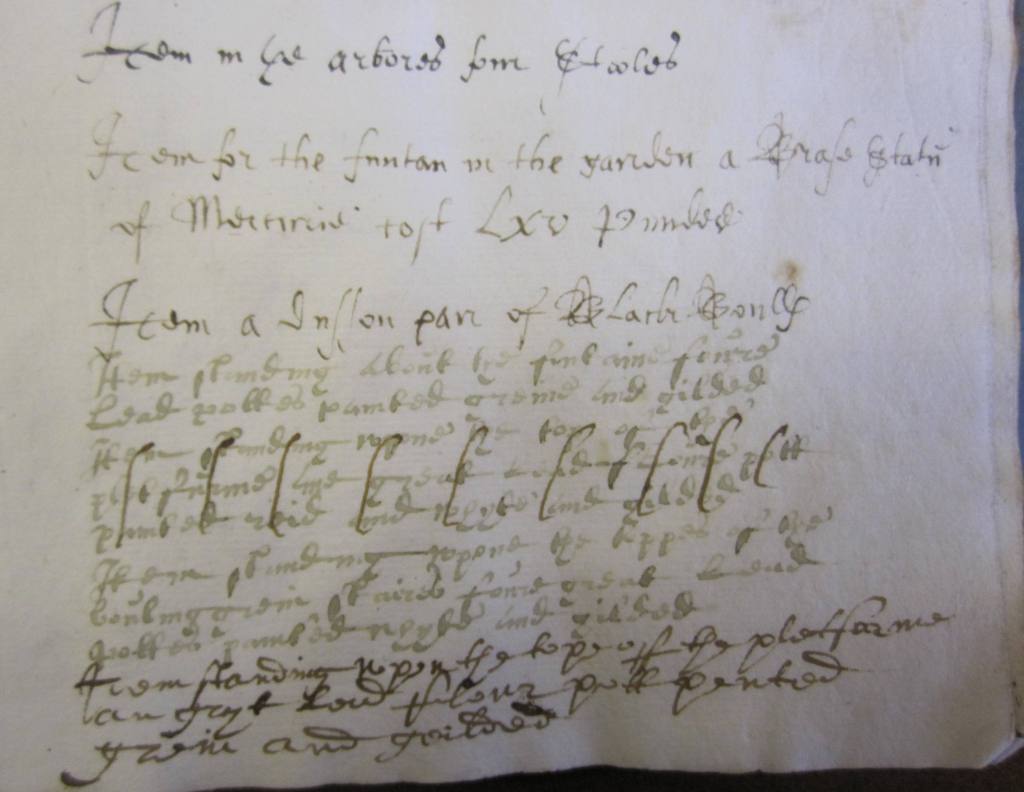
Moray also bought cloth from Clerk. Clerk had sent him a fabric sample. However, the detailed inventories kept by his wife Margaret Home and mother-in-law, Mary, Countess of Home, mention only his purchase of a single French carpet from Mr Clerk, and some plaiding he bought in the north, and it seems probable that the majority of furnishings at Donibristle listed in their inventory were bought by the women. Moray’s purchases may have been for his cabinet and other spaces private to him.
Clerk told the Earl of Lothian that Moray would buy the best items from his stock if he would not commit to purchase them. To play off the two earls in this way, Clerk must have been confident that his business was unrivalled in Edinburgh. He preferred Lothian as a client over Moray, writing that in terms of discounts and rebates he ‘wold not doe to none in Scotland what I have done to your Lordship’. After Moray had spent an afternoon with Clerk in Edinburgh, Clerk offered Lothian another chance to buy, claiming that Moray complained that Lothian bought the best things and he sold him trash:
“My Lord Morray wes with me yesterday all afternoon and hath boght divers things: he is to be again betuixt 12 off the clok and on: this day: and for any thing I knowe will be heir all this afternoon – since your Lordship wreat to me ye would not have them: I did shewe him all thes things is in the enclosit memoire – except the things markit [tick] which I wold not showe till your Lordship refused them – off a treuth yesternight we wer verie neir agried for the most part off all when he returns iff they be to be disposed on: Treulie I knoue nothing bot we will agrie for the choysest of them all.
If your Lordship tak them I wold send them down to your Lordship presentlie; and thair efter shall cum doun – and number everie thing acording to the accompt; unlesse they be taken away as I am a Christian he will never beleve me that they are sold – he vexes me continuallie and sweirs your Lordship gets all the best things and he gets the trash – I shall be glad your Lordship wold make an end and returne me an answer without delay that I may transport them iff your Lordship tak them”.[7]
Clerk was not embarrassed to represent to the earls that they were rivals for his merchandise. At first sight he seems to have invited the earls to a ‘tournament of value’ an exchange framed as a status contest, where prices exceed those realised in ordinary circumstance since the participants are purchasing their honour as well as the goods. Clerk addresses the earls’ apparent rivalry, perhaps based on Moray’s superiority in terms of lineage and Lothian’s rising status, his familiarity with the court and channels of patronage, and expertise in connoisseurship of new luxuries. However, Clerk seems only to have made modest profits from this stock. It seems that this was a tournament with a twist, where Clerk gained not by the prices realised, but by the future profits of his relationship with the Earl of Lothian.
The Earl of Moray died in 1653. He had not repaid his loan from Clerk. A cautioner, Alexander Brodie of Brodie became liable for the debt, and Clerk had him ‘horned’ at the market cross of Forres, temporarily declared bankrupt for non-payment. Brodie became active in the financial affairs of the new earl, and for more than a decade they attempted unsuccessfully to alter the financial settlement of the earl’s widow, Margaret Home, dowager Countess of Moray. She composed a bitter speech to her advocate, Alexander Falconer of Halkerton in January 1665, denouncing Brodie and his influence over her eldest son, Alexander Stuart, 5th Earl of Moray, and wrote a forceful letter to her son that he was ill-advised in his attempts to convert her income to a ‘salary’. She died in 1683, her affairs managed by Huw Paterson of Bannockburn, and was never fully reconciled with her son.
[1] Siobhan Talbott, ‘Beyond ‘the antiseptic realm of theoretical economic models,’ new perspectives on Franco-Scottish commerce’, Journal of Scottish Historical Research (vol. 31 no.2, 2011), 165: J. J. Brown, ‘The social, political and economic influences of the Edinburgh merchant elite, 1600-1638,’ unpublished Edinburgh PhD (1985), p. 211-8: J. Lloyd Williams, ‘The import of art: the taste for northern European goods in Scotland in the seventeenth century’, in J. Roding & L. van Voss eds., North Sea and Culture 1550-1800 (Amsterdam, 1996), pp. 298-323: Siobhan Talbott, ‘British commercial interests on the French Atlantic coast, c.1560–1713’, Historical Research, vol.85 no.229, (2012), p. 394: R. Wenley, ‘William Third Earl of Lothian, Covenanter and Collector’, Journal of the History of Collections, vol. 5 no. 1 (1993), pp. 23-41.
[2] D. Laing ed., Correspondence of the earls of Ancram and Lothian, vol.1 (Edinburgh 1875), pp. 153-4, 157: NRS GD40/2/13, 3 Oct. 1643.
[3] National Records of Scotland GD40/2/18/1.
[4] NRAS 217 box 5 nos. 66-70.
[5] The English joiners working at Donibristle were William Gabriel and Robert Cockeshead, the painter was George Crawford, see NRAS 217 Moray Papers, box 5 nos. 808, 814, 945.
[6] NRS GD40/2/18/1 no. 17.
 Objects and the archive