In July 1602 Jens Pierson wanted to go home to visit his parents and friends in Denmark. He had worked for twelve years in Scotland looking after Anna of Denmark’s horses. James VI noted that Jens ‘as yit is unrecompensit in any sort’ and gave him ten gold crowns. He seems to have missed an opportunity in 1595 when Anna recommended him to her brother Christian IV’s service as a coachman. [1]
James Glen was a lackey to the queen’s gentlewomen. His job was ‘running and travelling with hir in all partis sen hir arrival and riding within this realme and utherwayis serving of hir quhen occassioun servis’. According to the household roll, he was allowed four shillings a day for 360 days in a year, totalling £72. He did not receive this money. To encourage him to continue in his service, James VI made his appointment permanent in February 1595 with a yearly fee of £20 Scots and a daily allowance of five shillings.[2]
In 1592, Anna’s Danish goldsmith Jacob Kroger ran away to England in the company of Guillaume Martyn, a French servant in the king’s stable who looked after a camel in previous years. Jacob took a quantity of the queen’s jewels (and some textiles) and met up with the rebel Francis Stewart, Earl of Bothwell near Newcastle. The two fugitives were sent back to Edinburgh and hanged. John Carey marshal of Berwick heard they were ‘very weary of their service, for that they could not get their wages nor any money at any time to relieve their wants, still calling and crying out both to the king and queen for money, being everyday ready to be arrested and cast in prison for debt’.[3] In subsequent decades three more servants, Margaret Hartsyde, Anna a Danish maid, and the page Piero Hugon were accused of stealing and selling the queen’s jewels.
William or Kilion Freliche was the German keeper of a lion sent by Christian IV of Denmark (which had been a present from Sigismund III Vasa of Poland, sent to Scotland as a gift at the baptism of Prince Henry). After three years without promised pay or livery clothes, William wrote that he was ‘now werit with the said service’ and wanted to return to his own country with ‘honest recompense’ or else a ‘testimoniall’ to take to Christian IV. On 2 August 1597 he was given £30 cash and £24 for a stand of clothes and was to hand over the lion (E23/7/6).
David Myreton usher at the queen’s bedchamber door was not paid until March 1592 despite performing well in a delicate task that began immediately on the king’s marriage, involving ‘his passing to Denmark and thair behaving himself verie cairfullie in quhatsoever his majestie requyrett him’, (PS1/63 f239r). James VI included him in the trip to Norway and coached him for the role because he could already speak “Duche”. His language skills had proved useful during the 1587 embassy to Denmark, as Sir Patrick Vaus recorded. The Jesuit James Myreton who brought a locket for Anna with a scene of the crucifixion from Rome in 1595 was probably his younger brother.
These servants and others, including the masters of household, lived at court with food and lodging for years but without receiving promised cash payments of fee or wage. The incomes assigned for household food and fees simply did not cover the expense, and papers now in the National Library of Scotland and National Records of Scotland offer various suggestions to ease the problem. These include increasing income from rents of crown properties, buying food of the same quality for less money (carrying a suggestion of incompetence or corruption), visiting and dining at others’ expense, and letting some officers go. In particular, Anna should spend no more than £1,500 yearly on sugar, comfits, almonds, vinegar, oil, and lard. This advice appears in a letter to the Masters of Household of ‘things having cum in my mynd this morning’ possibly composed by the Chancellor John Maitland of Thirlestane.[4]
When times were better, or the cash-flow eased, at least some of the servants who had stuck out the lean times were rewarded with permanent appointments and fees that were paid. Their lack of pay however became a serious political problem. The valet John Wemyss of Logie explained to the king in August 1592 that want of money had led him and other household servants to join the cause of the rebel Earl of Bothwell.
The secretary William Fowler was appointed by James in Denmark. For Anna’s servants James Glen and Jens Pierson, James VI made the gift or appointment and signed the surviving precept or privy seal letter. Anna is nowhere to be seen in the paper trail and it might seem she had little control or agency over appointments in her household, as if she was allowed no formal participation in a process of government committing the expenditure of public money. However the picture is more complicated, as other privy seal letters of appointment to her household, recorded in the registers of the privy seal (PS1), were made jointly ‘be oure sovereign lord and lady’, including one for William Bell, server at the queen’s gentlewomen’s table (PS1/67 f.90r). The surviving letter to Patrick Home of Polwarth making him master of her household was signed by both James and Anna. James later sent him an order to swear an oath of fidelity to the chancellor (GD158/2974, 2982).
James and Anna both signed a letter for her page of honour Archibald Murray to receive straw and corn from the royal avery in 1594. This required countersignatures by the Comptroller David Seton of Parbroath, the Collector, and the Master of Requests, (GD32/1/4). Some privy seal letters acknowledged Anna’s involvement in decisions, John Schankis of Leith was made sole supplier of fish to both households with the queen’s advice, (PS1/68 f.71r.) he was already her fishmonger, (PS1/66 f28r.)
Occasionally James VI made gifts to Anna’s servants by formal privy seal letter. Jane Drummond, later the countess of Roxburghe, who looked after Prince Charles at Dunfermline Palace, was given the ‘ward’ of the property of her deceased father Patrick Lord Drummond on 22 September 1601, (PS1/72 f150r.) James Cunninghan usher of the queen’s inner chamber door got a gift of ‘escheat, forfeited property, on 10 February 1598 (PS1/69 f179v.) and the poet and secretary William Fowler got one on 8 June 1598 (PS1/69 f269r.) as did John Elphinstone gentleman in her chamber on 20 February 1596 (PS1/69 f59v.) These gifts of escheats were much more frequently given to the gentlemen, ushers, porters, and lackeys of James’ own household. John Drummond of Slipperfield and Hawthornden, a seemingly obscure usher, married to William Fowler’s sister Susannah, received several such gifts.
Anna signed an order at Dunfermline Palace on 6 November 1602 directing her master of household Patrick Home of Polwarth to make an allowance of food, coal and candle for Thomas Barclay her embroiderer. In 1591 her masters of household David Beaton of Melgund and Harry Lindsay of Carestoun had to write to the treasurer for permission to add people to household roll or increase allowances of food. So Anna’s role and management evolved and expanded. [5]
She was said to have signed accounts for costume provided by Robert Joussie, and signed accounts and precepts for jewels supplied by George Heriot. Heriot was appointed her jeweller ‘be oure soverane lord and ladie’ on 17 July 1597 (PS1/69 f132r. & PS1/73 f239r.) Anna also made and signed some instruments, when James was at Dunfermline on 2 November 1601 he gave her 10,000 marks and two days later she made a warrant for her agent to collect the money from the depute-treasurer. Her agent would give the depute the king’s warrant for the money to be given to Anna and Anna’s warrant for him to collect the cash (E23/11/3, 4).

In 1591 Anna’s masters of household had to ask the comptroller to arrange breakfasts for themselves, Marie Stewart and Margaret Stewart Lady Ochiltree.
Some servants like the musician John Norlie, paid £1,000 pa, who was to provide four suitable musicians, were appointed to the king’s household but in reality served the queen, (PS1/73 f24v. E23/11). Permanent household appointments using exchequer funds were not wholly in Anna’s power without consulting James and his officers. But she had some latitude over her own money, especially in the disposal of income from her own estates, although little is known of this. Anna was said to have given a purse of gold to James at New Year 1596 from her councillors, appointed by James in 1593 to managed her private income, who had ‘preserved so much of hir leving to that use’. [6] Wherever this money came from, it was not part of the routine household finance.
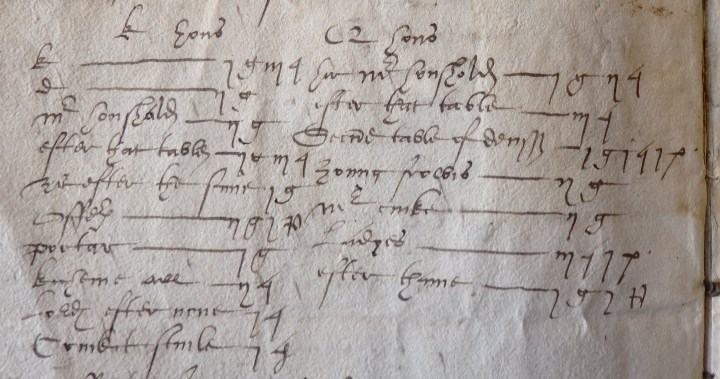
In this calculation, the table for the queen’s maidens is called the ‘young frowis’.
Because of her position and identity as a Danish princess, demonstrated by her costume and company of maidens of honour known as the ‘young frowis’, some were wary of intervening in her household arrangements. One list of suggestions states that there was no way to cut the costs of spices consumed by the queen; ‘… nathing in the quenes hows for her majesties selff or the Denssis hir servands may be retranscheit on quantities of spices and uther thingis’.
Another suggestion was to reduce costs by sacking or ‘sparing’ officers. This economy could not be applied to Anna’s household and her Danish servants, without consulting her, ‘… Reservand only the Denssis feis to stand haill. See gif the quene can be delt with or ony serving hir for bringing of the expenssis of hir hous to mair moderat quantitie with hir awin consent, or gif the personis eikit of hir desir & in hir kair [-]’[7] The last word here, regarding newly added members of her household, is illegible, but the queen’s consent in these matters was clearly a necessity.
In 1595 Sir James Anstruther, as Master Household was rewarded for making economies in Anna’s household with a permanent appointment and salary, as the royal letter made clear:
… Remembering the gude trew and thankful service done to thame be thair hienes richt trustie and weillbelovit servitour Sir James Anstruther of that ilk knicht in his excessive travell and painis takin be him thir divers yeiris bigane in the office of maister houshald to hir majestie and of his ernest cair to Reduce the samen to the lyik guid and commendabill ordour estait and conditioun as the samen hes bene the tyme of thair majesteis predecessours of worthie memorie quhairby thair hienes haiffing sufficient experience of his fervent zeale and gude intensionis to continew and persever daylie mair and mair, thairin quhairthrow thay ar moved of thair [?] honour upoun gude and weightie consideratiouns tending to the singular proffit and honourabill intertainment of hir majesteis hous to mak chois of him as ane maist meit abill and qualifiet to use and exerce the said office in tyme cuming Thairfore [etc …] 17 May 1595 (PS1/67 f125v.)
Anstruther had taken pains and earnest care to reduce [the household] to same order and condition as their majesty’s predecessors. Elsewhere this kind of phrasing refers to cost-cutting and the good order of the household and rule of James V is cited. This preoccupation with reducing the royal household expense is reflected in the story of Anna presenting James with a purse of gold from her savings.
—————————————————————————————————–
[1] National Records of Scotland E23/11/40, 41: Rigsarkviet, 1 August 1595
[2] National Library of Scotland Adv. MS 34.2.17 f.130r: NRS PS1/67 f.86v-87r.
[3] Calendar of Border Papers, vol. 1 (Edinburgh, 1894), pp. 538-9.
[4] NLS Adv. MS 34.2.17: NRS E34/44 and E35/45.
[5] NRS GD158/532: NLS Adv. 34.2.17
[6] Julian Goodare, ‘The Octavians’ in Miles Kerr-Peterson and Steven J. Reid, James VI and Noble Power (Abingdon, 2017), pp. 176-93 at p. 177 & fn. 7.
[7] NRS E34/44 and E34/49/2 ‘Advise Anent the expensis of the kingis hows’.
 Objects and the archive