Visual sources for costume and clothing in sixteenth-century Scotland are very rare, but there are archival sources. Personal clothing appears, albeit infrequently, in wills. The wills of Edinburgh merchants and stall holders regularly include their entire stock books of textiles running a gamut from local woollens to figured Italian velvets imported via the markets of Flanders. The dress of Anna of Denmark and James VI in the 1590s was recorded on an almost daily basis. Melanie Schluessler Bond has made an exhaustive survey of clothes at the court of Regent Arran (1543-1553), Jemma Field’s 2019 article published details from the wardrobe account of Anna of Denmark for the first time.
Away from the court, sixteenth-century tailor’s bills are rare. Descriptions of clothes belonging to other sectors of Edinburgh society were recorded in the twelve Books of Decreets covering the years 1580 to 1630, (Edinburgh City Archives SL234). This is a record of a court convened by a Baillie from Edinburgh town council, no lawyers were present. The primary purpose of the court was resolve cases of bad debt, to satisfy creditors and encourage lending, and shame bad payers. Anyone, man or woman had access to this court to get redress from men or women in Edinburgh, and women frequently give oaths about loans.
Those warned by the court for overdue debts for ale, meat or rent, or other goods, include some well-known names like the printer Robert Waldegrave, the painter Adrian Vanson and his money lending wife Susanna de Colony, and a Barbara Napier who may perhaps be the North Berwick witch-trial survivor. These people had been of good credit in Edinburgh society, but were now fallen on bad times, or perhaps caught in a chain of bad debt, and some were victims of the fall of the financier Thomas Foulis in 1598.
The usual method of resolution taken by this court was to confiscate the debtor’s goods, most often clothes, and less frequently bedding & linen, rolls of new cloth, pewter, jewellery, oak furniture, and firearms, and sell them to the highest bidder at Edinburgh’s market cross on three successive market days. This was called ‘apprizing and comprising’. In many cases the clothes had been pledged for the loan and the items were said to be ‘laid in wed’.
Perhaps the council was helpfully selling pledged goods on behalf of lenders who might not have had access to the market places. This ‘laying in wed’ was very different to modern pawnbroking, although the practice under the same name by contemporary goldsmiths may have had more in common. John Mosman weighed Mary Queen of Scots’ jewels to lay them wed, and his receipts for this survive.
In many cases the price of goods sold by the court officer rarely equalled or exceeded the sum owed or borrowed, and there is no indication that that the court followed this up. This is an indication that sales at the Mercat Cross were a form of retributive justice by shaming debtors rather than repaying creditors.
These following are examples from the record of the years 1599-1600 involving clothes:
(1) Apprysing Thornetoun officer:
The quhilk day etc comperit Symoun Thorntoun officer with his witnesses William Rollok & George Geddes officers, And maid faithe he had lauchfully compryset ane womanis clok of Frensche blak slevet, lynit in the lappes with blak velvoit, & barret in the sleves & about with ‘scheimettet’ velvoit at £16 gevin him to appryse be Alesoun Mandersoun alledgit led in wed to hir be Mareoun Leyth for £32 quhilk he [Thorntoun] had offerit to the said Mareoun quha refuissit the same quhairfoir etc
Alisoun Manderstoun had come to court to allege the debt. She had loaned Marion Leith £32 and took her cloak in pledge, of French black, with sleeves, lined in the lapps, at the breast with black velvet, with bars of ‘schemellit’ velvet on the sleeves and round about’.
Alesoun brought the cloak to the court when she felt payment was not going to be forthcoming. The officers accepted her story and took the cloak. First they showed it to Marion and asked if she would have it back and pay £32 but she refused, or could not pay. So, as subsequent entries show, the cloak was displayed for three several market days at the mercat cross, and given to those who had bid the most.
The entries were written to record and exonerate the actions of the court officers. The officer, Simon Thorntoun swore an oath, he ‘maid faith’ that he had lawfully sold the goods listed, after offering them first to the owner to redeem them.
Marion Leyth’s cloak made only half the value of the loan, and how the shortfall was resolved the record does not say. Presumably pledge taking by small lenders was not an exact science, with the expectation that loans would be repaid in full and never come to court.
(2) Apprysing Cairny officer
The quhilk day etc Comperit Peter Cairny officer with his witnesses Johne Crawfurde & [blank] officer, And maid faithe he had lauchfully compryset ane coit of quhyte frensche claithe & ane clok of the samyn claithe baithe passmentit with silver pasments at £24 led in pledge be William Lawder [tailor] to Archibald Cowper [tailor] for £36 quhilk he offerit.
The tailor William Lawder had borrowed £36 from another tailor, Archibald Cowper. Lawder had ‘laid in wed’, pledged, a matching coat and cloak of French white cloth decorated with silver passments. The court took the clothes, offered them back to Lawder, who refused them, and then displayed them for three days at the market.
But they sold for only £24, leaving Cowper out of pocket by £12. Lawder had his £36 but had lost coat and cloak, and perhaps some of his standing in the town.
We can’t be sure that these were clothes that Lawder wore, or that they came into his hands as a tailor. Many similar entries show that matching coat and cloak combinations were usual in Edinburgh.
This example of an apprising by decreet of the Baillie Court involves a stock of woollen fabrics.
(3) 17 July 1599 Apprysing Banks officer
… compryset 24 elns of hoddene gray claithe at £12 the scoir, sevin elns & ane quarter milk and watter hewet claithe at 15s the elne, 11 elns of gold hewet claithe at 17s the elne, 4 elnes & thrie quarters of blew at 12s-6d the elne, 3 elns of wadschit at 13s 4d the elne , 16 elns of kell at 8s the elne, ane kist at £3, ane bed at 20 merks 10s, ane almery at £6-10s poyndet be him fra Andro Lyll [skinner] by ane decreit at Cristian Johnsoun & David Balfour hir spous instance quhilk he has offerit.
Christian Johnson and David Balfour appeared before the Baillie and claimed that Andrew Lyll owed them money. Acting on the court’s decision, the officer took these lengths of fabric from Lyll, and household goods including a chest, a bed and an almery cupboard to approximate the sum owed.
It is likely that Johnson & Balfour had supplied goods or food to Lyll, or lent him money without a pledge. No more is known is of the couple and their occupation. Equally it is not clear what use Lyll, as a skinner dealing mostly in leather had for these fabrics.
The fabrics were hodden grey (used for working clothes), milk and water hued cloth, gold hewed cloth, blue (probably Yorkshire blue, used for bonnets and servant’s liveries), and watchet (a shade of blue, more often encountered as a colour name in silk dress fabrics for aristocrats), and kell which in Scotland was particularly used for outfits worn by sea-farers in this periods. These were useful and relatively inexpensive workaday woollen fabrics.
My best partlet
One of the most frequently pledged items of clothing in Edinburgh in 1600 was the partlet, worn at the neck and shoulders. These were mostly made of black velvet, often with black trim or passementerie One old velvet partlet was rated only at 25s-8d Scots, while most were £5 or £6. An entry records that a partlet maker, David Courtie owed money for pile and half pile black velvet at £12 the ell.
Mary Queen of Scots had at least two partlets, and they also appear in bequests and testament inventories over a long period, ‘my best partlet’, ‘my other partlet’ and so on. But they are not conspicuous in Anna of Denmark’s wardrobe accounts, and court and conservative town fashion may have diverged.
Red schanks
There are several records of pledged pairs of schanks, the leggings or hose worn between breeches and shoes by men, and these were all of velvet or silk, either red, incarnate, or flesh coloured. Shoes do not occur, except once new shoes pledged by a shoemaker, or twice soldier’s boots with musket, jack and helmet. There are no hats of any description. Shirts, sarks, and linen curches for women’s hair appear only once. Old shoes and hats did not impress the market. Shoes rarely feature in inventories found elsewhere either.
A cloak of London green cloth
The cloak was the number one item for pledging, even in winter. A wealthy merchant like John McMorran had six, in 1596 described much like these. The market liked men’s cloaks of London cloth best. The top selling cloak in 1599 and 1600 was green, ‘ane cloik of Lundoun grene claithe with thrie pasmentis of silk about the taill and lynet in the neck with blak velvet at £28’, but most were black or russet brown. Some cloaks were in warm London wool cloths, but others were in silks, and not the heavy warming kind of cloak.
New cloaks were worth much more than the sums usually realised, and a new man’s ‘clok of grogram taffitie lynet all throw with singill Spanis taffetie’ was said to be worth £60. Old cloaks in Scottish or French black were only £2 or £3 Scots, and it is unclear if these were very decrepit or deeply unfashionable, while yet retaining this residual value.
Ane garnessing of gold
When James VI attended weddings, he frequently gave the brides a gold garnishing, or pair of garnishings. Lucky recipients included the Elphinstone sisters and Jean Stewart, Lady Bargany. This piece of jewellery was set at the front of a coif and ran from ear to ear.
A comparatively inexpensive garnishing was auctioned on 2 September 1600 by John Smilie on behalf of Jonet Schene or Cheyne, the wife of the most well-known of the baillie court officials, the despised and unfortunate Archibald Cornwall.
Jonet Cheyne had obtained the garnishing in pledge for £84 which she had loaned to Patrick Hoppringle. It had 65 gold pieces or links (sometimes called ‘chattons’). 53 pieces were decorated with enamels and 12 were enamelled and set with little garnets. The highest bid for the 53 enamelled links was £20, and for the links with garnets, £19. It seems to have been valued for its weight, so presumably the links set with garnets were much larger. Hoppringle refused to match the bid for this item, as was usual.
The passementerie maker’s fraud
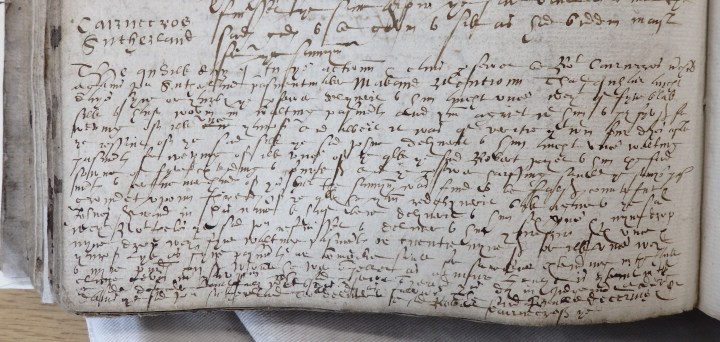
Cairncoss v. Sutherland is crammed into a page margin, but tells us how Robert Cairncross gave fine silk to John Sutherland to weave passments and received them in four days. He discovered that his passements were made from inferior thread. Cairncoss returned them to Sutherland’s servant, expecting to be given new fine silk passements, and so created an actionable debt situation. The court decided Sutherland should pay at the rate of 29 shillings per unce silk, ‘as fine passments are commonlie sauld’.
In this case the merchant’s action and the court shifted a case of fraud or sharp practice into a debt that came under its jurisdiction and could be settled without bringing a criminal case.
Along the way, we learn the market value of passements, and the quick turn around of the makers who weave to order. Sutherland was competing with passements made in Flanders, and Flanders passement sellers complained in this court about the bad payers from Edinburgh they encountered. There are thousands of cases to discover in the Edinburgh City Archives (SL/1/235), and careful sampling and analysis of these records could tell a lot about costume, tastes and fashions around the year 1600.
(4) Cairncross Sutherland November 1599
In the action and caus persewet be Robert Cairncross merchand aganis Johne Sutherland pasmentmaker, Makand Mention that quhair 8 days syne or thairby the persewer delyverit to him 8 unce of fyne blak silk to haif wovin in walting pasments and then agriet with him to pay 5s for the weving of ilk unce thairof and albeit it was of veritie that within four days after the ressait of the said silk the said Johne delyverit to him 8 unce walting passments for weving of ilk unce the said Robert payet to him the said sowme of 5s extending to 40s, and the persewer haiffing sauld the same pasments to certane merchands of this burgh, the samyn was fand to be fals counterfut & groundet upoun threids of the quhilk he then redelyverit bak agane to the said Johnes servand in his name to have bene deliverit to him 6 unce and 9 drop weycht,
Nochttheles the said Johne refusset to deliver to him 6 unce & 9 drop weycht fyne walting pasments or 29s for ilk unce lyk as fyne pasments ar commonlie sauld for samekill extending in the haill to £9-12s without he wes compellit as at mair lenthe is contenit in the clame gevin in thairupoun as said persewer comperand this day in judgement [] [] lauchfully [][] day as followis The said Baillie decerns & ordains the said Johne Sutherland to deliver to the said Robert Cairncross the [blank]
This research was presented at,
Dress and Décor in Medieval and Renaissance Scotland
An interdisciplinary workshop and study day held at the University of Glasgow, 9-10 April 2019
 Objects and the archive