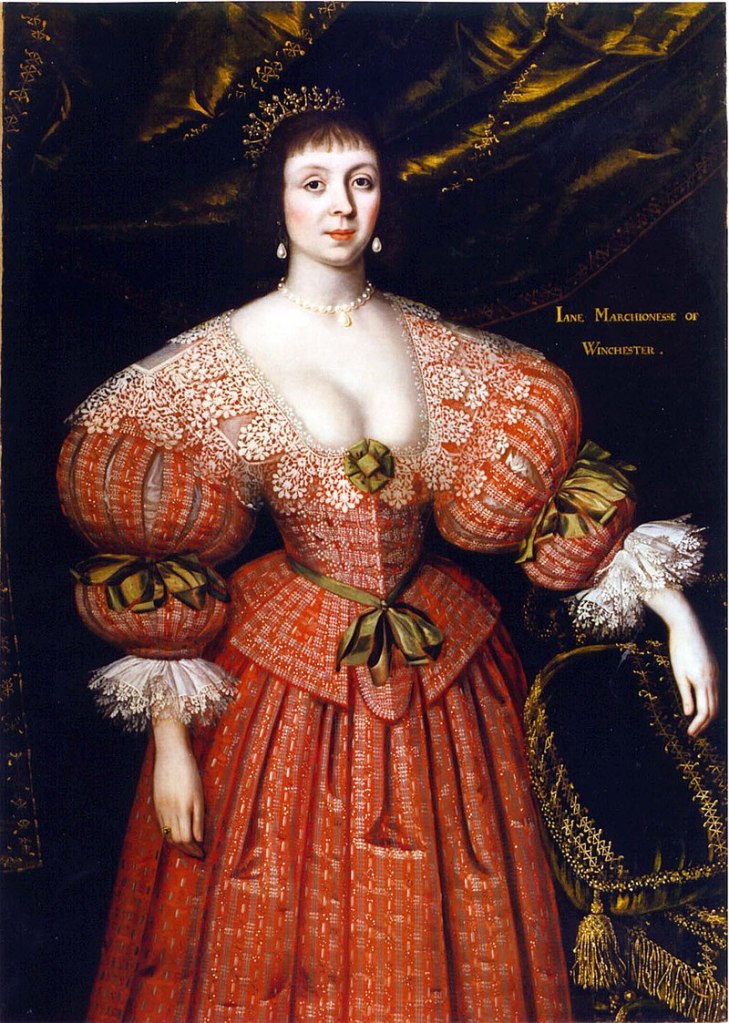
Mary Fane, Countess of Westmorland, wrote to her daughter, Grace, Countess of Home, on 22 April 1631 with news of the death of Lady Jane Savage. She had died following treatment for an infection in her mouth:
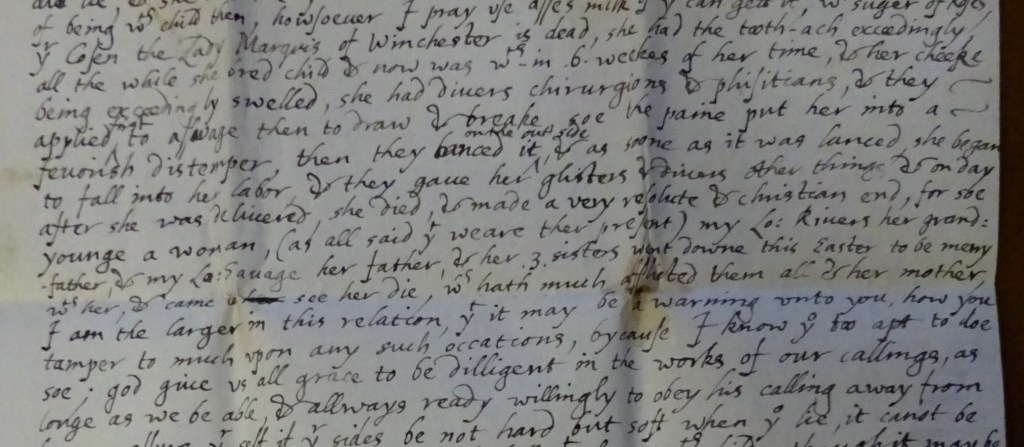
‘… your cosen the Lady Marquis of Winchester is dead, she had the tooth-ach exceedingly, all the while she bred child & now was with-in .6. weekes of her time, & her cheeke being exceedingly swelled, she had divers chirugions & phisitians, & they applied first to asswage then to draw & breake soe the paine put her into a fevorish distemper, then they lanced it on the out-side, & as soone as it was lanced, she began to fall into her labor, & they gave her glisters & divers other things & on day after she was delivered she died, & made a very resolute & christian end, for soe younge a woman, (as all said that weare ther present) my Lo: Rivers her grand:father, & my Lo: Savage her father, & her .3. sisters went down this Easter to be merry with her, & came ther see her die, which hath much afflicted them all & her mother, I am the larger in this relation, that it may be a warning unto you, how you tamper to much upon any such occations, by cause I know you too apt to doe soe; god give us all grace to be diligent in the works of our callings, as longe as we be able, & allways ready willingly to obey his calling away from home …’
Countess of Westmorland to her daughter, NRAS 217 Moray papers, box 5 no. 297.
The Countess of Westmorland’s version of this tragic death is slightly fuller than those written by John Pory or the Countess of Buckingham, mentioning that she was ‘6 weeks ahead of time’ and naming more of the company at Basing House. It’s not clear however that Westmorland had a source of detail independent to the other correspondents.
Pory wrote ‘The Lady Marquess of Winchester, daughter to the Lord Viscount Savage, had an impostume upon her cheek lanced; the humour fell down into her throat, and quickly dispatched her, being big with child, whose death is lamented as well in respect of other her virtues, as that she was inclining to become a protestant’. Buckingham’s version mentioned the delivery, ‘Your Lordship will to soune here the great lose my Lord and Lady Savage has had in the death of my Lady Marques who dyed with an impostome in her checke, and the extreemety of that putt her in a fever. Shee was delivered before shee died of a deed boye It was a great lose to her father and mother who takes it very hevelye’.
Westmorland does not use the word ‘imposthume’ for the infected swelling. She draws from Lady Jane Paulet’s story a moral for Grace, as if she was similarly at risk, and she thought Grace (after treatment for infertility) might now be pregnant. Grace was apt to meddle or tamper, perhaps somehow like the surgeons and physicians at Basing House.
Grace’s husband, James, Earl of Home, and his first wife, Catherine Cary, had severe toothache in December 1622, and news of their recovery was noted in a letter from Leonard Welstead to Henry, Viscount Falkland. Some details of James Home’s illness and his treatment by Dr David Arnot, the Edinburgh physician who attended Grace, were later copied into a recipe book for his sister:
‘My lord having his face mouthe & tongue mightilie swelled with greate pain in his eare on the sam syd. Doctor Arnetts advycments for my lo:’
Treatment included a glister (details left blank) and a poultice featuring camomile and common mallows. Neat’s foot oil can be applied to the swellings and blood letting may be ‘most sovereign’. He was prescribed a purge of cream and crystal of tartar in white wine, and was to apply oil of roses to his ear on a swab of black wool. As the swelling reduced or ‘dissolved’ he used a face cream (oil of camomile and lillies in lard) and wore a scarlet cloth in daytime. He took a course of pills, which ‘wrought very well, and with this course, God be thank, he presentlie recovered’.
This may be the illness mentioned by Leonard Welstead in 1622, but he had heard from Mary, Countess of Home, of an ‘imposthume growed in his mouth, which came to ripeness and brake’, which is not mentioned in the recipe book, (BL Add. 11,033: Richard Simpson, The Lady Falkland, Her Life (London, 1861), p. 129). Perhaps the treatment described in the recipe book, not requiring surgery or lancing, was for another infection. The death of Lady Winchester would have more relevance for the Countess of Westmorland if the oral health of her son-in-law was more recently compromised, and so prompt this warning against tampering.
For more details see Louis Schwartz, ‘Scarce-well-lighted Flame: Milton’s “Epitaph on the Marchioness of Winchester” and the Representation of Maternal Mortality in the Seventeenth-Century Epitaph’, Charles Durham & Kristin Pruitt, All in All: Unity, Diversity, and the Miltonic Perspective (Susquehanna University Press, 1999), p. 201, and, Louis Schwartz, ‘Tears of perfect moan: Milton and the Marchioness of Winchester’, Milton and Maternal Mortality (Cambridge, 2009), p. 91.
You can read my transcriptions of six letters from the Countess of Westmorland to her daughter here: Letters from Mary, Countess of Westmorland, to Grace Fane, Countess of Home
 Objects and the archive