James Murray (died 1613) was a younger brother of the laird of Polmaise near Stirling. In 1568 he was a friend of Regent Moray and William Kirkcaldy of Grange, and looked after the keys of the coffer in Edinburgh Castle where the jewels of Mary, Queen of Scots, were kept. He seems to have been in charge of Moray’s wardrobe including his furs, and obtained some masque costume from Mary’s wardrobe for Moray’s use.1
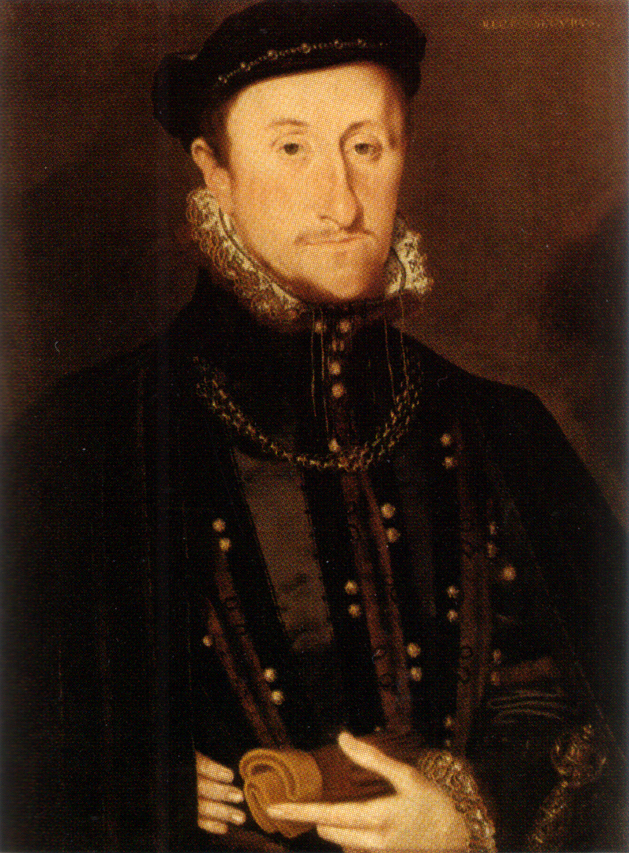
James Stewart, Earl of Moray.
William Kirkcaldy wrote a memorandum on 1 March 1570 mentioning that James Murray was one of the people who knew where Mary’s jewels were after the assassination of Moray and his secretary John Wood. He noted that “James Murray hes the keys and quha sa ev[er] got me lord purs quhen he deit hes the key of the hinging lok for he ware it ev[er] in his awin purs”.2

William Kirkcaldy decided to hold Edinburgh Castle for Mary, Queen of Scots, against Regent Lennox. On 11 November, Lennox sent a messenger to James Murray asking him to produce “certain jewels left to him in keeping” by Moray. Annas Keith, Moray’s widow, got a similar summons.3 She had a royal jewel known as the Great H or Great Harry of Scotland, which Moray had abstracted from the coffer and taken to England, and was in no hurry to hand this over.4
He was appointed Master of the King’s Wardrobe in 1579. On 26 September he took receipt of the king’s jewels and clothes at Stirling Castle from Annabell Murray, Countess of Mar. These included gold buttons which William Kirkcaldy and the goldsmith James Mosman had pledged to the Earl of Huntly during the civil war.5
The treasurer’s accounts for December 1579 record his purchase of crimson satin doublets trimmed with gold for James VI and purple satin doublets trimmed with silver, and more, while masque costumes were bought for the court musicians, the Hudson brothers. He travelled to the English court twice, as a diplomat to discuss border issues.6
“James Murray of Powmaes”, described as one of the “king’s old servants” was sacked and replaced in August 1583 at the end of the Gowrie Regime. At the time he was said to be a pensioner of Queen Elizabeth.7
Murray wrote letters to his friends in England, hoping in October 1589 to return to court by their influence, and replace William Keith of Delny as Master of Wardrobe (Delny had sailed to Norway with James VI). He wrote of Elizabeth’s goodwill towards “my deir kynsman of gude m[emory] Erle of Murray” (Moray’s mother Margaret Erskine was his cousin), and argued that he had been barred from the Scottish court because of his good service to Elizabeth. Delny was indeed sacked during the king’s voyage, but replaced by George Home, later Earl of Dunbar.8
After this, records seem fairly quiet about this James Murray. He died at his house in Stirling in 1613, by which time he was described as “father brother to the laird of Polmaise”, his brother William had died sometime before 1581. His will, or registered testament, itemises some of his clothing, which is unusual in Scottish wills of this date.9
His personal jewellery included a pair of bracelets, three “slight” rings, and a little tablet. The bracelets were a gift from Annabell Murray, Countess of Mar, newly made in 1603 with the “cypher of my name” according a bequest in her will.10 The Countess had looked after James VI and I and Prince Henry at Stirling Castle. It is not clear if this James Murray had a role in the household at Stirling. He signed the 1594 band for keeping Prince Henry at Stirling.11
In 1613, James Murray had a riding cloak of russet lined with “freis”, and a sleeved cloak “barred” with itself. Some of the clothes were old, though still valuable, an old grogram taffetie cloak was worth £30 Scots, an “ane doublet of browne satyne worne” was valued at £10, and “ane auld stikkit green dublet” was worth £10.
James Murray had bought furs for Regent Moray from Archibald Leich, an Edinburgh furrier who had previously supplied Mary. Murray’s will mentions a “sleiffed cloak of broune clayth, the foir laps with wolf skin”, and the lining of the foir lappets of a gown of “martrick skins”. Some items were described as old fashioned in design, and it’s very tempting to imagine these items worn in Regent Moray’s time, “Item, ane sleiffed cloik barred with velvet in the auld fassioun, £20, Item, ane pair of breiks in taggis of the auld fassoune, £3.”

- Amy Blakeway, Regency in Scotland (Boydell, 2015), p. 152: HMC 6th Report: Moray, pp. 655, 672. ↩︎
- National Records of Scotland, E35/9/3, Grange’s memorandum for the jewel coffer, 1 March 1569/70. ↩︎
- Charles Thorpe McInnes, Accounts of the Treasurer of Scotland, 12 (HMSO, 1970), p. 229. ↩︎
- Jade Scott, “Mary Queen of Jewels”, History Today, 70:10 (October 2024), pp. 54–61. ↩︎
- Thomas Thomson, Collection of Inventories (Edinburgh, 1815), pp. 277-284: More details of Mary’s jewels and the loans. ↩︎
- Charles Thorpe McInnes, Accounts of the Treasurer of Scotland, 13 (HMSO, 1978), pp. xxvi, 271, 274, 297-301, 307 ↩︎
- David Calderwood, History of the Kirk, 8 (Edinburgh, 1849), p. 250: Bowes Correspondence (London, 1842), p. 538, TNA SP 52/33 f.3, SP 52/32 f.112: Amy Juhala, “The Household and Court of King James VI of Scotland”, University of Edinburgh, PhD thesis (2000), pp. 45, 310. ↩︎
- Cott. Calig., D. I., fol. 361: Calendar of State Papers relating to Scotland, 10 (Edinburgh, 1936), no. 229: Miles Kerr-Peterson, “Sir William Keith of Delny: Courtier, Ambassador and Agent of Noble Power”, Innes Review 67:2 (2016), pp. 138-158 ↩︎
- National Records of Scotland, CC21/5/1, pp. 552-553: John Anderson, Calendar of Laing Charters (James Thin, 1899), p. 254 no. 1025. ↩︎
- National Library of Scotland MS Ch. 4031, more details of Annabell Murray’s will here ↩︎
- HMC Mar & Kellie (London, 1904), p. 40. ↩︎
- Printed in Joseph Robertson, Inventaires de la Royne Descosse (Bannatyne Club, 1863), pp. 186-187. ↩︎
 Objects and the archive