When Mary of Guise went to Dumbarton to put her daughter on a boat to France in August 1548, it was thought she would sail with Mary, Queen of Scots to Whithorn. The Master of Ruthven wrote to the English commander, Lord Grey of Wilton, that “For newes, the Queenes grace of Scotlande taketh shyppeborde this Satterdaie, and the Queene her modder conveys her doughter by the Muyll of Galloway and lands there and passys in pylgremage to St Tringence”, a usual spelling for Ninian in his day.1 However, Mary of Guise left the queen on her boat at Dumbarton and returned to Edinburgh.2
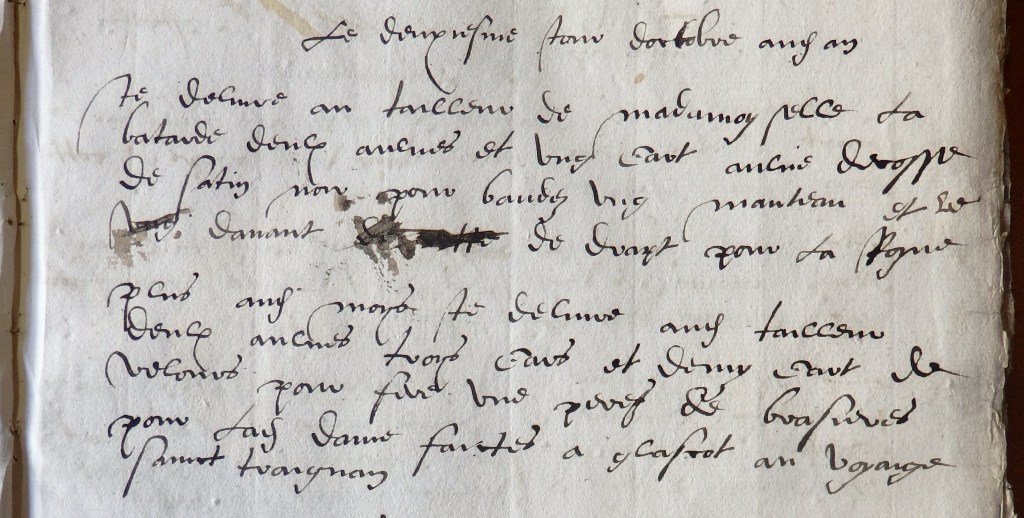
Mary of Guise went to the west of Scotland in October 1553. Regent Arran gave £10 to the servants of his daughters Barbara and Anne, who joined this progress as ladies in waiting.3 They went to Glasgow and Whithorn, a detail recorded in Guise’s wardrobe account because she had clothes refashioned in Glasgow by Lady Jane Stewart’s tailor.4 The account entry calls Lady Jane “Madamoselle la Batarde”:
Le deuxiesme jour d’Octobre audict an
Je delivre au tailleur de Madamoiselle La Batarde deulx aulnes et ung cart aulne d’Ecosse de satin noir pour bandez ung manteau et le ung davant de cotte de drapt pour la Royne.
Plus audict moys, Je delivre audict tailleur deulx aulnes troys cars et demy cart de velours pour fere une pere de brasieres pour ladict Dame faictes a Glascot au voyage Sainct Traignan.
And translated:
2nd day of October the said year,
I gave to the tailor of Mademoiselle la Bastard two ells and a quarter Scottish measure of black satin to band or edge a cloak and a woollen skirt for the Queen dowager.
More, the said month, I gave the said tailor two ells three quarters and a half of velvet to make a doublet for the said Dame made at Glasgow on the progress to St Ninians.5
Although “doublet” may seem an odd choice to translate une pere de brasieres, it was used by the Scottish clerks who made inventories of the clothes of Mary, Queen of Scots.
- Joseph Bain, Calendar State Papers Scotland, 1 (Edinburgh, 1898), p. 155 no. 306: TNA SP 50/4 f.316., the quoted text was written by Grey’s clerk ↩︎
- Rosalind K. Marshall, Mary of Guise (Collins, 1977), p. 175. ↩︎
- Accounts of the Treasurer of Scotland, 10 (Edinburgh: HMSO, 1913), pp. 206–207 ↩︎
- National Records of Scotland, E34/19 f.8r., and read a transcript of the whole account. ↩︎
- According to Rabelais, Scotsmen habitually swore by “Sainct Treignan”, a compound of St and Rinian, a Scots form of Ninian. In Les Cent Nouvelles Nouvelles, the Scottish archer swears by “sainct Engnan”, see Tom Turpie, Kind Neighbours: Scottish Saints and Society in the Later Middle Ages (Brill, 2015), p. 41. The messenger and spy Ninian Cockburn signed his letters with the initial “R” for Rinean, see Amy Blakeway, “A Scottish Anti-Catholic Satire Crossing the Border, and the Redeswyre Raid of 1575”, The English Historical Review, 129:541 (December 2014), pp. 1352, 1370. ↩︎
 Objects and the archive