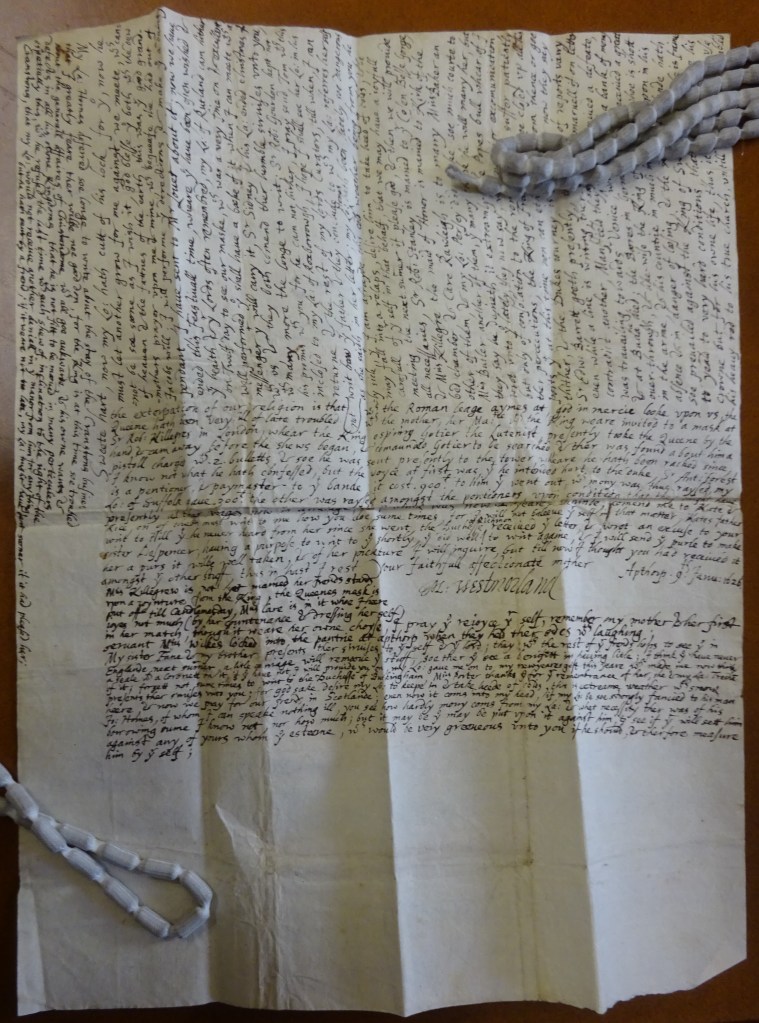
Six letters from Mary Mildmay Fane, Countess of Westmorland, to her daughter Grace, Countess of Home (died 1633), survive in the Moray papers, probably kept as keepsakes by her sister-in-law, Margaret Home, Countess of Moray (died 1683).
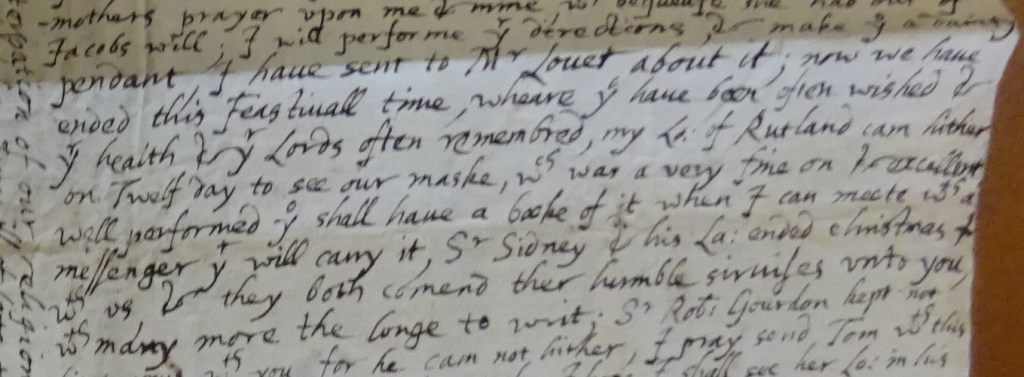
The Countess of Westmorland wrote to Grace on 9 January 1626/7 describing Christmas at Apethorpe in Northamptonshire. The family had put on a masque, a private Christmas panto in the hall or long gallery, for guests including the Earl of Rutland. She offered to send Grace the “booke”, the script:
“… I will performe your directions, & make you [Grace] a dainty pendant, I have sent to Mr [Drew] Louet about it; now we have ended this Feastivall time, wheare you have been often wished and your health & your lords often remembered, my lo: of Rutland came hither on Twelf day to see our maske which was a very fine on & excellent well performed, you shall have a booke of it when I can meete with a messenger that will carry it, Sr Sidney & his la: ended christmas with us, & they both comend ther humble sirvises unto you, with many more the longe to writ; Sr Robert Gourdon kept not his promis with you for he cam not hither, …”1
One Apethorpe masque book survives at the Kent History and Library Centre, Maidstone, attributed to Grace’s sister Rachel Fane, later Countess of Bath. With a green embroidered silk cover, the manuscript includes the May Masque, the Wishing Chair Entertainment, a Christmas Prologue (which may be a fit to this Twelf day maske), and other undated fragments.2 Rachel Fane made a New Year’s Day gift poem for her mother, apparently for January 1627.3
There is no doubt about the date of the letter, 9 January 1627 (1626/7), as the Countess of Westmorland included the latest news from court,4 with an inaccurate account of the recent arrest of the lutenist Jacques Gualtier:
“… the Queene hath been very ill of late troubled with the mother, her Matie with the King weare invited to a mask at Sr Rob: Killigres in London, whear the King espiing Gotier the Lutenist, presently tooke the Queene by the hand & cam away before the shews began & commanded Gotier to be searched, & ther was found about him a pistoll charged with 2 bulletts, & soe he was sent presently to the tower wheare he hath been racked since, I know not what he hath confessed, but the voyce at first was that that he intended hurt to the Duke. … “
Rachel Fane’s pastoral fragments call for props readily found at Apethorpe. The Christmas Prologue opens with a drum roll. There was a music chamber or musician’s chamber at Apethorpe, and its contents were listed in 1629:5
| In the Mussicke Chamber |
| Item one ffeelde bedd matted and Corded one Scarlet Canapie wth Satin lace one ffeather bedd, twoe pillowes, Three blancketts one little Square Table Twoe greate Chestes banded wth Iron, one viall chest wth Six vialls in it, one Theorbowe, Twoe bandores, one Lute, one pallett bedd one ffeather bedd one bolster one blanckett one Covrlidd one matt, one paire of tonges one Creeper, and twoe peeces of hanginges of Tapestrie |
- Moray papers, NRAS 217, Box 5:304: The text of the six letters is here. ↩︎
- Alison Findlay, Playing Spaces in Early Modern Women’s Drama (Cambridge, 2006), pp. 96-103: Erin Julian, ‘”Of no consequence”? Rachel Fane’s Manuscripts and Archival Erasure’, Shakespeare Bulletin, 42:2 (Summer 2024), pp. 135-162: Deanne Williams, “My Lady Rachells booke”, Shakespeare and the Performance of Girlhood (Palgrave Macmillan, 2014), pp. 173–188: Marion O’Connor, “Entertainments and Poems by Lady Rachel Fane”, Malone Collections, 17 (2016), pp. 151–196: Sackville MS. U269/F38/3. ↩︎
- Marion O’Connor, “Entertainments and Poems by Lady Rachel Fane”, Malone Society Collections, 17 (2016), pp. 178–179. ↩︎
- The other contents of the Countess’ letter can be compared with two newsletters, HMC 12th Report Part IV Duke of Rutland at Belvoir, 1 (London, 1888), pp. 479-481. ↩︎
- Northamptonshire Record Office, Apethorpe inventory of 1629. NRO W (A) Box 6, Parcel V, nos. 1 & 2, from a transcript prepared for English Heritage: Kathryn A. Morrison, Apethorpe: The Story of an English Country House (Yale, 2016), pp. 180, 415. ↩︎
 Objects and the archive