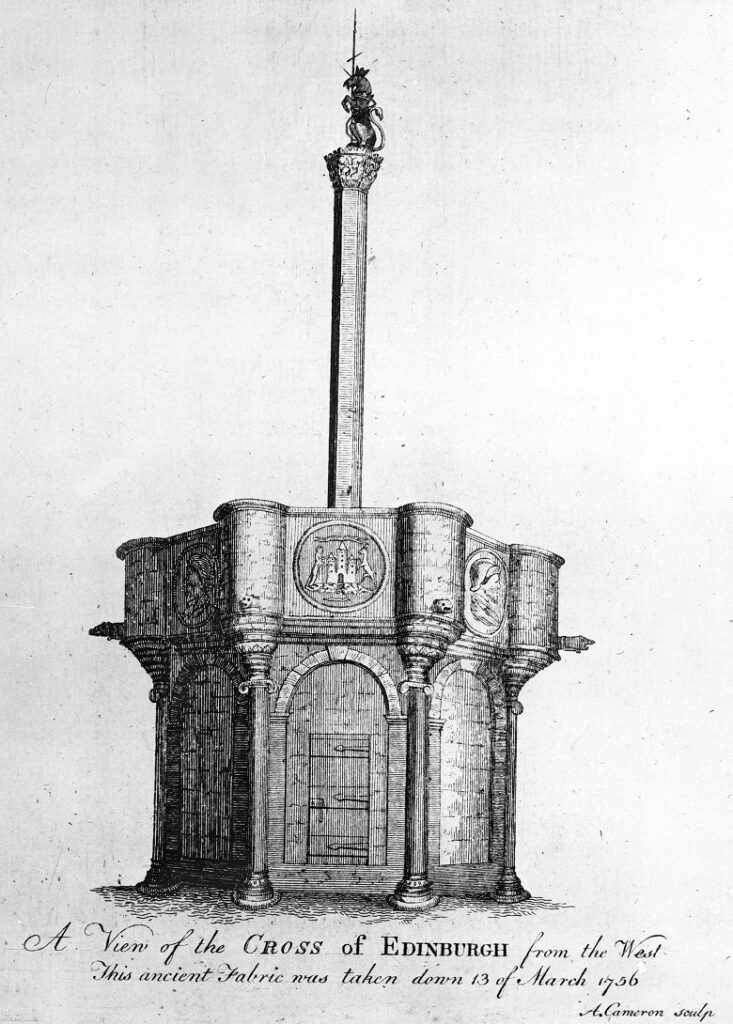
In Edinburgh, a court of baillies met regularly to hear complaints of bad debts and non-payments. The judgements were recorded in ledgers known as the ‘Books of Decreets’ which survive in Edinburgh City Archives, covering the years 1580 to 1635. The court proved a debt, typically accepting an oath made to a court officer, and would attempt to settle matters by auctioning property at the Mercat Cross. As Marguerite Wood observed in 1928, the sums realised frequently fell short of the debt.1 The most well-known case involved the officer Archibald Cornwell, who tried to auction portraits of James VI and Anna of Denmark for the court in 1601, but was hanged himself after he displayed the pictures on the gallows pole.2
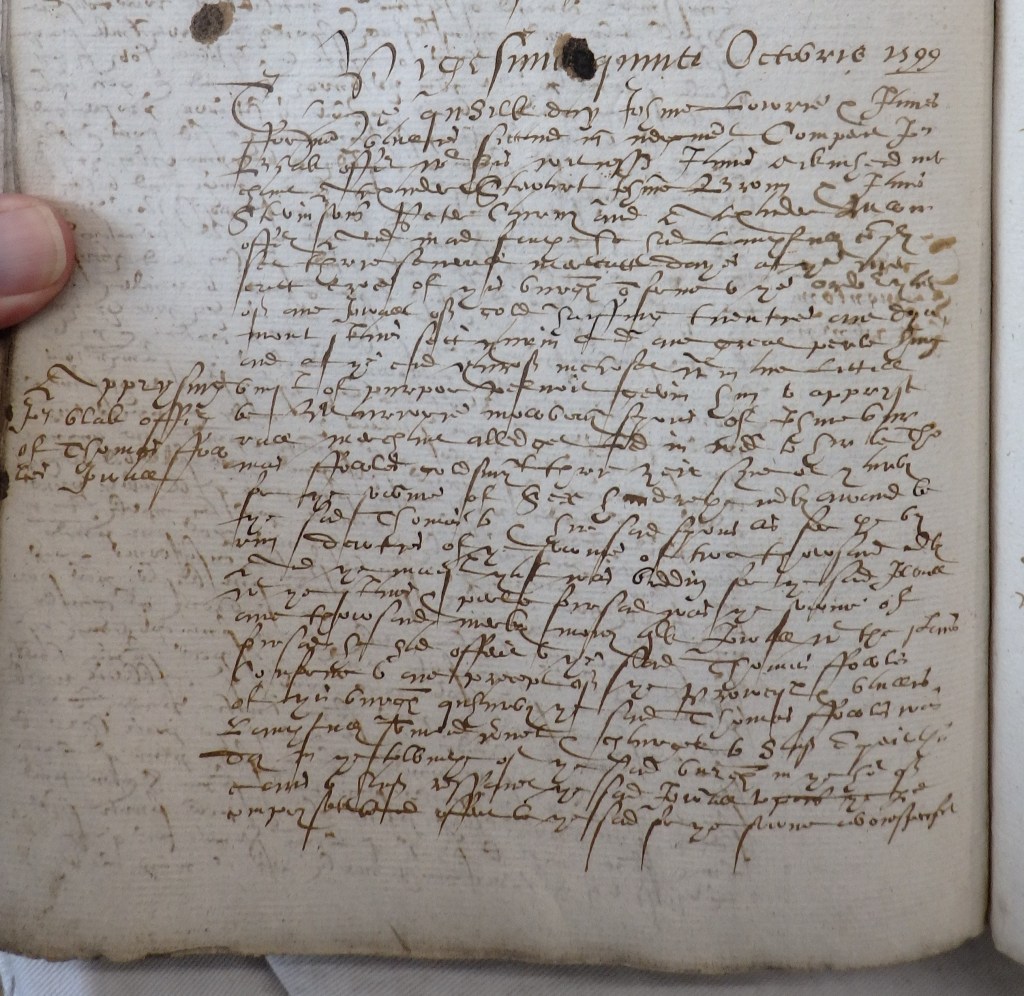
A record from 25 October 1599 is unusual for featuring a high value jewel and also explaining the court’s proceedings in some detail. The process was started by Marjorie Mowbray, who brought the jewel to the court and requested its sale. It was ‘a jewel of gold having twenty one diamond stones set therein and a great pearl hanging at the end thereof, enclosed within a little box of purple velvet’.

Marjorie was the wife of the merchant John Burrell. Jamie Reid Baxter has proposed that he was the poet and author of The Discription of the Queenis Maiesties most honourable entry into the town of Edinburgh.3 Marjorie told the baillie court’s officer John Blak that the goldsmith Thomas Foulis had left the jewel with them as a pledge for a debt of 600 merks and the ‘by run annual’ (interest) on another loan of 2,000 merks about three years ago. And they had not been repaid.
A merk is two thirds of a pound, a Scottish pound was then worth around one English shilling. Thomas Foulis was major supplier of jewels to James VI and also managed the English subsidy which largely funded the Scottish royal wardrobe. In 1589, when Sir George Beeston, an Armada veteran, visited Edinburgh in the Vanguard, Thomas Foulis sold James VI a comparable jewel to give to Beeston, ‘ane greit tablet set with diamants’, which cost 140 crowns, or £540 Scots.4
The debts of Thomas Foulis and his business partner, the textile merchant Robert Jousie (whose detailed accounts for the royal wardrobes survive), were listed in 1598 when they were bankrupted, and they owed John Burrel a grand total of £1,333-6s-8d. It seems that many wealthy people had entrusted their money expecting a heathy return of “by run annuals”.5
In October 1599, John Blak offered the pledged jewel at the Mercat Cross on ‘three several market days’ and the highest bid was 1,000 merks. After Blak reported this to the court, Foulis was given a chance to buy back the jewel from the court and was summoned to the Tolbooth. He did not respond and the jewel was sold to the highest bidder for the benefit of John and Marjorie.
The record doesn’t make it clear if John Burrell and Marjorie Mowbray were to discount the sum realised against Foulis’ debt. When John Burrell died in 1603, his assets included 2,000 merks still owed to him by Foulis, which corresponds to one of the loans mentioned in this case. That debt was subject to a decreet of the Lords of Council, which was logged in the Registers of Deeds still held by the National Records of Scotland.6 Burrel’s testament, available from the website Scotland’s People, informs us that the original cautioners for the loan, Foulis’ backers, were the merchants Alexander Hunter and John Gourlay (deceased).7
- Cases from the Edinburgh City Archive Books or Registers of Decreets (SL234) were included in Marguerite Wood and David Robertson, Castle and Town: Chapters in the History of the Royal Burgh of Edinburgh (Edinburgh, 1928), pp. 208-212, the books were rediscovered as a historical source and used by Cathryn Spence, Women, Credit, and Debt in Early Modern Scotland (Manchester, 2016). The volumes have recently been rebound. ↩︎
- Jemma Field, Anna of Denmark: The Material and Visual Culture of the Stuart Courts, 1589-1619 (Manchester, 2020), pp. 161-162. ↩︎
- Jamie Reid Baxter, “John Burel”, A Palace in the Wild: Essays on Vernacular Culture and Humanism in Late-Medieval and Renaissance Scotland (Peeters, 2000), pp. 204–205. ↩︎
- Miles Kerr-Peterson and Michael Pearce, “King James VI’s English Subsidy and Danish Dowry Accounts, 1588–1596”, Miscellany of the Scottish History Society, XVI (Woodbridge: Boydell, 2020), pp. 11-12, 22-23, 61. ↩︎
- Julian Goodare, “The Octavians”, Miles Kerr-Peterson and Steven J. Reid, James VI and Noble Power in Scotland 1578-1603 (Routledge, 2017), pp. 184-186: Acts of the Parliaments of Scotland, 4:168, Roll of the creditors of Thomas Foulis and Robert Jousie, The Records of the Parliaments of Scotland to 1707, K.M. Brown et al eds (St Andrews, 2007-2020), 1598/6/18: Robert Jousie’s accounts for the royal wardrobe are National Records of Scotland E35/13 and E35/14. ↩︎
- National Records of Scotland, RD1/63/155, this loan of 2,000 merks was made on 11 June 1595, thanks to Jamie Reid Baxter for finding this. ↩︎
- Will of John Burrell, National Records of Scotland, CC8/8/37 pp. 700-702. ↩︎
 Objects and the archive