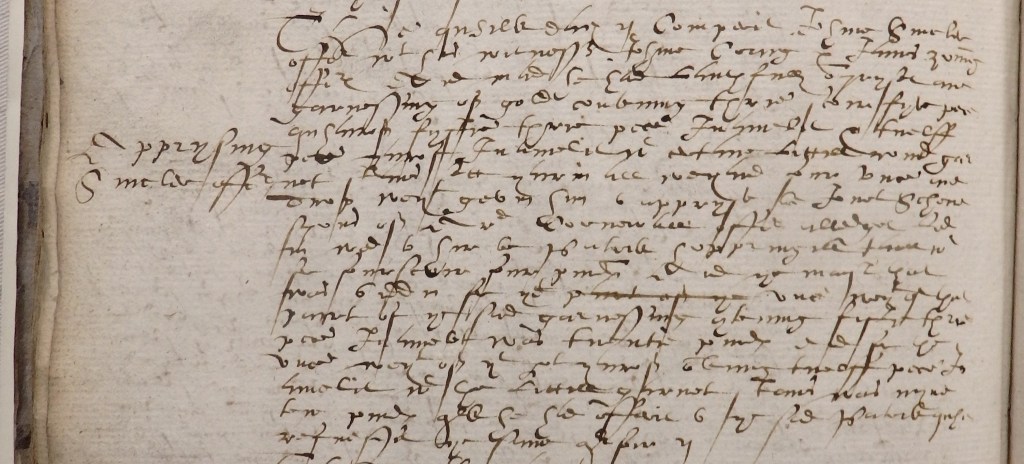
There was a court in Edinburgh dealing with small debts. The officers of the court auctioned goods to settle claims on market days at Edinburgh’s Mercat Cross. In September 1600, Jonet Cheyne or Schene produced a garnet garnishing for auction which she had been given as a pledge for a loan of £84 Scots made to a tailor Patrick Hoppringill.
A garnishing was a chain of jewels suitable to wear on a French hood or other item of costume. James VI regularly gave them as wedding presents.1 This one was carefully described:
ane garnessing of gold contening thrie scoir fyve pece, quhairof fyftie thrie inamelit & twelf with certane littill rond garnet stanes set thairin all weyand four unce ane drop weyt
a garnishing of gold containing three score five (65) pieces, fifty three enamelled & twelve set with certain little round garnet stones, all weighing four ounces one drop weight
The court officer John Sinclair took bids for the garnishing. The twelve pieces with garnets were offered separately, with a bid at £20 the ounce of gold, and the 12 pieces with “little garnet stones” got a bid of £19 the ounce. In this case, the bids were not far short of the unpaid loan. Patrick Hoppringill waived his option to buy the garnishing from the court, and the money from the bidders would be given to Jonet Cheyne.
It’s interesting that enamelled gold jewellery set with garnets was worn in late 16th-century Scotland. The Fettercairn jewel, a locket acquired by the National Museums of Scotland in 2017 features a large rectangular garnet possibly from India.2 Another probably Scottish 16th-century pendant sold by Christie’s in 2018, which includes a pair of miniature portraits, features three small round cabochon garnets and three larger pendant facet cut garnets. The late historian Diana Scarisbrick reflected on this garnet-set pendant as the product of Edinburgh goldsmiths clustered around St Giles.3
Jonet Cheyne was married to a court officer Archibald Cornwell. He was executed in April 1601 for treason after trying to auction portraits of James VI and Anne of Denmark which he displayed on the gallows. After his death, James VI granted his escheat to his widow Jonet Cheyne on 19 June 1601 (the king’s birthday).4 The Edinburgh diarist Robert Birrell described Cornwell as an “unmerciful greedy creature”,5 although the records of the baillie court rarely show how he might have profited from his office.
Of course, other stones were available. A stock of precious stones was listed with prices in the 1586 testament of Katherine Sym, the wife of an Edinburgh goldsmith John Mosman: “Item mair, aucht small dyamontis … xx li, Item mair xxxvi littil rubeis … £7, Item mair foure saphieris … £6, Item mair twelf sparkis of turkess … 40s, Item of doublettis, garnettis, vermiellis, & cristalleins, xij dossone estimat to the soum of £10, Item of perles thrie dossone, price of the dossone … £3-6s-8d, Item half ane unce of small perle … £6”.6
- Robert Pitcairn, Ancient Criminal Trials in Scotland, 2 (Edinburgh, 1833), p. 238, quoting the royal treasurer’s accounts; “ane cheinzie and ane belt of goldsmyth work, set with pearle, with ane pair of garnissingis in the lyk wark, set with pearle, propynit in his Maiestis name, to Sir George Elphinstounis wyff the day of hir mariage”. ↩︎
- Lore Troalen, “Analysis of the Fettercairn jewel”, Anna Groundwater, Decoding the Jewels: Renaissance Jewellery in Scotland (NMS, 2024), pp. 188-189. ↩︎
- Christie’s, 28 November 2018, lot 159: Rare 16th Century enamel and garnet two sided portrait minature pendant ↩︎
- National Records of Scotland, Register of the Privy Seal, PS1/72 f. 170v, 19 June 1601, Dalkeith Palace. ↩︎
- “The Diarey (sic) of Robert Birrell”, in John Graham Dalyell, Fragments of Scottish History (Edinburgh, 1798), p. 54 ↩︎
- NRS CC8/8/16, will of Katherene Sym, 25 November: The list of stones is cited by A Dictionary of the Older Scottish Tongue ↩︎
 Objects and the archive