In 1556, John Knox wrote a letter to his female Protestant following in Edinburgh, advising on suitable clothing for the godly. The new-ish French farthingale was deprecated.1 After finding some scriptural justification for censuring hairstyles, Knox wrote:
‘Gif sic thingis as Esay the Prophet repruiffit in the wemen of his time be dampnabill, verdingallis, and sic other fond fantaseis that wer knawin in theis dayis, can not be justifeit’2
If such things as Isaiah the Prophet reproved in the women of his time be damnable, farthingales, and such other fond fantasies that were known in these days, cannot be justified.
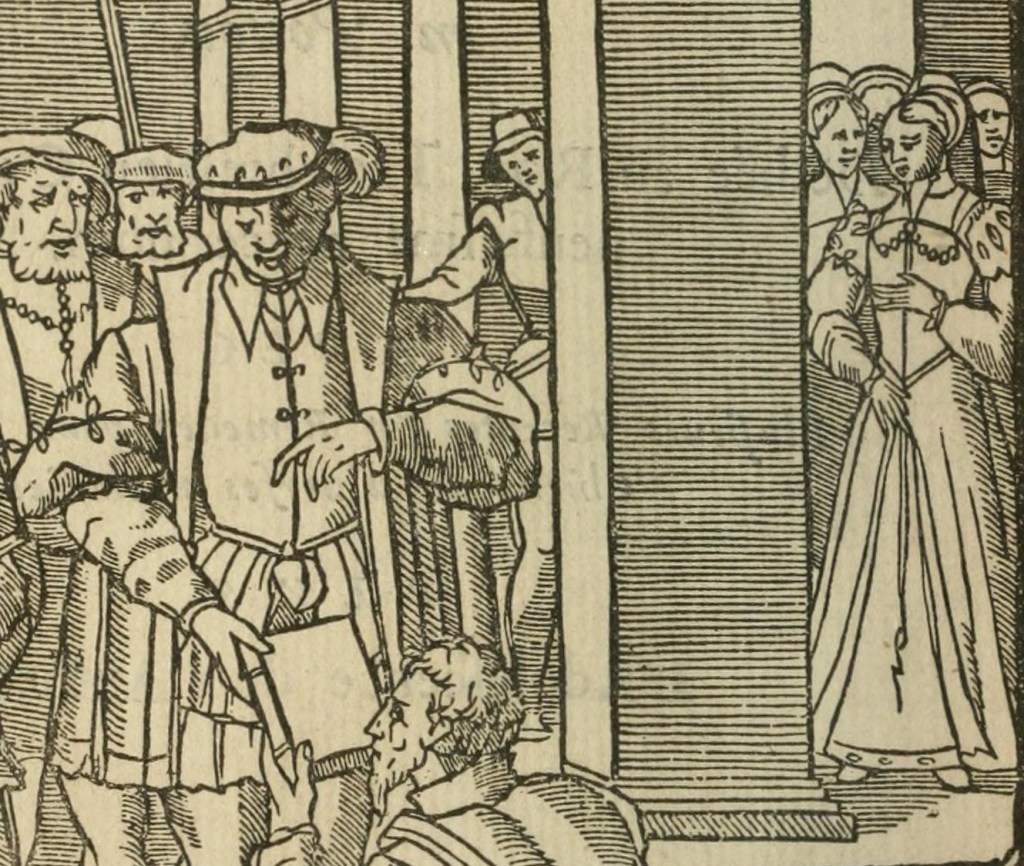
Knox was directing his audience to Isaiah’s warning to the proud women of Sion, (Isaiah 3:16-24). In the English Great Bible of 1540, the passage includes a checklist of Tudor fashion and jewellery:
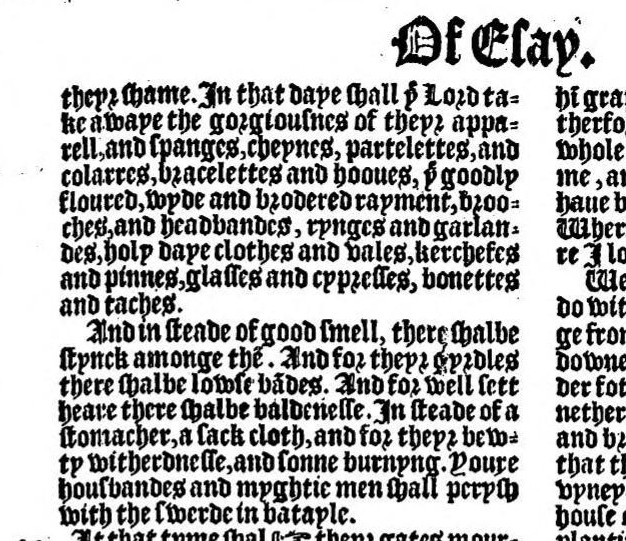
“Seeing the daughters of Sion are become so proud … In that daye shall the Lord take awaye the gorgiousnes of theyr apparell, and spanges, cheynes, partelettes, and colarres, bracelettes and hooues, the goodly floured, wyde and brodered rayment, brooches, and headbandes, rynges and garlandes, holy daye clothes and vales, kerchefes and pinnes, glasses and cypresses, bonnettes and taches.
And in steade of good smell, there shalbe stynck amonge them. And for theyr gyrdles there shalbe lowse bandes. And for well sett heare there shalbe baldnesse. In steade of a stomacher, a sack cloth, and for theyr bewty witherdnesse, and sonne burnyng.”4
John Calvin commented on these verses that ‘women will spare no cost to make themselves fine: yea they will pinch their bellies, and offer violence to nature itself, that they may have wherewith to attire themselves the more costly & sumptuously’. He briefly mentions the Roman Lex Oppio, a sumptuary law defended by Cato the Elder. Calvin’s 1551 Commentary was dedicated to Edward VI. Both John Aylmer and Antoine de Noailles commented on sober female dress at the court of Edward VI. According to Noailles, Mary I put aside former superstitions which proscribed wearing ‘jewels and coloured gowns’ and she and most of her companions wore French-style gowns with wide sleeves (at least, on formal days, according to the Venetian ambassador Giacomo Soranzo). Noailles wrote to Mary of Guise in October 1553 that the English court now displayed a surfeit of ‘la pompe & gourgiaseté‘.5
Doubts however were raised about a sombre dress code at Edward’s court by Patrick Fraser Tytler as long ago as 1839.6 Edward’s own clothes, by report and the appearance of his portraits, were as decked with jewels and as brightly coloured as his father’s, and Aylmer himself wrote to Bullinger that women at court had not set aside jewels and the braiding of hair.7
The passage from Isaiah,8 with its mention of ‘stynck’, underlies two comments on costume that Knox included in his History of the Reformation in Scotland. Knox wrote that in June 1563, he personally criticised the jewellery, the ‘gold, garnishing, targetting’, worn by Mary’s gentlewomen in the outer chamber at Holyrood Palace. Knox described Mary’s entourage on 26 May 1563 at the opening of Parliament as a ‘styncken pryde of wemen’ which caused kirk minsters to comment and call for sumptuary laws. This was a public occasion when the monarch rode from Holyrood Palace to the Tolbooth near St Giles.9
According to the letters of Thomas Randolph to William Cecil and the Earl of Rutland, Mary had cast off her ‘sorrowful garments and mourning weeds’. The women taking part in the opening of Parliament were ‘abowte xxx of the chosen and picked ladies that are in this realme’ comprising ‘noblemen’s wyves as theie were in dignitie, 12 in number, after them the four virgins, maydes, Maries, damoyselles of honor, or the Quen’s mignions, cawle them as please your honor, but a fayerrer syghte was never seen’. The 16 women were followed by ‘maynie more so wonderfull in beautie that I know not what courte may be compared unto them’. Mary herself wore ‘her roobes upon her backe, and a riche crown on her heade’.10 New sumptuary laws were not discussed in Parliament, apparently because the discussion would antagonise Mary and so jeopardise other legislation and the holding of parliaments.11
- Jane Dawson, John Knox (Yale, 2015), p. 141: Patrick Collinson, Elizabethan Essays (Hambledon, 1994), p. 134 fn. 48. ↩︎
- David Laing, Works of John Knox, 4 (Edinburgh: Wodrow Society, 1865), p. 227. ↩︎
- This image is discussed in John M. Gilbert, Elite Hunting Culture and Mary, Queen of Scots (Boydell, 2024), pp. 66-68 & plate 2: via archive org / University of Toronto ↩︎
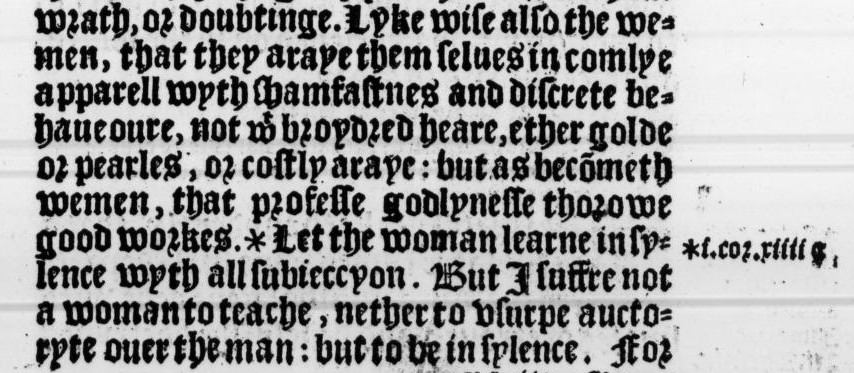
- The booke of the prophete Esay, The Byble in Englyshe (Edward Whytchurche, 1540), fol. xlii-xliii. ‘Hooues’ or howes were hoods or coifs: In the same letter Knox refers to the commands of the apostles Peter and Paul on women’s apparel, presumably including 1 Timothy 2:9-10, ‘Lykewise also the wemen, that they araye themselves in comlye apparrell with shamfastnes and discrete behaveoure, not with broydered heare, eyther golde or pearles, or costly araye: but as becometh wemen, that professe godlynesse thorowe good workes.’, The Byble in Englyshe (Edward Whytchurche, 1540), fol. lxxxiii. ↩︎
- William J. Bouwsma, John Calvin: A Sixteenth-Century Portrait (Oxford, 1988), p. 53: René Aubert de Vertot, Ambassades de Messieurs de Noailles en Angleterre, 2 (Leyden, 1763), pp. 104, 121: Quotation from, Clement Cotton, A Commentary upon the prophecie of Isaiah by Mr John Calvin (London: Felix Kyngston, 1609), pp. 43-44. ↩︎
- Patrick Fraser Tytler, England under the reigns of Edward VI and Mary, 2 (London: Richard Bentley, 1839), pp. 241-242: For a list of clothes sent to Anne, Duchess of Somerset in the Tower of London, Henry Ellis, Original Letters, 2nd Series, 2 (London, 1827), p. 215. ↩︎
- Jennifer Loach, Edward VI (Yale, 1999), pp. 137-139: Leanda de Lisle, The Sisters who would be Queen (HarperPress, 2008), pp. 74–76: Hastings Robinson, Zurich Letters (Cambridge, 1846), pp. 278–279. ↩︎
- For a modern discussion of the text, see Laura Quick, Dress, Adornment, and the Body in the Hebrew Bible (Oxford, 2021), p. 123. ↩︎
- Jane Dawson, John Knox (Yale, 2015), p. 237: Rosalind K. Marshall, Queen Mary’s Women (John Donald, 2006), p. 155: Thomas Thomson, History of the Kirk of Scotland by David Calderwood, 2 (Edinburgh: Wodrow Society, 1843), p. 216: David Laing, Works of John Knox, 2 (Edinburgh: Wodrow Society, 1848), pp. 381, 389. ↩︎
- Randolph to Cecil, 3 June 1563, TNA SP 52/8 f.74r., and David Hay Fleming, Mary Queen of Scots (London, 1897), p. 490 citing HMC 12th Report IV, Rutland (London, 1888), pp. 84-85: Clare Hunter, Embroidering Her Truth: Mary, Queen of Scots and the Language of Power (London: Sceptre, 2022), pp. 130-131. ↩︎
- Thomas Thomson, History of the Kirk by David Calderwood, 2 (Edinburgh, 1843), pp. 216-217. ↩︎
 Objects and the archive