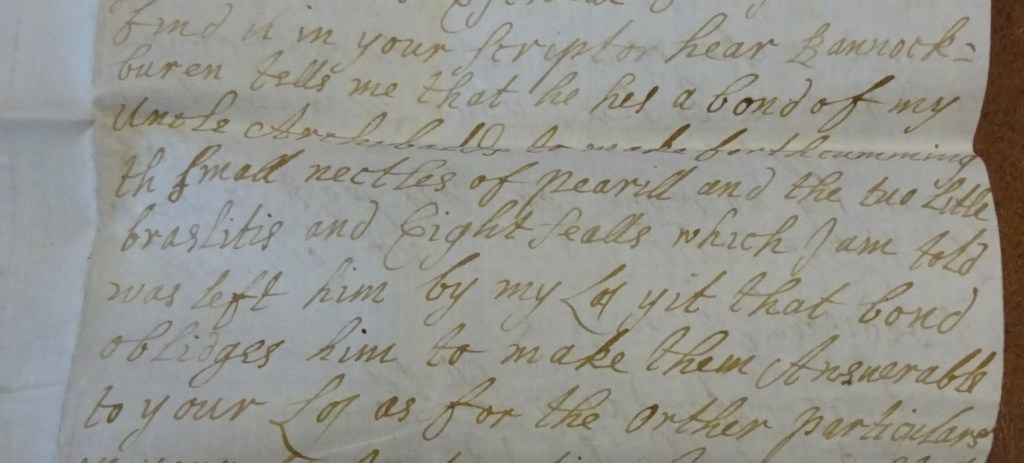
Hugh Paterson was a lawyer, joint deputy-keeper of the signet, and builder of Bannockburn House. He was made a baronet in 1686, apparently by the influence of Alexander Stuart, 5th Earl of Moray. Paterson had worked for the earl’s mother Margaret Home, Countess of Moray. She bequeathed him a small necklace of pearls, bracelets, and eight seals.
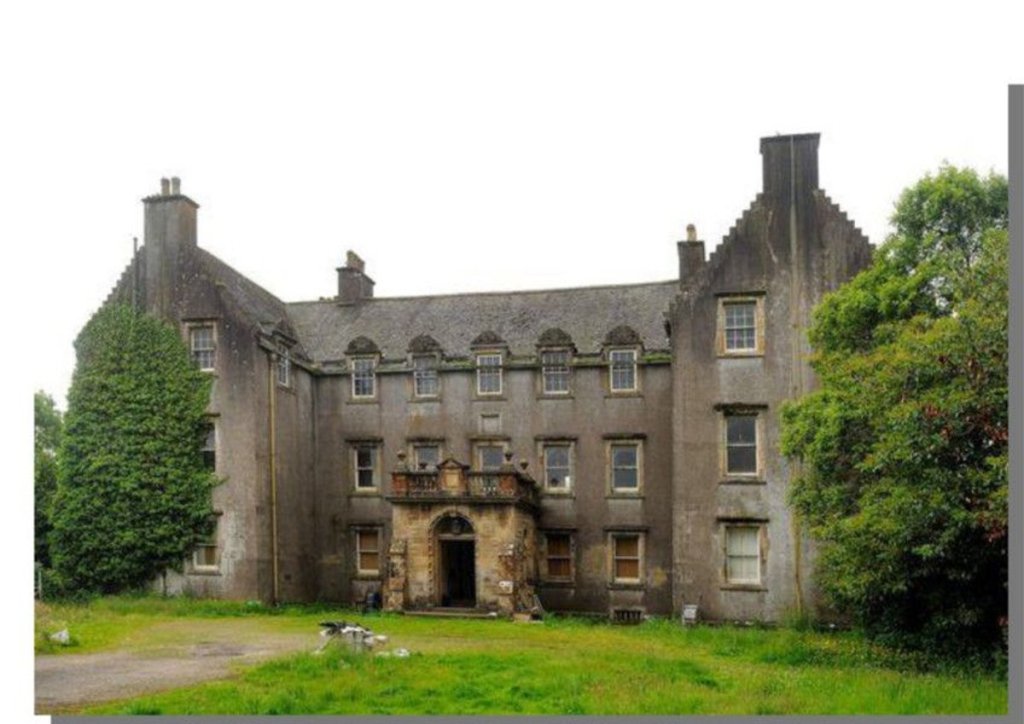
Bannockburn House
Family papers indicate that Alexander Stuart and his mother had a major disagreement after the death of his father in 1653. The cause was money. Margaret had received a substantial windfall at the death of her brother in 1633 when the earldom of Home was transferred to a cousin. Two particular issues now were the valuable assets that Margaret Home held in her own name, such as the mill at Cullaloe by Aberdour, and the debts of the late earl, especially a loan from John Clerk of Penicuik. A cautioner for the loan, Alexander Brodie of Brodie, became liable for the money and, objecting to pay, was “horned” at the cross of Forres.
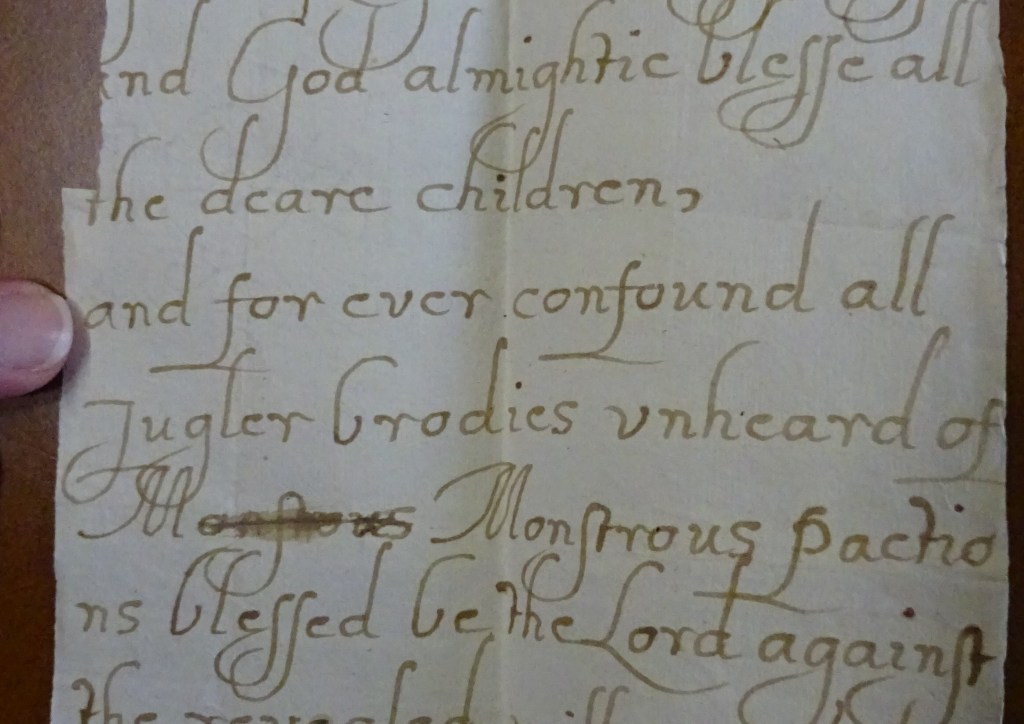
Brodie may have enlisted the support of Alexander Stuart at this point. Relations thereafter may have continued to be distant, and subsequently Countess Margaret strongly objected to a scheme or settlement in favour of her son that would convert her landed income to a salary. She drafted a passionate prayer and declaration denouncing Brodie and her son to present to an advocate, Alexander Falconer of Halkerton.
In 1667, the Earl of Argyll (who was Margaret Home’s son-in-law) intervened in a crisis. A younger son, Archibald Stewart, had staged a robbery at Donibristle, helping himself to valuables in her closet. When she arrived at the house in a litter, he took her jewels. Argyll smoothed this over. He thought the robbery was a sort of stunt to persuade the Countess to give him a larger income. Argyll was also concerned about another son Francis, who was presumably his brother’s accessory. Argyll locked Archie up for time in a room in his Edinburgh lodging and recovered the loot
The Earl of Argyll wrote to the Duke of Lauderdale (who was Countess Margaret’s brother-in-law), hoping the reputataion of these “pretty sweet young gentlemen” was not lost and they could find employment. Argyll was also concerned about the butler in the Canongate, who was said to be cheating Countess Margaret, and running a disreputable house with his sister, who had two children by Archibald Stuart. Meanwhile, the Countess was still railing about Alexander Brodie, and felt that Argyll and her daughter Mary Stuart were also after her money.1 At the time, Archibald was betrothed to marry Anne Henderson of Fordell (near Dunfermline). Francis Stuart would have a heated argument with Hugh Paterson of Bannockburn at Inverkeithing in 1683.
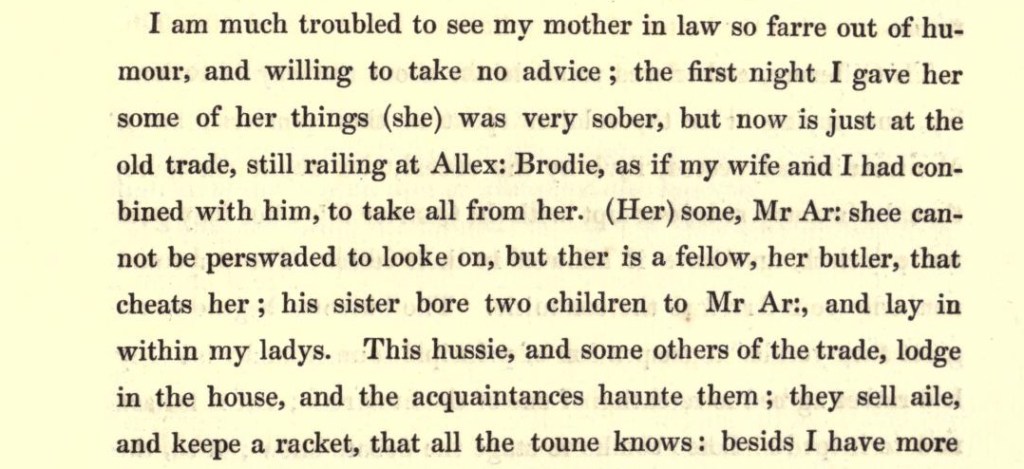
Letters from Archibald, Earl of Argyll, to John, Duke of Lauderdale (Edinburgh, 1829), 51
When Margaret Home died in May 1683. Hugh Paterson, who was evidently familiar with her houses at Donibristle and in Edinburgh’s Canongate, helped make inventories of her possessions.2 He had worked for her from 1662, if not before, and was now keeping things things afloat.3
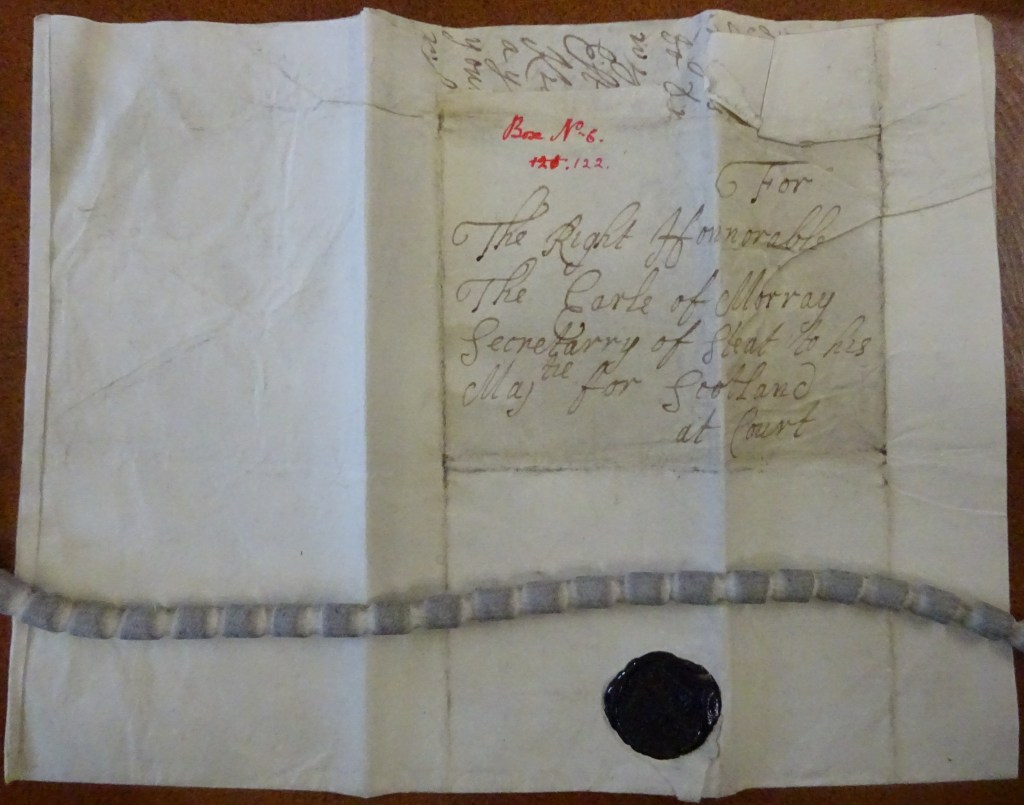
Margaret Home’s son, Alexander Stuart, now Earl of Moray, was in London. His son, Charles Stuart (later Lord Doune and Moray), sent him updates and these letters have interesting sketches of Hugh Paterson at work and his interventions in other family disputes. He calls Paterson “Bannockburen” and his son and business partner “Litle Hugh Patersone”.
Hugh Paterson and the housekeeper Anna Forrest4 rediscovered a significant cache of silver in a closet adjacent to Margaret Home’s bedroom at Moray House in the Canongate. The Countess had made a legal protest to retain her “chamber plate” in November 1653 after her husband’s death and the silver would have been a reminder of her struggle.5
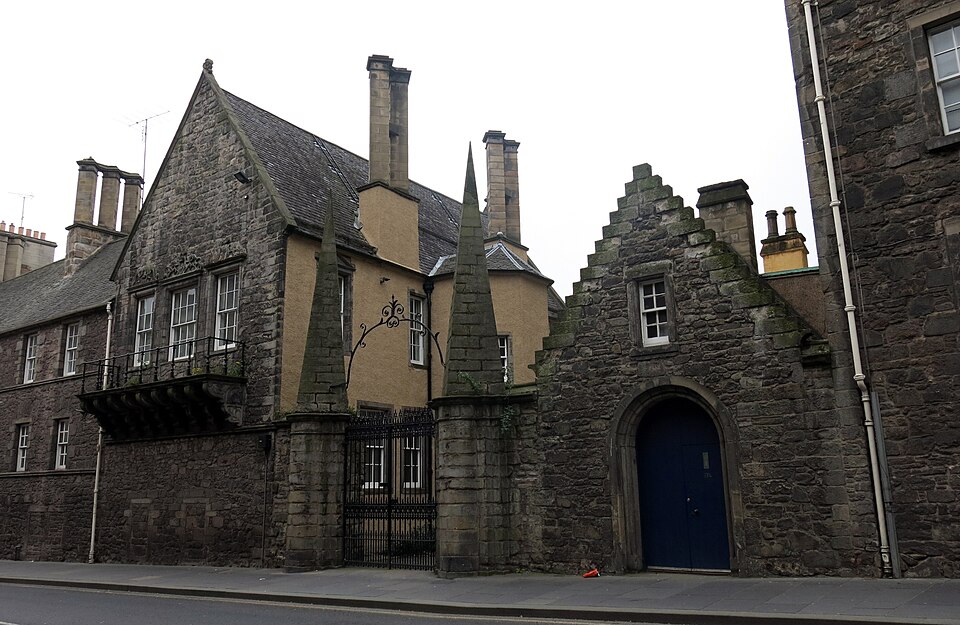
Paterson gave Charles Stuart a recommendation for the good treatment of Henderson, the Moray House gardener, which Charles seems inclined to disregard: “Henderson the gardner the old man still, he can doe no work himself, all that Bannockburen says for him is that he hes been an old servant, but you may doe what you pleas with him”.
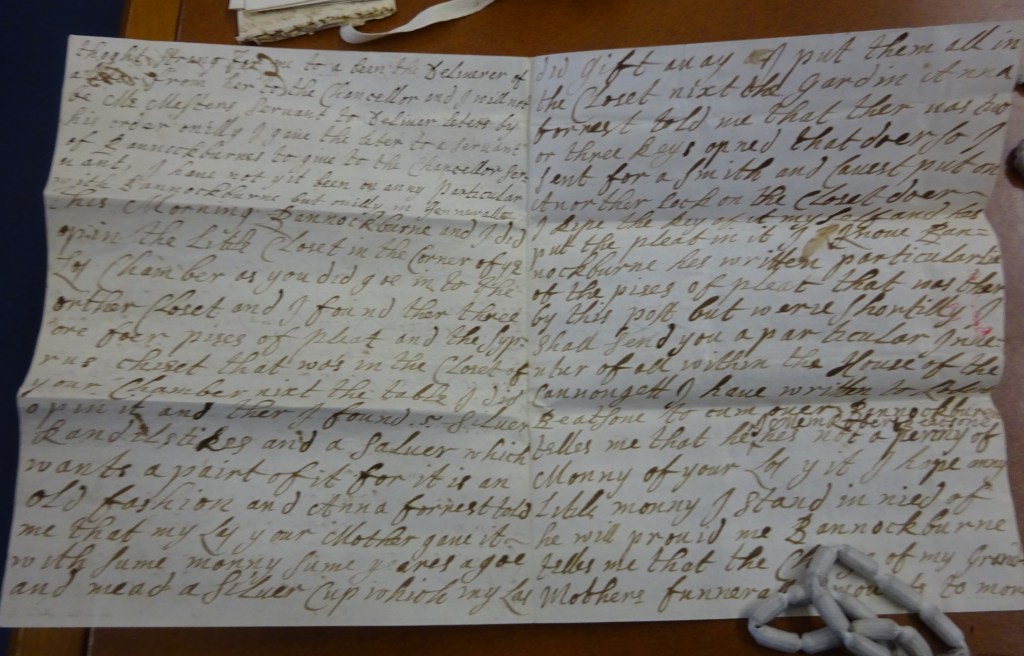
Paterson made a reckoning for the cost of Margaret Home’s funeral. On the Friday after the funeral at Donibristle, there was a supper at a house in Inverkeithing, almost certainly in Fordell’s Lodging. Charles Stuart gives a vivid account of an argument there, as the family confronted his uncle Francis Stuart, a favoured son of Margaret Home, thought to have received substantial gifts from her in her lifetime. Francis, whatever his role had been, was now given a hard time.
Charles wrote to the earl that Francis complained: “everie day he hears that thay calumniat him to you, that he should have embasild furnitur and stolen away goods out of the House of Dunebrisell, but what oaths he did swear that he did niver take the worth of a six pens”.
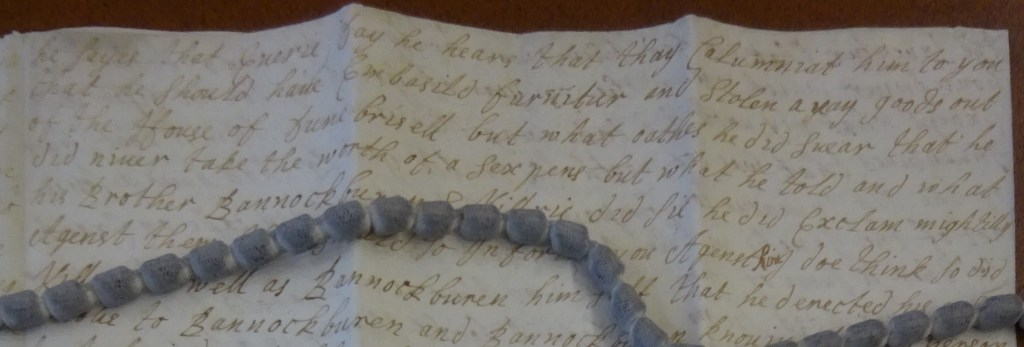
Charles continued that Francis Stuart and “Bannockburen had verie free languig, in short, he told thay your lordship was offended he went from Dunibirsell before my ladies funerall, and that he was not present at it, then, that he should have takin any thing out the house, till he had acquainted you and gottin your leave”.
Francis then assured Charles that he had now written twice to the earl and only spoke of him with “all deference that can be”. Hugh Paterson left them talking at the Inverkeithing supper table, where Charles Stuart remained to defend Paterson’s reputation from Francis’ implications. Francis had complained that some “underlings and common people” spread rumours about him which had reached the Earl of Moray. Charles pointed out to his uncle that the Earl was only informed of family events by Bannockburn’s letters, and so he had directly accused Bannockburn.
Charles extracted an apology for Hugh Paterson, asking Francis “why did he give ear to theis mein people which he acknowledged he was in the wrong to do it, and to speak so derectilly to Bannockburen how (who) did never give your Lo. anny wrong information of him but which he could not nor did go agens thimself, He desired me then ernestily to tell Bannockburen he did not in the least mein by him, and then he told me your Lo. should command him and all the things he hes to, So I cam away …”
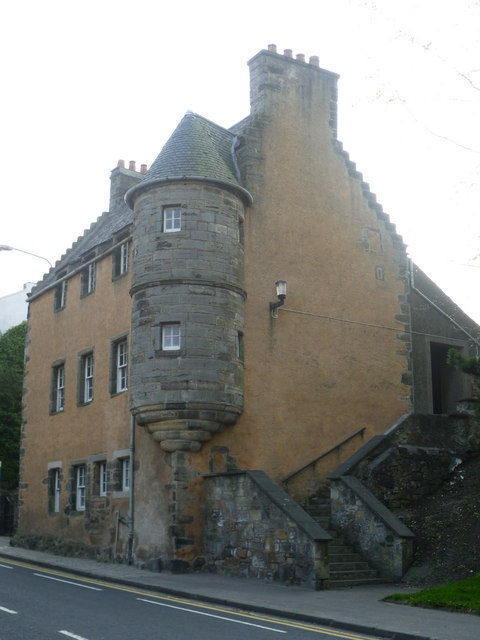
Hugh Paterson, who had his own coal workings,6 subsequently toured the Moray coal mines in Fife with Charles Stuart, and they established or renewed a chain of command with the colliers.7 Charles Stuart wrote: “I gave them two dollars, Amongst them to drink your Lordship’s good health and to be diligent in ther work and to obay ther oversman as they have promised to doe, if thay doe not obay him Killrie befor Mr Shaw, Bannockburen & I told the Coalliers he would punishe any that did not severilly”.
Charles Stuart’s letters and related papers are kept with the papers of the Earls Moray, National Register of Archives for Scotland, (NRAS) 217, box 6 nos. 120-123. Hugh Paterson of Bannockburn (died 1696) married Elizabeth Kerr in 1654, and their son “Little Hugh”, married Barbara Ruthven.8 The inventory of Moray House made by Hugh Paterson is NRAS 217 Box 5 no. 558.
Charles Stuart became the 6th Earl of Moray and built the now roofless chapel at Donibristle in 1731.9 He also rebuilt Donibristle House, sweeping away the grand staircase, dining room, and other costly interiors added to the old structure by Margaret Home and her husband in the 1630s and 1640s. His brother Francis (not the Francis in this story) was the next earl and died in 1739.
Possibly, Hugh Paterson never received the necklace mentioned in Countess Margaret’s will, it was still in Uncle Archie’s hands in 1683.
- George Sinclair and C. K. Sharpe, Letters from Archibald, Earl of Argyll, to John, Duke of Lauderdale (Edinburgh, 1829), pp. 44-51. Argyll’s letters are held by the National Library of Scotland, Adv. MS.81.1.13. ↩︎
- Hugh Paterson’s inventory of furnishings at Moray House Canongate is dated 5 May 1583, NRAS 217 Box 5 no. 558. Charles Wemyss made a transcription of this inventory during his PhD research. ↩︎
- Register of the Great Seal of Scotland, 11 (Edinburgh, 1912), p. 187 no. 372, Hugh Paterson was involved in a property transaction with Countess Margaret in December 1662. ↩︎
- Possibly the servant Anna Forest mentioned, Letters from Archibald, Earl of Argyll, to John, Duke of Lauderdale (Edinburgh, 1829), p. 36. ↩︎
- Legal advice given to Margaret Home in November 1653 included “Item, for sutch particular articles as concerns my lady hir chalmber plait quhich shee now presentlie hes, … she had good sufficient furnitour of chalmber plait according to rank and dignitie … wes sold for payment of my lord his debtis, In lieu and place quhairof this present chalmber plait wes put, … and thairfor aught to be allowit to hir as ane honorable ornament of hir awin persone”, Moray Papers 5:58, Information for My Lady Murray, 12 November 1653. Countess Margaret also transferred lands in Moray to her huband in 1652 to help pay debts incurred by the “iniquitie of the tyme”, an action which, according to a Victorian writer, earned her place among “Noble and Exemplary Wives”, Edward Dunbar Dunbar, Social Life in Former Days, 2 (Edinburgh, 1866), pp. 72–74. ↩︎
- HMC Mar & Kellie, 1 (London, 1904), p. 208. ↩︎
- For a discussion of early modern roles at Scottish coal mines, see Robert D. Tree, “Navigating Marginality: The Coal Mine Workers of Seventeenth-Century Scotland”, Allan Kennedy and Susanne Weston, Life at the Margins in Early Modern Scotland (Boydell, 2024), 145-160 at p. 150. ↩︎
- History of the Society of Writers to Her Majesty’s Signet (Edinburgh, 1890), p. 159. ↩︎
- Donibristle, Moray chapel, HES TROVE. ↩︎

