George Crawford was hired in London by the Earl of Moray in 1646 to paint at Moray House in Edinburgh’s Canongate and at Donibristle House in Fife. The Earl also hired English plasterers and joiners to work on new interiors at Donibristle in a wing built by the Scottish architect John Milne. Moray bought furnishings from the merchant John Clerk, who was invited to Donibristle to give his opinion on the work of the two joiners Robert Coxehead and William Gabriel.1 They argued with the Earl’s steward over the quantity of food allotted to them.
Crawford came with recommendations from the London painters and stainers, and his conditions were signed by Thomas de Critz and endorsed by Matthew Goodrick of Longacre. Crawford had an advance of £10 and the Earl undertook ‘to pay and beare the charges of the gooing and returning of the said George from and to the said citty of London unto the house or houses of the said earle in the kingdom of Scotland’.2
The steward at Donibristle got on with Crawford and praised the speed of his work in a letter to the Earl, ‘Mr Crawford is verie bissie and hath out red the best hallf of the roum’. He asked the Earl to give Crawford an allowance of money for meat and drink. It seems that Crawford was employed in the new dining room, which was panelled with pilasters and capitals. William Gabriel was paid ten shillings for each carved capital,3 and probably Crawford gilded them.
It isn’t very clear why Moray employed Crawford. His mother-in-law, Mary, Countess of Home, had employed John Sawers, an Edinburgh painter at Moray House in the 1630s. Crawford’s bill for his work at Moray House in 1646 survives. He painted the railings of the balcony blue. The gold leaf was supplied by Robert Inglis, a Scottish merchant and banker based in London who had worked for the Earl’s mother-in-law.
Mr Crafurd his note of worke done in the Canongaitt 1646, For the right hon. the earle of Murray, George Crafford his bill
Item for six chimney peces of a stone coller in oyle att 4s 6 pence a pece £1-7s
Item for culloring 3 leaden pottes of a stone coller in oyle att halfe a crowne a pece comes to 8s.
Item for painting a seat with greane in oyle being in the garden 4s-10d
Item for painting the bellconie of an aser blew in oyle £4-10s-0.
And in gould 5 englisch bookes
And foure others containg all 9 bookes
And as also comes to 15s, The somme of this bill is £7-12s-5d.
This was all satisfactory, and Crawford came back to Scotland in 1650 and 1653. By now the Earl and his Countess had built a banqueting house at Donibristle with a black white marble chequered floor and an insalubrious name ‘the butyaird hous’. Moray and his wife owned a number of Italian-style chairs which they had bought in London and were probably similar to the survivors now loosely associated with Francis Cleyn. Crawford freshened some of these up for banqueting house and painted others green for the garden.
The house was raided by English soldiers during the battle of Inverkeithing (20 July 1651) and Crawford had to make good some damage. An inventory records that the troops took a painting of ‘rats and cheese’ from the staircase and stole several embroidered chair covers.
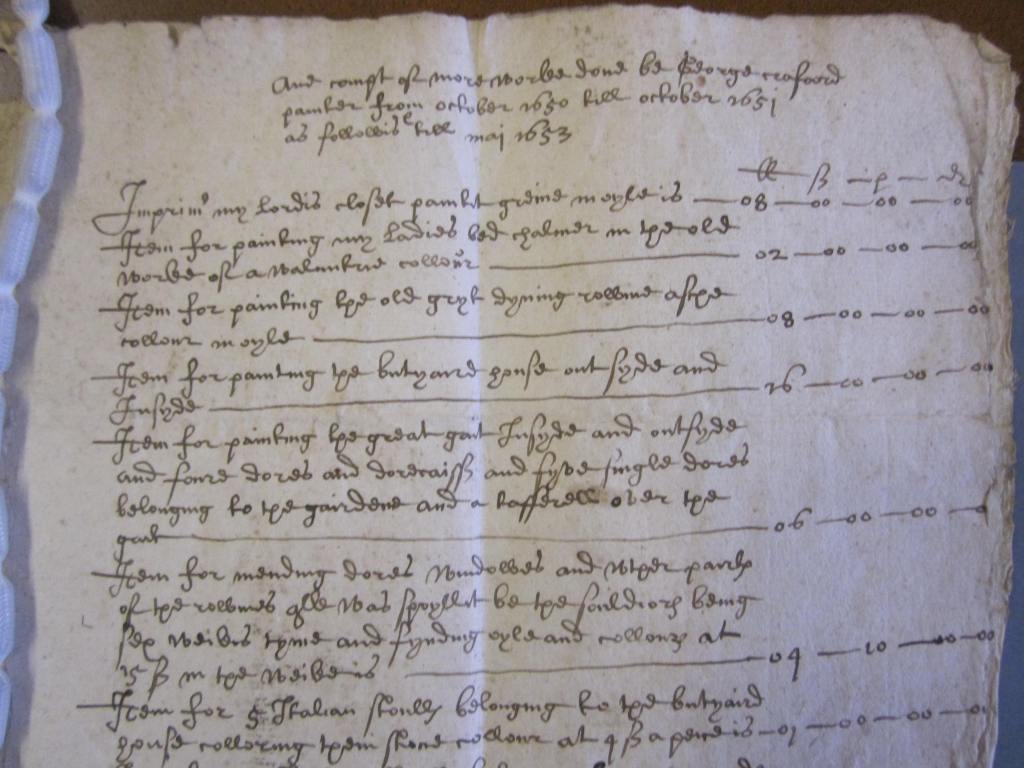
Crawford’s bill (NRAS 217 5:1207), transcribed below, and the other sources mentioned above reside with the papers of the Earl of Moray.
Crawfurd paynter his accompt and agriement
Ane compt of more worke done be George Craford painter from October 1650 till 1651 as followis till mai 1653
Imprimis my lordis closet paintit greine in oyle is £8-0-0-0
Item for painting my ladies bed chalmer in the old worke of a walnutrie collour, £2
Item for painting old gryt dining rowme asche collour in oyle, £8
Item for painting the butyard house outsyde and insyde, £16
Item for painting the great gait insyde and outsyde and foure dores and dorecaiss and fyve single dores belonging to the gairdene and a tafferell over the gait, £6
Item for mending dores windowes and wther pairts of the rowmes qlk was spoylled be the souldiers being six weikes tyme and fynding oyle and collours at 15s in the weike is, £4-10s.
Item for 5 Italian stoulls belonging to the butyaird house colloring them stone cullour at 4s a peice is, £1
Item for 14 Italian stoulls belonging to the garden culloring them greine a 5s a piece is, £3-10s
Item for the thrie seattis belonging to the garden painting them greine with armes and siphers at 30s a piece is, £4-10s
Summa £53-10s-0-0
- Moray wrote to John Clerk, ‘my Inglishe joyneris are heir making readie my closet within ten dayes or fortnight, I will advertise yow to come over that I maye have your advyse in some things’, NRS GD18/2489, 9 August 1649 ↩︎
- NRAS 217, 5:283, 27 March 1646, Articles of agreement betwixt the earle of Murraye and George Craford painter, March 1646. ↩︎
- The contracts with Gabriel and Coxehead for joinery at Donibristle are NRAS 217 5:945, 18 May 1644 (dining room); 5:1191, 1 June 1647 (staircase and crimson room), and 5:814, 1 August 1649 (old dining room, closets, and ‘butyard hous’). ↩︎
 Objects and the archive
Interesting. Could Crawford have been a Scot in London or of Scottish descent? The surname occurs in both countries.
LikeLiked by 1 person
Yes, that seems possible, I should have called the blog, “George Crawford, a Scottish painter-stainer in London and his sojourn in Fife”. These people may have worked for the mother-in-law, Mary, Countess of Home (died 1644), at her house in Aldersgate.
LikeLike