John Workman or Warkman was a prominent artist in Edinburgh. He painted scenes for the Royal Entry of Anna of Denmark in May 1590 and decorated her coach in 1603 when she left for England, and his brother James made and painted a board for the game of the goose for James VI.
John Workman died of the plague on 31 October 1604. An inventory was made of his possessions, which included 12 ‘broddis’ (possibly pictures or play boards), 4 pounds of colours worth 20 shillings, yellow orpiment, and azure.1 The orpiment was useful for the yellow in Stewart heraldy, and was commonly mixed with indigo for the green leaves in the painted ceilings popular at this time.2
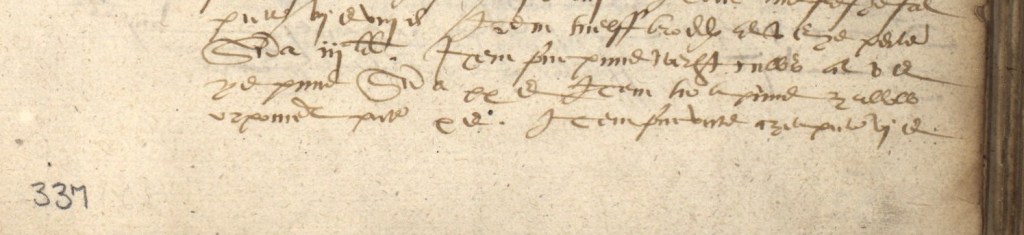
It’s hard to find evidence of where painters like John Workman bought their colours. Sometimes wills record debts to apothecaries, and the stock lists of apothecaries can include lines that might serve as pigments. On 5 June 1600, a court of the bailies of Edinburgh found against John Workman for not paying £14-5s for “certain colours” supplied by a merchant, Archibald Geddes younger, in December 1599. That sounds like a lot of paint. The payment had been due by Fasterins Even, or Pancake Day
Archibald Geddes senior died in 1612, but his will isn’t very informative about their business. Many other merchant wills include helpful lists of merchandise. Geddes junior doesn’t seem to have left a will, and is mostly recorded in family papers as a lender of large sums. So, some further research is needed here. Perhaps John Workman anticipated some large contract and made arrangements with Geddes for his colours.
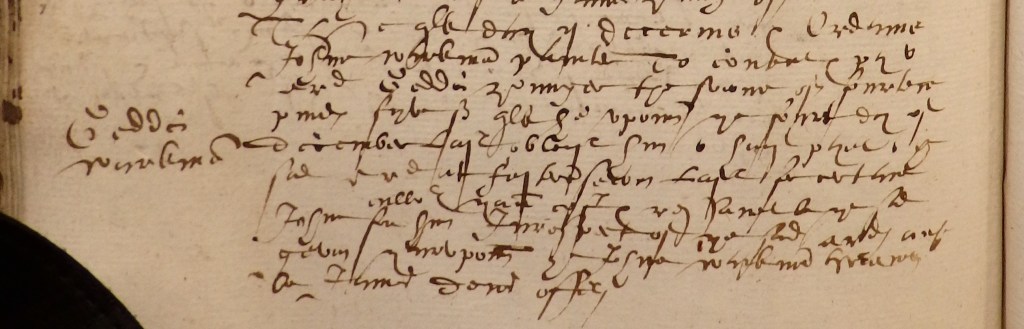
The Register of Decreets case entry reads, as far as I can make it out: “Geddes, Warkman: The q[uhi]lk day [5 June 1600] decernes & ordanes Johne Warkman painter To content & pay to Ar[chibal]d Geddes younger the soume of fourtene punds fyve s[hillings] qlk he upoun the fourt day of December last oblist him to haif payet to the said Ard at fasterins even last for certane [left blank] culloris then cost & ressavit be the said Johne fra him, In respect of the said Ardis aith geven thairupoun …”
- Michael Apted & Susan Hannabuss, Painters in Scotland: A Dictionary (Scottish Record Society, 1978), pp. 108, 110-111, 132, 135, 145: TA 1602, “for painting and causing mak the brod quhilk his maiestie pleyis at, callit the guse”. ↩︎
- Michael Pearce, “Paint”, in Moses Jenkins, Building Scotland (Edinburgh: John Donald, 2010), pp. 92-93, 96, 99: Karen Dundas, “Painted ceilings: their significance on the Royal Mile and wider context”, Michael Cressey, “Riddle’s Court, Lawnmarket, Edinburgh: a merchant’s house fit for a king”, Scottish Archaeological Internet Reports, 102 (2023), pp. 43–52. ↩︎
 Objects and the archive
Very interesting. Could ‘broddis’ mean piborders i.e. frames?
LikeLiked by 1 person
Well, can’t be sure. I would think they were panels, painted or not yet painted, for something he made and sold regularly. At least we know he made a board for the Game of the Goose, but he may have more often made funeral hatchments, as he did for the Bonnie Earl of Murray. Here is Brod n.2 Dost/Dsl with lots of ideas: https://dsl.ac.uk/entry/dost/brod_n_2
LikeLike