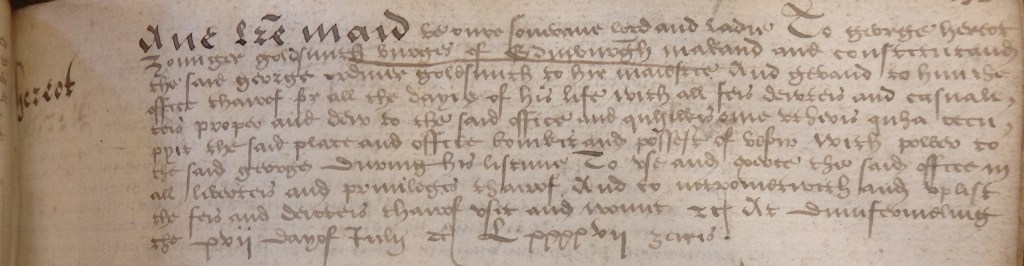
Birrel’s Diarey (sic), an important source for Edinburgh’s early modern history, and published as long ago as 1798, says that George Heriot was appointed as goldsmith to Anna of Denmark on 27 July 1597, and proclaimed by trumpet in this role at the Mercat Cross. He displaced a French craftsman “Clei”. Heriot’s appointment is also recorded in the register of the privy seal, held by the National Records of Scotland.

Before “Clei”, Anna employed Jakob Kroger from Lüneburg as her goldsmith. He ran away to England in May 1594 with some of her jewels and a French footman and stablehand from Holyrood called Guilliaume Martyn.1 According to John Carey, who interviewed him, Kroger was “the Queenes owen jueler a Dane” and the “Dane was the quenes jueler and mad[e] moste of her jeuelles himselfe and had the kepinge of moste of them”.2
The jewels taken by Kroger included a bag of red buckram tied with white tape containing gold studs and aiglettes for a gown, a ring like a belt set with a diamond, two wings or rings for a gown sewn with pearls, the nether skirt of an old black satin gown, a pair of blue taffeta sleeves, white taffeta from the lining of a garment, and two pieces of carnation coloured satin. The lists show that Kroger’s role involved embellishments and fasteners for clothing and the day to day costuming of the queen.3 Her household at first included several Danish or German speaking servants, including her tailor Paul Rey and master of wardrobe Søren Johnson.4
“Clei”, the name given only by Birrel, seems to be a misreading for “Elias” or “Elei”. The French goldsmith Elias le Tellier was established in Edinburgh’s Canongate as a goldsmith by 1594, and was later described as the queen’s goldsmith. The Italian writer Giacomo Castelvetro was a customer and a friend. They kept in touch after Castelvetro left Edinburgh in August 1594 to work for Christian Barnekow in Denmark.5
Castelvetro wrote to “Seigneur Elie, mon bon amy” when he was travelling on to Nyköping in February 1596. He had ordered a ring in Edinburgh and bought textiles, presumably from the goldsmith’s wife, the silkwoman Hester des Granges. The Master of Whittinghame, the “Monsr de Wtingiam”, had brought the goldsmith’s bill to Castelvetro in Copenhagen. Castelvetro mentions letters from Ambrosius Lerice, an author and merchant based in Gdansk, and the prospector Eustachius Roche.6
Moving in these circles brought Elias into contact with the English ambassador in Edinburgh, Robert Bowes. In August 1597, Bowes asked Robert Cecil to entrust Elias with the £100 reward money which Queen Elizabeth had offered to Andrew Knox for tackling Hugh Barclay of Ladyland at Ailsa Craig. Elias was travelling to London with Bowes’ messenger Christopher Sheperson.7
Elias le Tellier was the queen’s goldsmith in 1597, and continued to work in Edinburgh. He was still described as a goldsmith to the Queen’s Majesty in 1600. He probably worked with or for George Heriot, and in 1603 he moved to London and was located at Charing Cross in 1613.8
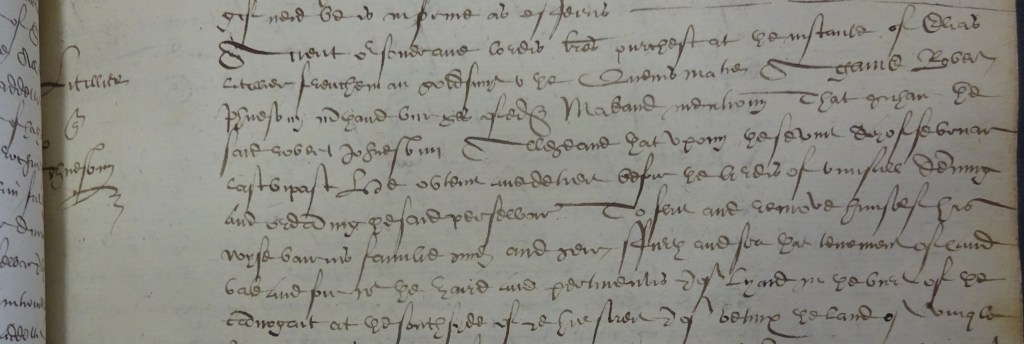
The family connections of Elias le Tellier were described by Mary Edmond and Winifred Coutts.9 Edmond inferred that the family had been in Edinburgh in the 1590s. Coutts worked through court registers in the National Records of Scotland for the year 1600. She found two records of Elias Litillier or Littleyear, who was based in Edinburgh’s Canongate. One was a long-running dispute with an Edinburgh goldsmith James Crawfurd,10 the other case with Elias’ Canongate landlord Robert Johnston who had sought to evict him and his family.11
Winifred Coutts noted these cases for the apparent xenophobia, where foreign craftsmen, even with royal patronage, were at a disadvantage in disputes with local craft colleagues and other citizens. William Schaw, the chamberlain of Anna’s Dunfermline estates, had intervened in the dispute with James Crawfurd in March 1595.
Anna of Denmark promoted the interests of artisans who served her. In April 1592, she requested that a Flemish confectioner, the sugarman Jacques de Bousie, be made a burgess and guild brother of Edinburgh. The burgh council sent a delegation to Dalkeith Palace to argue against this.12
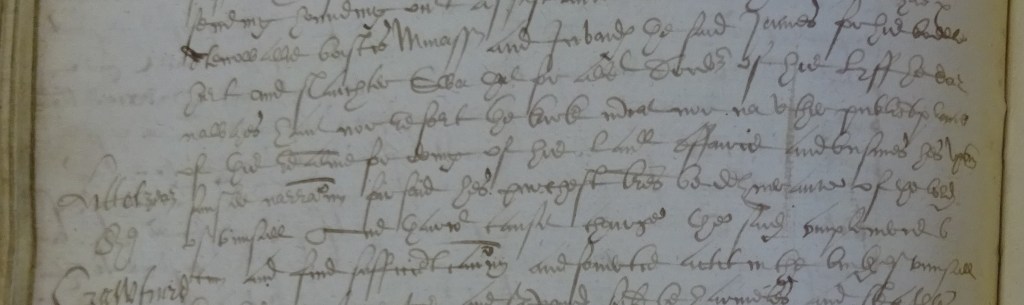
Crawfurd had made the serious allegation that the French goldsmiths had menaced him, to the extent that he was afraid to go church, “swa that for [terror / dreadour] of his lyff he dar nawayes hant nor resort the kirk, mercat, nor na uther publick place”.13 The cause of their feud was not recorded here, but other registers may hold further information.
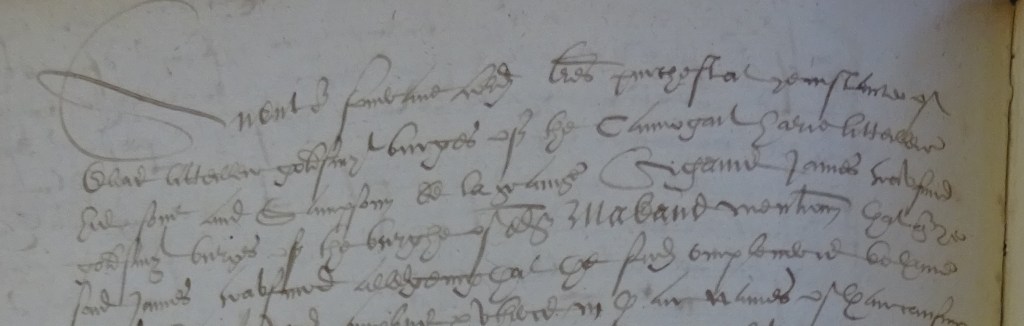
The Crawfurd case confirms the family connections. Elias worked with his son Harry, and a colleague Samson des Granges.14 His wife is not mentioned by name in the Edinburgh these court records. Robert Johnston tried to evict Elias’ “wyfe, bairns, familie, guids, and geir”, and obtained an order for them to remove and flit. She was Hester or Esther des Granges, later recorded as a silkwoman to Anna of Denmark.15 In 1603, after the Union of the Crowns, she delivered “diverse parcels of lawn, cambric, needlework, purls, bone lace” and other materials to the lady in waiting Jane Drummond.16
The Canongate house was a “back and fore, with the yaird and pertinents, … at the south syde of the hie streit [Royal Mile], … the land of umqle [deceased] Johne Cairnis on the eist, … the strand [Abbey Strand] on the south and the kingis hie streit to the north”. The lords of council ordered the keys to be delivered to Elias’ lawyer James King.17 John Cairns, a kirk minister, had died in 1595.18
Samson des Granges (died 1635) seems to have been a goldsmith colleague of Elias and Harry le Tellier, although the record of Crawfurd case does not specify his trade. His son, born in London in 1611, was the miniature painter David des Granges, and Hester was David’s godparent and presumably an aunt.19 In May 1649, David and Judith Hoskins des Granges named their Edinburgh-born son Samson des Granges.20 They had at least four other children, baptised in London.
Judith Hoskins was perhaps a relation of the miniature painters John Hoskins and Samuel Cooper, and though this relationship is unclear it is often cited for the career choice of David des Granges. Miniature portraits were made in Edinburgh the 1590s, and burgh court records mention relatively inexpensive examples painted on paper and housed in gold “tablets”.21
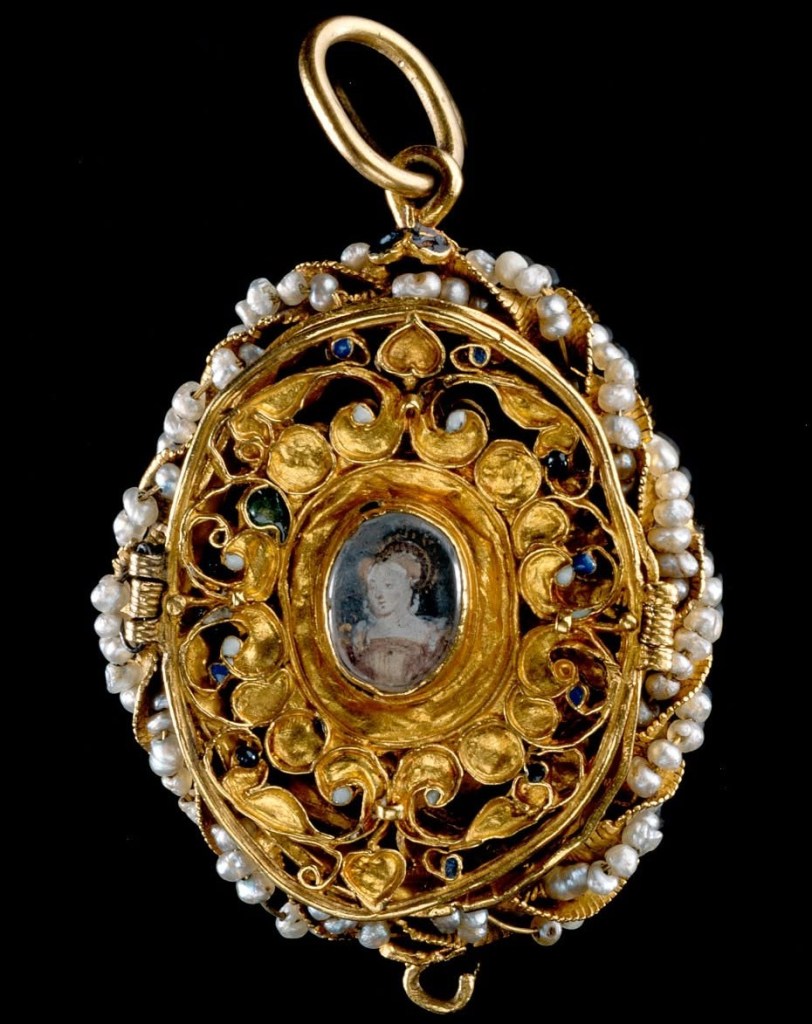
Four oval enamelled gold pendant lockets thought to be Scottish and made to hold miniatures and a further pair of small portraits survive from the 16th century. These unmarked pieces are dated only by association with Gillis Mowbray who joined the household of Mary, Queen of Scots, in England in 1585, and on stylistic grounds the historian Diana Scarisbrick suggested a date nearer 1600. The lockets have been associated with “gold frames for pictures” mentioned in the bills of George Heriot.22
- Annie I. Cameron, Calendar State Papers Scotland, 11 (Edinburgh, 1936), p. 342 no. 267: Mary Anne Everett Green, Calendar State Papers Domestic, Addenda 1580-1625 (London, 1872), pp. 364-5, TNA SP15/33/30-32. ↩︎
- Joseph Bain, Border Papers, vol. 1 (Edinburgh, 1894), p. 538: SP 59/29 f.97. ↩︎
- Calendar State Papers Domestic, Addenda 1580-1625 (London, 1872), pp. 364-5, 368: TNA SP 15/33 f.32, SP 15/33 f.46. ↩︎
- Jemma Field, “Dressing a Queen: The Wardrobe of Anna of Denmark at the Scottish Court of King James VI, 1590–1603”, The Court Historian, 24:2 (2019), pp. 155–156. ↩︎
- For Castelvetro in Denmark see, Anders Toftgaard, “Battles of Books in Denmark”, Jonas Nordin, Peter Sjökvist, Gustavs Strenga, The Baltic Battle of Books: Formation and Relocation of European Libraries in the Confessional Age (Brill, 2023), p. 221: Anna Maria Segala, “Machiavelli’s Belfagor in seventeenth century Denmark”, inTRAlinea (2019), and Chiara Franceschini, “Nostalgie di un esule. Note su Giacomo Castelvetro (1546-1616)”, Cromohs, 8 (2003). ↩︎
- TNA, SP 89/2 f.229, J. de Castelvetri to Elei le Tellier, 27 February 1596 “Herebro” (Örebro). He sends best wishes to John Fowler, twin of the poet William Fowler, who had not answered his last three letters from Copenhagen, and encloses a letter for the Edinburgh landlady of the house where he stayed after the death of his wife: For a letter from Castelvetro to Christian Barnekow, dated Örebro 26 March 1596, see Peter Wieselgren, Dela Gardiska Archivet, 5 (Lund, 1834), pp. 103-5. ↩︎
- John Duncan Mackie, Calendar State Papers Scotland, 13:1 (Edinburgh, 1969), p. 74 no. 54, TNA SP 52/61 f.23: Christopher Shepherdson was mentioned in the will of Castelvetro’s wife, Isotta de Canonici, Henry Meikle, Works of William Fowler, 3 (Edinburgh, 1914), p. cxxx: British Library Harley 7004, f.21. ↩︎
- David Masson, Register of the Privy Council of Scotland, 10 (Edinburgh, 1891), pp. 130, 142, Elias and his spouse “Eister Tailyeour”. ↩︎
- Mary Edmond, “Limners and Picturemakers”, Walpole Society, 47 (1978-1980), pp. 123-124: Winifred Coutts, The Business of the College of Justice in 1600 (Stair Society, 2003), pp. 64, 70, 73. ↩︎
- National Records of Scotland, CS7/186, ff.120v-121r. (9 January 1600), which twice refers to an earlier legal act in the same feud dated 20 March 1595 involving William Schaw. ↩︎
- National Records of Scotland, CS7/190, ff.12r-12v. ↩︎
- Marguerite Wood, Extracts from the Records of the Burgh of Edinburgh: 1589-1603 (Edinburgh, 1927), p. 64: Jacques de Bousie was involved the confectionery served at the baptism of Prince Henry at Stirling Castle in August 1594, Miles Kerr-Peterson and Michael Pearce, “King James VI’s English Subsidy and Danish Dowry Accounts, 1588–1596”, Miscellany of the Scottish History Society, XVI (Woodbridge, 2020), p. 80. ↩︎
- Winifred Coutts, The Business of the College of Justice in 1600 (Stair Society, 2003), p. 70 citing NRS CS7/186, f.120v. ↩︎
- National Records of Scotland, CS7/186, f.120v. ↩︎
- Jemma Field, “Clothing the Royal Family: The Intersection of the Court and City in Early Stuart London”, Peter Edwards, Monarchy, the Court, and the Provincial Elite in Early Modern Europe (Brill, 2024), p. 251: John Nichols, Progresses of James the First, 3 (London, 1828), p. 541. ↩︎
- Sarah A. Bendall, The Women Who Clothed the Stuart Queens: Gender and Work in the Royal Wardrobe and the Fashion Marketplace (Bloomsbury, 2026), pp. 74, 139, 221. ↩︎
- Archaeological finds from this area, at the site of the Scottish Parliament buildings, are described in, Simon Stronach, Adrian Cox, Derek Hall, Stephen Carter, “Archaeological Evidence from the Parliament Site”, Scotland’s Parliament Site and the Canongate: Archaeology and History (Edinburgh, 2008), pp. 17-57. ↩︎
- Steven W. May and Alan Bryson, Verse Libel in Renaissance England and Scotland (Oxford, 2016), p. 276. ↩︎
- William Moens, Registers of the French Church, 1 (Lymington: Huguenot Society, 1896), p. 81: A summary of the French church registers (noting the attendance of George Heriot and members of the Harderet family) was given by Lionel Cust, “Foreign Artists of the Reformed Religion”, Proceedings of the Huguenot Society of London, (1903), pp. 80-81. The surname “Des Granges” occurs on Guernsey. ↩︎
- Canongate, 29 May 1649, to David Desgrange painter and Judeth Desgrange, a s[on] n[amed] Sampsone, w[itnesses] Jon Patersone baillie, Mr Robert Leslie, Robert Murray. National Records of Scotland, old parish registers 685/3 Canongate, p. 306. ↩︎
- Edinburgh City Archives, ECA SL234/1/5, Register of Decreets, 1598-1602, 1 July 1600, “… ane taiblet of gold inamellit with Reid with ane pearle, ane taiblet of gold sett with pearle haiffing ane cristell, & ane with ane pearle & ane litill paintet pictour of paper sett thairin, ane uther taiblet of gold with ane cristell stane & paintet paper all thrie of the weycht of ane unce & seven drop weycht at twentie aucht punds the unce Laid in wed be Margaret Cuik to Cristene Hog the spous of Alexander Auld for thrie scoir ten punds [£70] … ” ↩︎
- George R. Dalgleish, in Rosalind K. Marshall and George R. Dalgleish, The Art of Jewellery in Scotland (Edinburgh: HMSO, 1991), p. 19: Lyndsay McGill, “Scottish Renaissance Jewels in the National Collection”, Anna Groundwater, Decoding the Jewels: Renaissance Jewellery in Scotland (Sidestone, 2024), pp. 111-117. ↩︎
 Objects and the Archive