An array of household lists were made after the death of Anna of Denmark, for accounting wages and payments. One of them (TNA SP 14/107 f.124) allots extra reward payments and gives lengths of service. It mentions Edward Ashburner, yeoman of the leash (15 years service), Richard Polhill (15 years), yeoman of bows and lymehounds, the groom Salamon Cole (8 years), and Hans Popillman who was Anna’s Danish cook for 30 years.
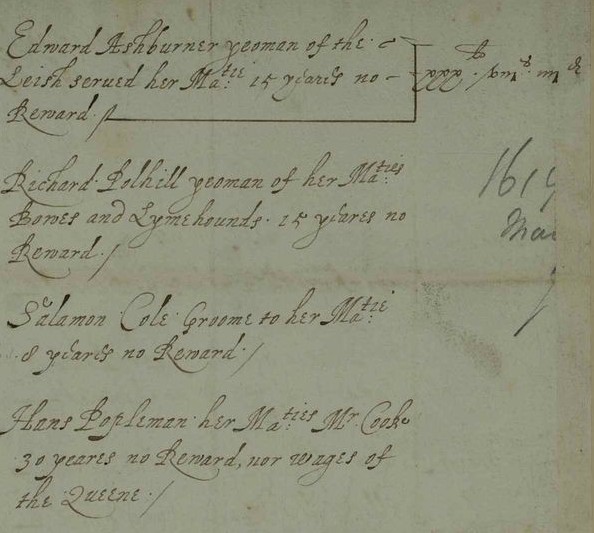
The groom ‘Salamon Cole’ was not the French garden designer Salomon de Caus, or a groom of the privy chamber, but a groom of the bows, and Richard Polhill’s junior. Solomon Cole rode to Penshurst from Woodstock in August 1616 carrying a letter from Robert Sidney, Anna’s chamberlain.1 At Anna’s death, Cole was allocated a pension of £15.2 Another source, a petition, identifies Solomon Cole as the queen’s bow bearer. From Liss in Hampshire, he was bow bearer or groom of bows and lime hounds to Henrietta Maria from 1626.3
Richard Polhill had been the keeper at Penshurst’s deer park. He was one of the unseasonal ‘outragers in the park’ mentioned by Rowland Whyte in May and June 1600. Susan Pittman has described the ensuing Star Chamber case.4 Despite their differences, it seems Robert Sidney, as Anna’s chamberlain, got him a new job in 1603/4.
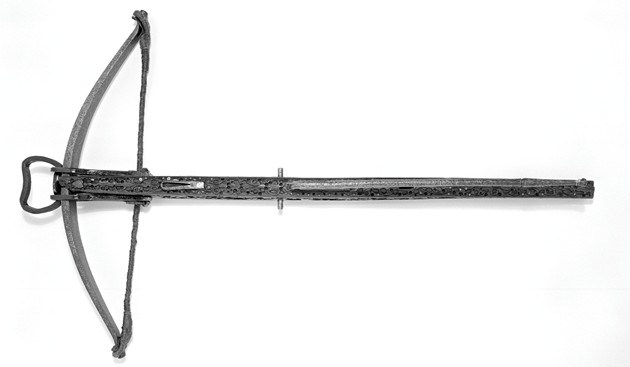
Like Solomon Cole, Richard Polhill carried letters to Barbara Sidney at Penshurst.5 Polhill baptised his own daughter Barbara in 1593.6 He died in 1618, and was a grandfather and probably around the same age as Robert Sidney. Polhill’s family was from Shoreham and Otford. Sidney was steward of the manor of Otford from 1587, and these two men had a long association. After Polehill’s death, his family kept a bow for many years at Philpots near Tonbridge. According to tradition the ‘curiously studded and enamelled’ bow or crossbow had been Queen Elizabeth’s.7
While Anne of Denmark may have given a crossbow to Richard Polhill, the bow could have come to Philpots by another route. Polhill had married the heiress of Philpots, Sindonie Childrens or Childerne, and her relation (probably her uncle) Robert Children of Tonbridge (died 1592) was Yeoman of the Crossbows or Master of the Crossbow to Elizabeth I. Robert Children’s house in Tonbridge was called Mountains. According to his will, he left ten shillings to his grandson to buy bows and arrows, and twenty shillings to Arthur Children, perhaps a brother of Sindonie.8
The Philpots crossbow may have been like those that James sent to Spain with a couple of lyme hounds. Glasgow Museums has a bow of a similar type engraved with Queen Elizabeth’s heraldry.9
Richard Withers was also a yeoman of the queen’s bows and keeper of the forest of Dowles and Chute at St Mary Bourne in 1611. Halfway between Winchester and Newbury, it was railed and stocked with deer. Anna may have hunted there in 1603 or on her progresses to Bath. Anna’s jointure lands included the manor of Newbury, the lodge at Dowles belonged to James. She visited nearby Hurstbourne Park in August 1613.10
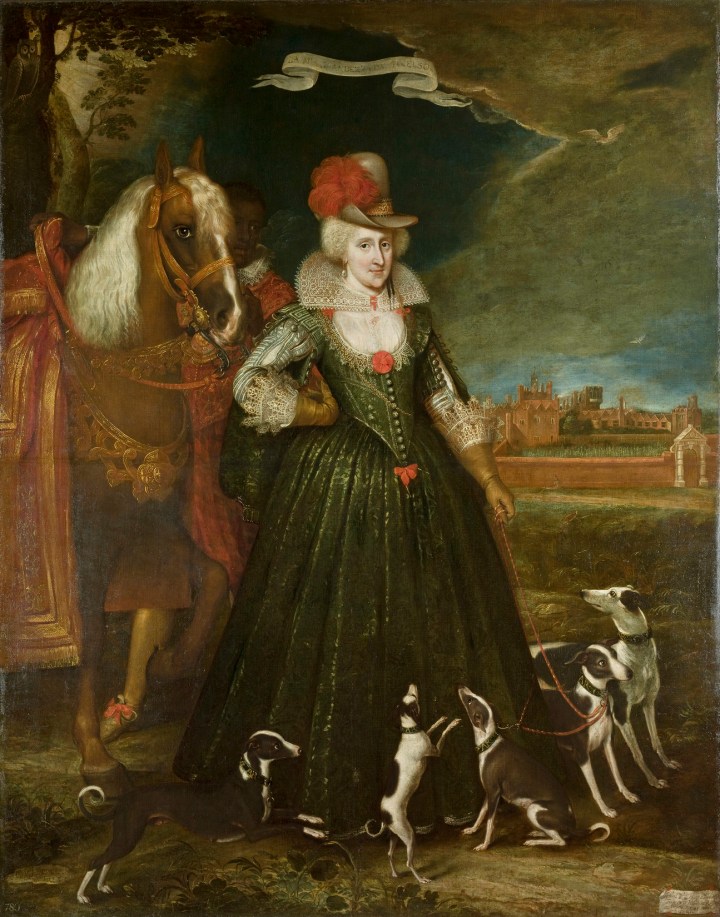
Presumably, the lyme hounds flushed out the deer (or hares) to bring them within range of Anna of Denmark’s bow and her notably small hounds. Richard Polhill’s 1580s marriage to Robert Children’s niece or relative Sindonie, and his subequent appointment to Anna of Denmark’s household, can be taken as an indication that her hunting practice in England was similar to Queen Elizabeth’s.
It must a been a very bad day at Theobalds for Polhill and Cole when Anna ‘mistook her mark’ and accidentally shot the ‘Kings most principall and speciall hound’.11
- William Shaw & G. Dyfnallt Owen, HMC Manuscripts of the Viscount De L’Isle, vol. 5 (London, 1962), p. 408. ↩︎
- TNA SP 14/109 f.96, Notes of the decision of Council relative to the disposal and pensioning of the late Queen’s household, 23 May 1619. Richard Polhill is not included in this list. ↩︎
- James Edwin-Cole, The Genealogy of the Family of Cole, of the County of Devon (London, 1867), p. 30: John Bruce, Calendar State Papers Domestic, 1625-1626 (London, 1858), p. 558: Francis W. Steer, A Catalogue of the Earl Marshal’s Papers at Arundel Castle (London, 1964), p. 31 no. 297, Petition of Solomon Cole, bow-bearer to her Majesty; see also Richard Cust, Andrew Hopper, ‘240 Garter v Cole’, in The Court of Chivalry 1634-1640, British History Online https://www.british-history.ac.uk/no-series/court-of-chivalry/240-garter-cole [accessed 24 September 2026]: John Bruce & William Douglas Hamilton, Calendar State Papers Domestic, 1638-1639 (London, 1871), p. 185. ↩︎
- Michael Brennan, Noel Kinnamon, Margaret Hannay, The Letters of Rowland Whyte to Sir Robert Sidney (Philadelphia, 2013), p. 495: Susan Pittman, “Elizabethan and Jacobean deer parks in Kent”, University of Kent at Canterbury PhD, 2011, pp. 77, 159, 285-290. ↩︎
- HMC Report on the Manuscripts of Lord de L’Isle & Dudley Preserved at Penshurst Place, 4 (London, 1942), p. 37. ↩︎
- Leland L. Duncan, ‘Extracts from Lost Kentish Registers: Leighe’, Archaeologia Cantiana, XXXI (London, 1915), p. 182. ↩︎
- Edward Hasted, The History and Topographical Survey of the County of Kent, 5 (Canterbury, 1798), p. 225. ↩︎
- Dustin M. Neighbors, “Elizabeth I, Huntress of England”, The Court Historian, 28:1 (April 2023), pp. 62, 78: George Armytage, Visitation of Kent (London, 1906), p. 135: PROB 11/80/135, will of Robert Children, Yeoman of Tonbridge, Kent: TNA REQ 2/253/38, Pollhill v Stace. Plaintiffs: Richard Pollhill and Sindonie Pollhill, 1589: An Edward Children worked as a servant for John Stace of Moorden, Leigh. The Stace and Children families disputed lands left by Sindonie’s father William Children. ↩︎
- Claude Blair, “Arms and Armour from Spain”, The Connoisseur, 146 (August 1960), pp. 16-26. ↩︎
- TNA SP 14/64 f.64, petition of Richard Withers, the Queen’s Yeoman of the Bows and Keeper of the Forest of Dowles: Emanuel Green, ‘The Visits to Bath of Two Queens’, Proceedings of the Bath Natural History and Antiquarian Field Club, 7 (1893), p. 216. ↩︎
- Norman McClure, Letters of John Chamberlain, 1 (Philadelphia, 1939), p. 469. ↩︎

