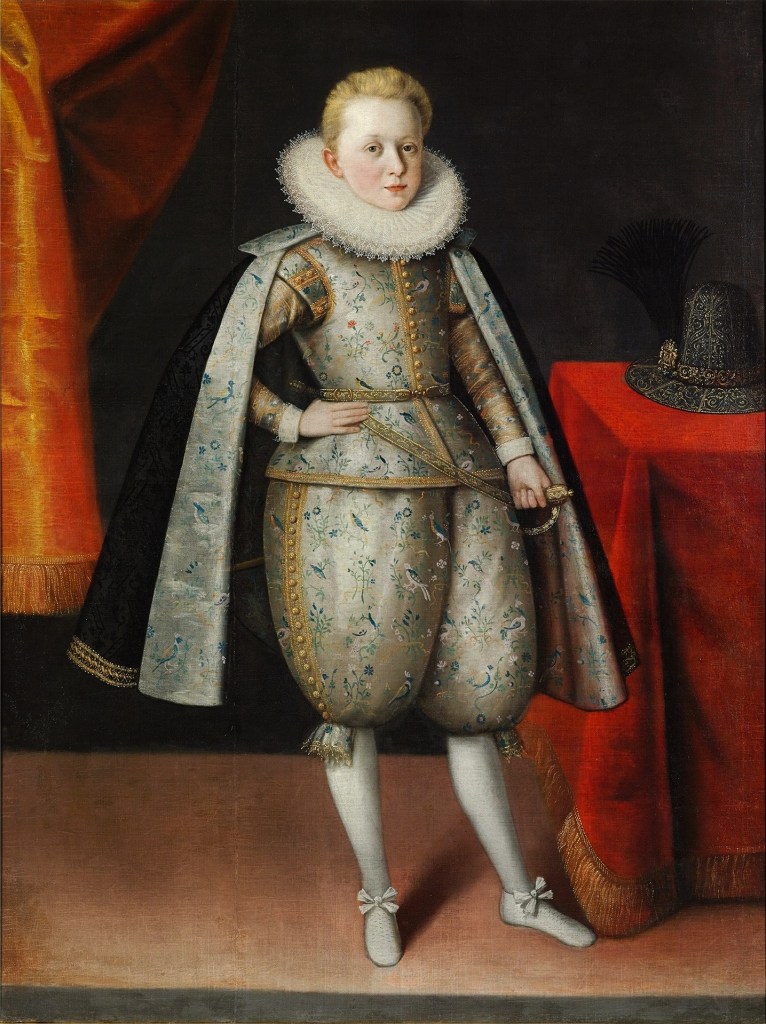
William Bruce was a diplomat in Poland, and wrote letters with news to Robert Cecil.1 King James gave him a yearly allowance of £100 in May 1604.2 Bruce became involved in a plan to send a portrait of a Polish prince (Władysław IV Vasa) to Anna of Denmark in 1608. Bruce’s draft letters explain the picture was really for Princess Elizabeth, who might someday marry the Polish prince.3
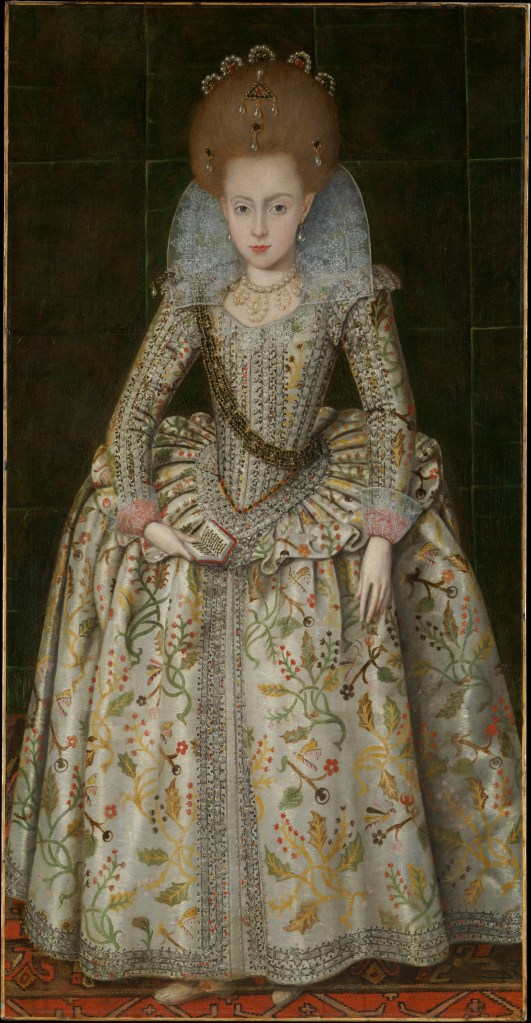
Princess Elizabeth (1596–1662), Later Queen of Bohemia, ca. 1606
The Metropolitan Museum of Art, New York, Gift of Kate T. Davison, in memory of her husband, Henry Pomeroy Davison, 1951 (51.194.1)
http://www.metmuseum.org/Collections/search-the-collections/437263
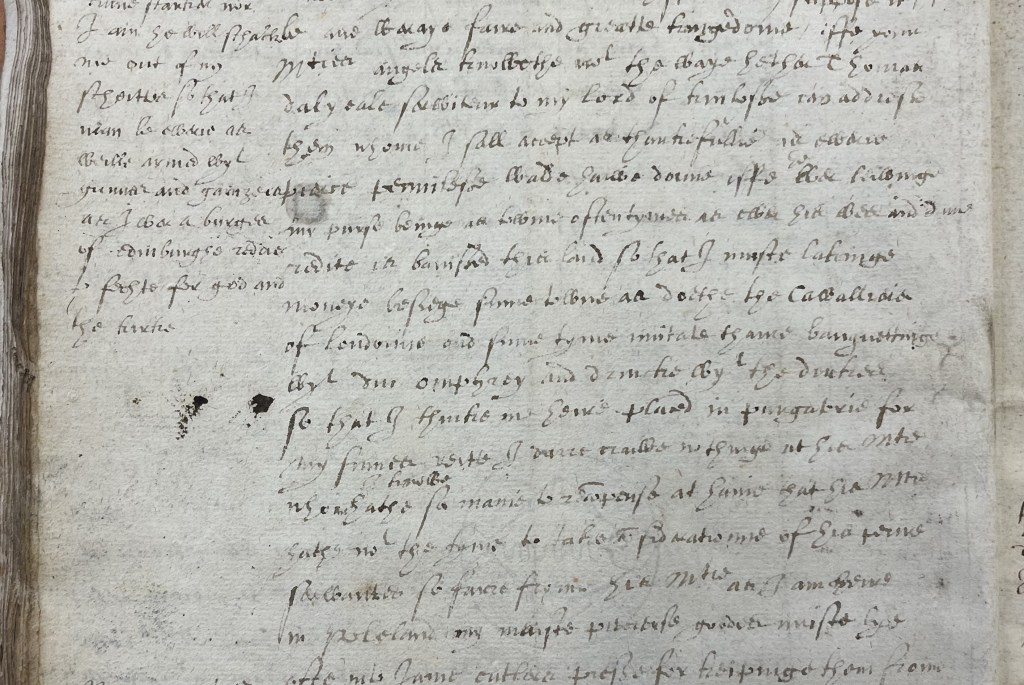
William Bruce wrote to Anna of Denmark, “I wrote to your Majesty latterly, a letter to recreat your Majesty in your melancholy and saturnial humour, and now to your Majestie, in remembrance of my true devotion to her Majesty’s service, I write by this bearer letting your Majesty to wit that I have procured this young prince his portrait for your Majestie, which your Majesty shall receive with the latest London ships godwilling, they mean here the estate of his father being settled that he shall be indeed one suitable to our Lady Elizabeth your Majesties daughter”
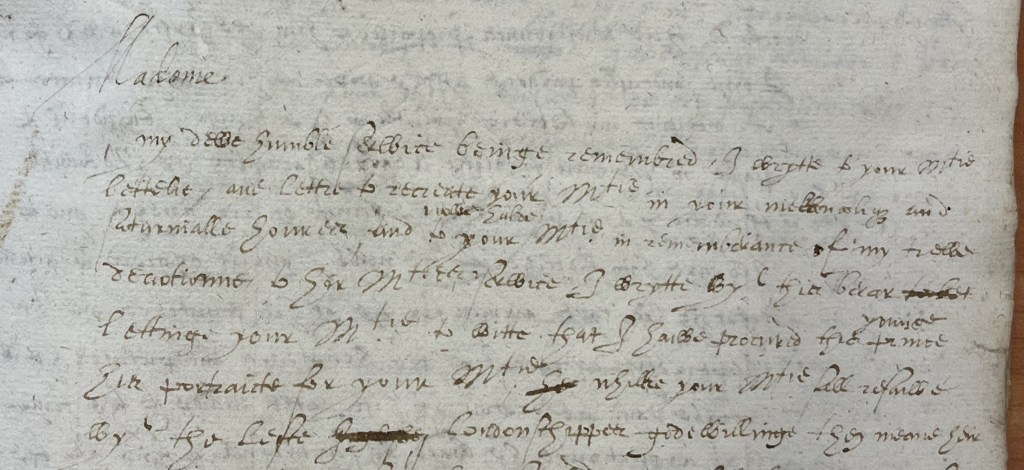
Bruce took the opportunity of this correspondence to ask Anna of Denmark to send him money, as living in Gdansk and travelling to the Polish court at Warsaw and eleswhere was costly. He wrote about this in comic terms which suggest some level of familiarity, and he may have visited Anna in Dunfermline in the 1590s. Bruce mentions a royal servant, the poet John Murray,4 and Thomas Dalyell, a servant of Edward Bruce, Lord Kinross, who could help deliver the queen’s gold angels.
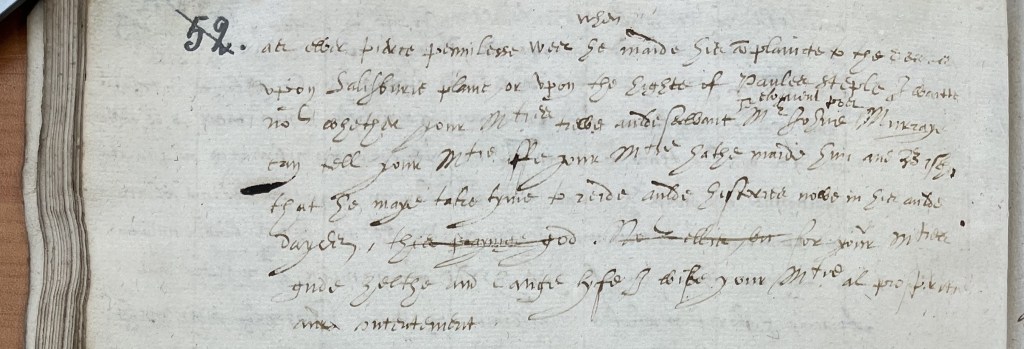
In his comic moments Bruce invokes Pierce Penniless twice, as the Thomas Nashe character, and the presumption Anna of Denmark recognises these references may be interesting.
“Madame I am scarce of moneye as ever pierce penniless wes when he made his complainte to the devill upon Salisburie plaine or upon the highte of Paules steple I wiette nocht whether your Mties trewe auld servant & eloquent poet Mr Johne Murraye can tell your Mtie iffe your Mtie hathe maide him ane Bischop that he maye take tyme to reide aulde histories nowe in his aulde dayes”
And, in another passage ‘dining with Duke Humphrey’:
“iffe your Mties angels knowethe nocht the waye hethar Thomas Dalyeale sarviteur to my Lord of Kinlosse can addresse them whom I sall accept as thankfully as evare pierce pennilesse walde hawe donne iffe he wer leivinge my purse beinge as towme [empty] often tymes as ever his were and [my] credite is banished this land so that I muste lakinge moneye besiege some towne as doethe the Cavallrais of Londonne and sume tyme imitate thame banquettinge wyth duc omphrey and drinke wyth the deukes so that I thinke me heire placed in purgatorie for my sinnes”
Amber portrait jewels
William Bruce’s journal or diary including his draft letters and accounts is held in Gdansk.5 Many thanks to a colleague for sending pictures. Text from the journal regarding miniature portraits encased in amber which Bruce sent to Anna of Denmark and her lady-in-waiting Jane Drummond (later Countess of Roxburghe) has been transcribed by Felix Manczak, who translated the excerpt into German for display in the current Berlin DHM exhibition, “Objects. History. Stories Reviewing the Collections” (08.05.2026 – 31.10.2027).
Bruce sent an amber portrait of King James to Anna of Denmark, and promised to send similar miniatures to her children Henry, Charles, and Elizabeth. He would commission an amber jewel depicting Anna, if he had a suitable picture to serve as a model. A jewel depicting Anna’s mother, Sophie of Mecklenburg, and her brother Christian IV was not as good, “not so curiously made as the other”, so Bruce sent this double portrait to Jane Drummond.6
A similar object, a contemporary heart-shaped amber foil-backed miniature depicting Elizabeth I, the other Elizabeth, has recently been rediscovered, and is described in this Sotheby’s lot essay, Master Sculpture from Four Millennia, Live Sale 1 July 2026, lot 246. It used to be thought the white-coloured image of Queen Elizabeth set in amber was made of ivory. It may be fashioned in white amber.7
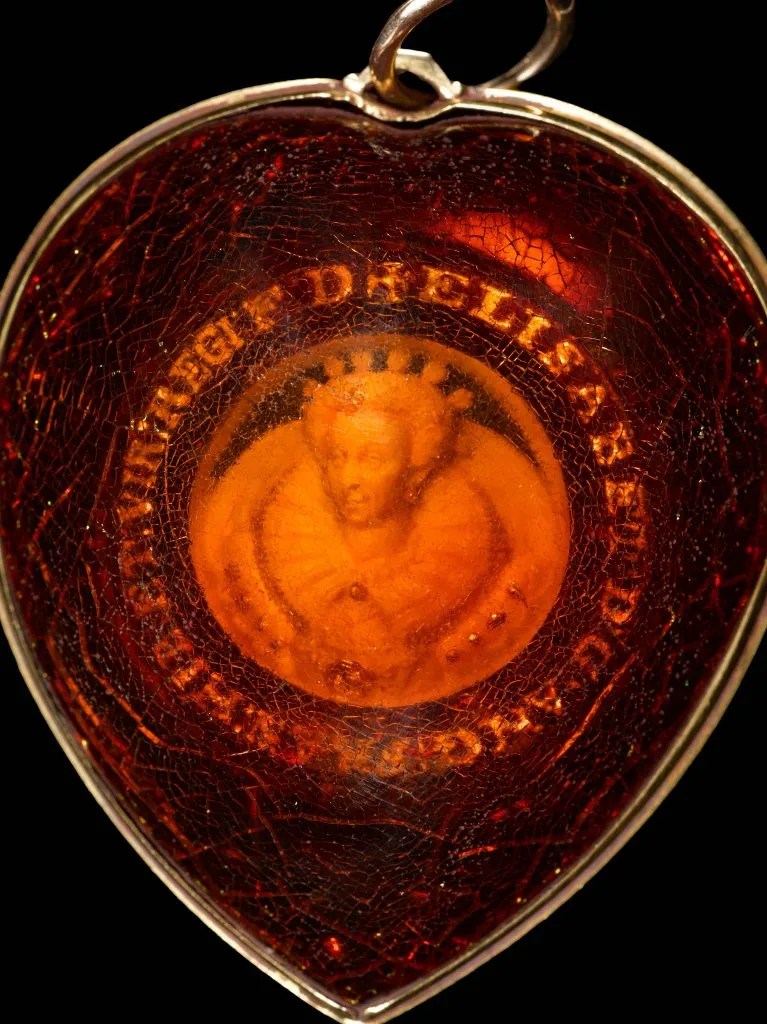
Amber seems to have been a popular choice for jewellery and the hafts of knives by the mid-sixteenth century. An Italian recipe book, the Secreti del reverendo donno Alessio Piemontese (Venice, 1555), includes two methods for making imitation amber from turpentine and gum.8 Henry Wotton described testing suspect amber in a letter of June 1633.9
Cardinal Cajetan’s jewel
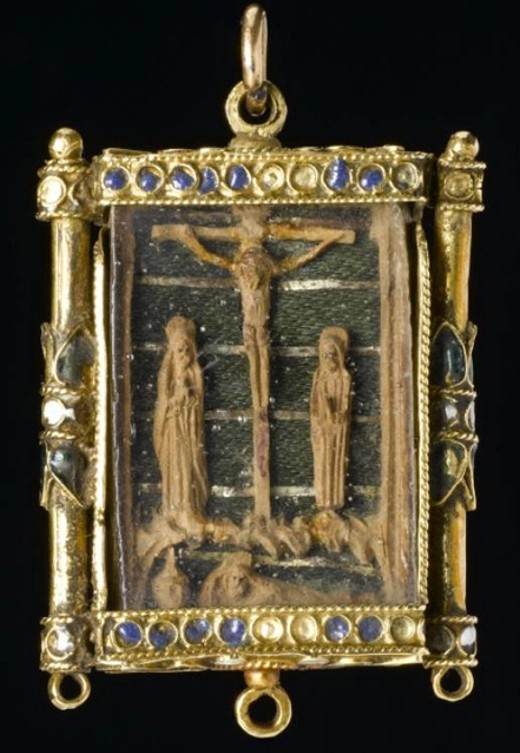
Another jewel story has an oblique connection, worth a quick digression. Cardinal Enrico Caetani (Cajetan) was Cardinal Protector of the English and Scots nation and legate a latere in Poland in from 1596 to 1597. He received amber gifts from Sigismund, and may have commissioned more.10 Before his posting, in March 1595, his agent Father John Myreton or Morton (a brother of the laird of Cambo near Kingsbarns, and a brother-in-law of Robert Dennistoun, Conservator of the Scottish Staple) brought a little square jewel or “tablet” of gold with a depiction of the crucifixion in ivory or bone set under crystal or glass to the Scottish court. Myreton was arrested at the Port of Leith and his papers were seized.
King James gave the crucifixion jewel, with its chain suitable for wearing, to Anna of Denmark. Judging from the inventory of her collection in England, she shared an interest in the imagery of the passion with her Danish siblings.11 The English diplomat Robert Bowes and others reported this incident, and Christian Barnekow in Denmark also heard about the gift. Father Myreton said he received the jewel from Cajetan in Rome and was instructed to give it to a suitable noble woman in Scotland. There is no indication that the crystal of this tablet was yellow amber, and the date of this particular gift predates Cajetan’s time in Poland. He may have continued to commission and send gifts to noble women.12 There was talk of torturing Myreton with the “boot”. He was released and made his way safely to Brussels by October 1596.13
The descriptions of Cajetan’s “square” crucifixion jewel resemble a locket said to have been a gift from Mary, Queen of Scots, to Thomas Andrews, Sheriff of Northampton, in 1586, now in the collection of the National Museums of Scotland, except that James VI was supposed to have joked that he could not kiss the jewel without kissing the thieves depicted in the tiny scene. The NMS jewel, in pearwood, does not include the thieves.
Robert Shirley in Poland
Bruce recorded the arrival of the beardless Robert Shirley speaking in Italian to the Polish Parliament:
“Mairover heire is received ane ambassador frome Persia called Robert Shirley youngest son to Sr Thomas Shirl, 8 Martij, who is to entreate al Christian princeis to make weare against the Turke he is a younge man without ane bairde but a man of ane excellent airte he had his narration before this kinge in Italiane in Parliament, whiche was holden so weille spoken that this kinge dide ordaine him to be at his charges als longe as he sall remaine into Poleland”
William Bruce was also a correspondent of the Danish diplomat Christian Barnekow.15 There is a biography of William Bruce in the University of St Andrews SSNE database
Continue a Puritan?
According to the letter book, the portrait of the Polish prince was received in London, delivered by Alexander Abercromby,16 and Bruce wrote to one of Anna’s ladies (presumably Jane Drummond) on 30 June 1609, “I am very glad the picture is come to her Majesties hands, I had meikle ado or I could have it, and at the last it were sent down to the country to me from the court to be send to her Majestie, but I being on the way to the court, so it were delivered to another who send it with one of his friend’s piece in my name as he said to me.”
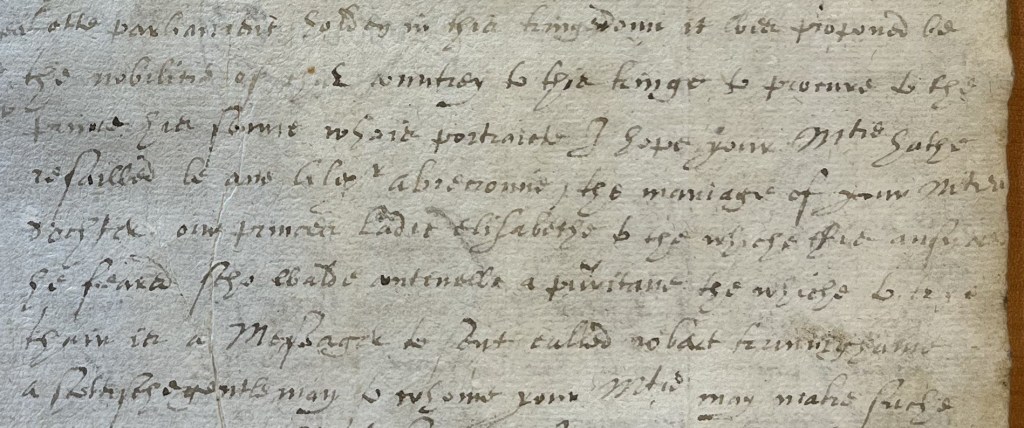
Bruce had reported the major stumbling block for an Anglo-Polish royal marriage was religion, the Polish nobles noted Elizabeth was a Protestant, and a Scottish agent, Robert Cunningham, was coming to London to make enquiries if “she would continue a Puritan”. Bruce thought it would be a good match, if Sigismund III Vasa’s invasion of Russia was a success.
A poet and pages in the household: Who was Mr John Murray the poet?
Bruce’s journal mentions Anna’s “trewe auld servant & eloquent poet Mr Johne Murraye”. This was Mr John Murray (died April 1615)17 a poet and a cousin of David Murray of Gorthy, the poet and keeper of Prince Henry’s purse.18 This poet was possibly mentioned by Alexander Montgomerie as “Murray myne”.19 There is much confusion over his identity. The issues seem unresolved: here are some details and references.
William Bruce may have met Anna’s servant Mr John Murray, while he was a member of her Scottish household. Jane Drummond was also a member of the household at Dunfermline Palace,20 and Bruce may have become reasonably familiar with the queen’s household on a return visit to Scotland.
A “Mr John Murray” signed receipts from the treasurer in 1601 (as “Mr”, as Anna’s servitour). A John Murray, who was a page of honour to James VI, also signed treasury receipts in 1597. A page of honour “to their majesties” called John Murray served at the baptism of Prince Henry in 1594.21 It is unclear how many John Murray identities were at court.
Another “Mr John Murray” who was active in the intrigues of Francis, Earl of Bothwell, in November 1592, has also been connected with Montgomerie’s Murray. This John Murray kidnapped Lord Lindsay’s tailor and son. He may have been the John Murray mentioned by Robert Bowes, as the brother of a James Murray, a follower of Bothwell captured in April 1594.22
In 1599, another John Murray was valet to Prince Henry at Stirling Castle and keeper of his coffer keys under Sir Patrick Murray, and was subsequently valet to Charles at Dunfermline Palace. He wasn’t a very close relation to the Murray cousins, David and John the poets, but was the grandson of James V’s barber.23
A John Murray was rewarded for bringing James VI the first news of the birth of Prince Charles at Dumfermline.24 This could have been Mr John Murray, servant of queen, rather than the valet, who would have still been at Stirling with Henry in 1600. He may therefore have been the poet friend of Bruce.
Some of these household roles are given by biographers to John Murray (died 1640), later Earl of Annandale. Annandale was perhaps the “page of the chamber” in Anna of Denmark’s 1597 household roll, while in the same year a John Murray, page of honour to the king, signed a receipt. Pages like the valets and other servants could change their roles and join other households.25
Below, three John Murray signatures from the receipts known as “exchequer vouchers” at the National Records of Scotland:
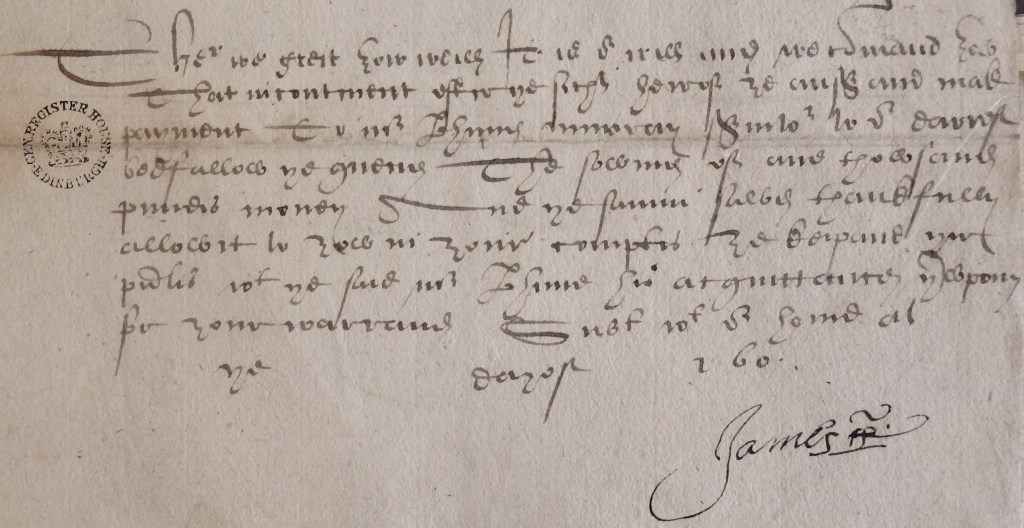
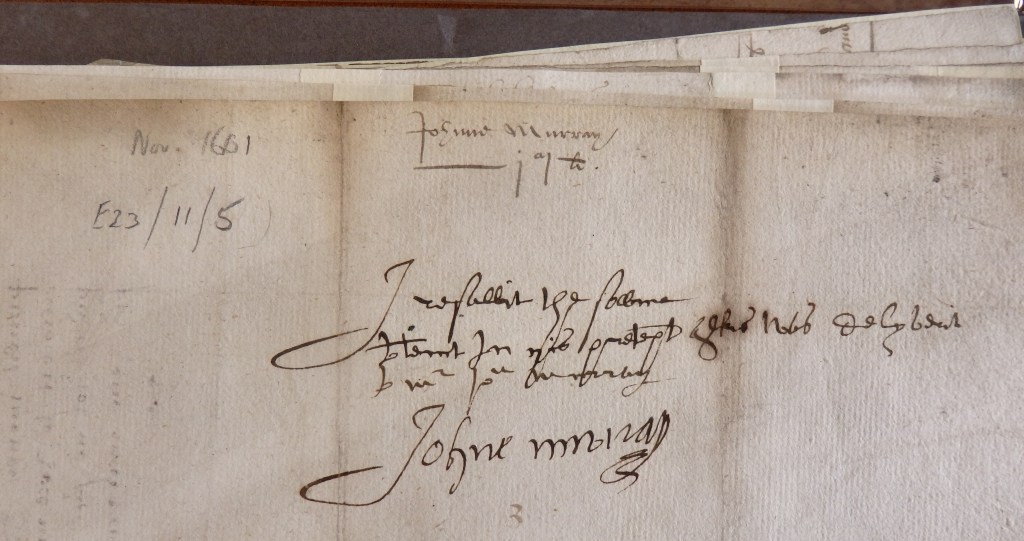
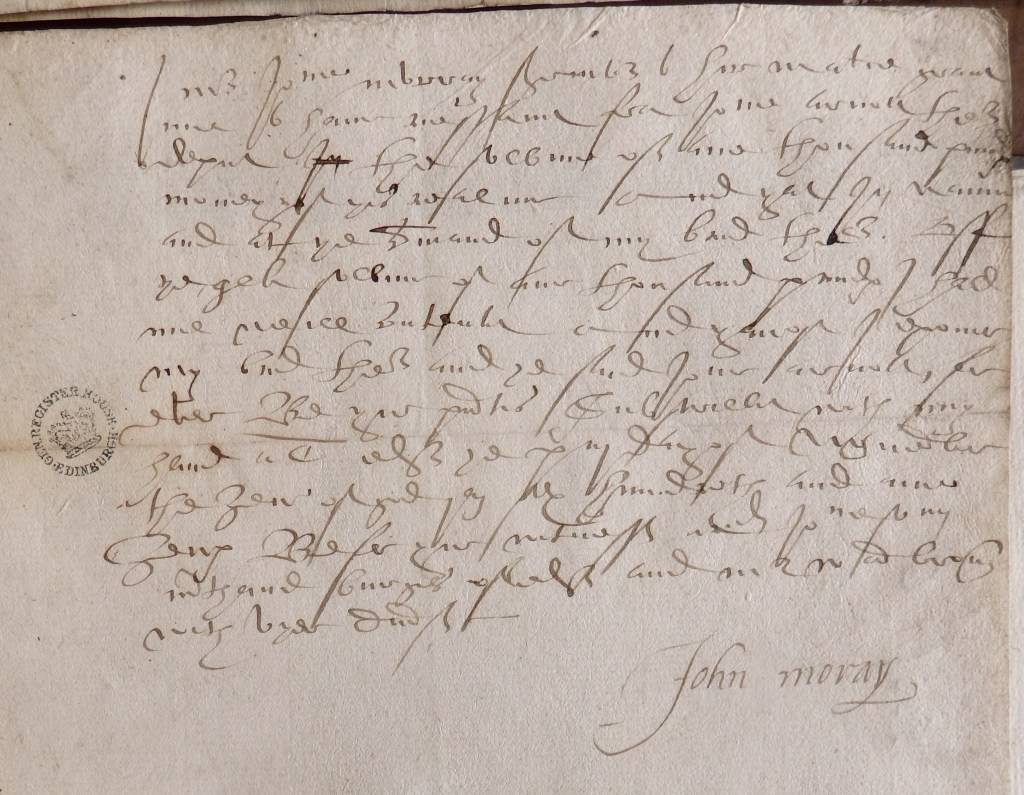
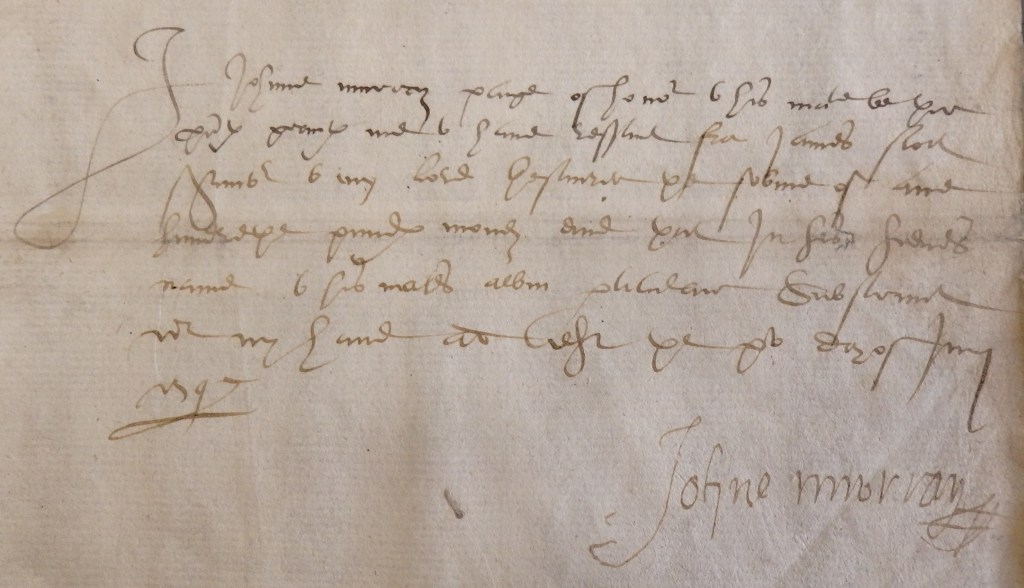
- Anna Bieganska, “The Learned Scots in Poland: from the Mid-Sixteenth to the Close of the Eighteenth Century”, Canadian Slavonic Papers, 43, 1 (2001), 18-19. ↩︎
- Frederick Devon, Issues of the Exchequer: Pell Records (London, 1836), 12. ↩︎
- Rachel King, “Post‑medieval European Ambers in Britain, Tankards in the British Museum, and the Biographical Data of Seventeenth‑Century Bernsteindreher in Königsberg”, Porta Aurea, 23 (2024), p. 81 fn. 26. ↩︎
- “Mr John Murray” signed a receipt as the queen’s servitor in November 1601, (NRS E23/11/5), as a poet (and the confusion regarding his exact identity), see Helen M. Shire, Song, Dance and Poetry of the Court Under King James VI (Cambridge, 1969), 182-186. ↩︎
- J. K. Fedorowicz, England’s Baltic Trade in the Early Seventeenth Century Trade: A Study in Anglo-Polish Commercial Diplomacy (Cambridge, 1980), 17: Archiwum Państwowego w Gdańsku, sign. APG 300 R/Rb. ↩︎
- SG-0759, “Journal” (excerpt) of the envoy William Bruce, Warsaw, 1607: Reproduction, Transcription and German translation: Felix Manczak, Berlin. Danzig, Archiwum Państwowego w Gdańsku (Gdańsk State Archive): APG 300 R/Rb, S. 36 recto DHM Berlin, Objects. History. Stories. Reviewing the Collection, Pei Building, Ground floor. ↩︎
- Catalogue of bronzes and ivories of European origin, exhibited in 1879 (London: Burlington Fine Arts Club, 1879), p. 61 no. 377. ↩︎
- Michele Nicole Robinson & Sophie Pitman, “Imitation of amber and pearls”, Paula Hohti, Refashioning the Renaissance: Everyday dress in Europe, 1500-1650 (Manchester, 2025), 201-208. ↩︎
- Logan Pearsall Smith, Life and Letters of Henry Wotton, 2 (Oxford: Clarendon, 1907), p. 346. ↩︎
- Tomasz Grusiecki, “Locating the Material: Prussian Carved Ambers, Place Ambiguity and a New Geography of Central European Art”, German History, 41:3 (September 2023), 444–471: Tomasz Grusiecki, “Foreign as native: Baltic amber in Florence”, World Art, 7:1 (2017), 3-36 citing, Elżbieta Mierzwińska, “Bursztynnictwo”, Aurea porta Rzeczypospolitej: Sztuka Gdańska od połowy XV do końca XVII wieku (Gdańsk, 1997), 147. ↩︎
- Jemma Field, “Anna of Denmark and the Politics of Religious Identity in Jacobean Scotland and England, c. 1592-1619”, Northern Studies, 50 (2019), p. 106. ↩︎
- Maureen M. Meikle, “Once a Dane, Always Always a Dane? Queen Anna of Denmark’s Foreign Relations and Intercessions as a Queen Consort of Scotland and England, 1588-1619”, Sara Ayres, The Court Historian, 24:2 (August 2019), 174: Maureen M. Meikle & Helen M. Payne, “From Lutheranism to Catholicism: The Faith of Anna of Denmark (1574–1619)”, Journal of Ecclesiastical History, 64:1 (2013), 52: Annie I. Cameron, Calendar State Papers Scotland, 11 (Edinburgh, 1936), pp. 557, 559-61, 565-66, 569-70: Peter Wieselgren, Dela Gardiska Archivet, 5 (Lund, 1834), 121 as “ex auro, crystalle, ebore Dominicae passionis”: HMC Calendar of the Manuscripts of the Marquis of Salisbury, 5 (London, 1894), 123, 125: Thomas Birch, Memoirs of the Reign of Queen Elizabeth, 1 (London, 1754), 223–25, adds that Myreton was schooled with Dr. Thomas Morison, author of Liber novus de metallorum causis et transsubstantiatione (Frankfort, 1593). ↩︎
- Thomas M. McCoog, The Society of Jesus in Ireland Scotland and England (Ashgate, 2012), 174–176, 241. ↩︎
- Double sided pendant ‘jewel’ containing carved pearwood biblical scenes: NMS. ↩︎
- Peter Wieselgren, Dela Gardiska Archivet, 5 (Lund, 1834), 109: Lund Universitetsarkiv, Breve til Christian Barnekow (1556-1612). ↩︎
- Possibly Alexander Abercromby, later grand falconer to Charles I. Robert Abercromby, the Jesuit, was also said to be a royal falconer. ↩︎
- Allison L. Steenson, The Hawthornden Manuscripts of William Fowler and the Jacobean Court (Routledge, 2011), p. 68, (& p. 171 apparently Annandale): Priscilla Bawcutt, “James VI’s Castalian Band: A Modern Myth”, Scottish Historical Review, 80:210, Part 2 (October 2001), 256: Works of William Drummond: Familiar Epistles (Edinburgh, 1711), 150-151: John Murray who graced the Muses’s band died in April 1615, and does not feature in a March 1616 list of Anna’s household, TNA SP 14/86 f.180. ↩︎
- Helen M. Shire, Song, Dance and Poetry of the Court Under King James VI (Cambridge, 1969), 184-186. ↩︎
- Sebastiaan Verweij, The Literary Culture of Early Modern Scotland (Oxford, 2016), 212: Roderick J. Lyall, Alexander Montgomerie: Poetry, Politics, and Cultural Change in Jacobean Scotland (Arizona, 2005), 222, 226: David J. Parkinson, Alexander Montgomerie, Poems, 2 (STS, 2000), 69. ↩︎
- Walter W. Seton, “The Early Years of Henry Frederick, Prince of Wales, and Charles, Duke of Albany”, Scottish Historical Review, 13:52 (July 1916), 370. ↩︎
- John Murray, page of honour in 1594, attended the baptism of Prince Henry in Stirling, “Fyrst for Jhone Morraye Harye Levingston James Douglas and Archibald Morraye pages of honour to thair majesties ~
Item 20 ellis blew vellvot and 20 ellis grene vellvot to be thame cloikis doublets and hois at 14 li the ell __ vc iijxx li. …”, NRS E35/13 (section 7). ↩︎ - David J. Parkinson, Alexander Montgomerie, Poems, 2 (STS, 2000), 69: Calendar State Papers Scotland, 10 (Edinburgh, 1936), p. 801 no. 769: Calendar State Papers Scotland, 11 (Edinburgh, 1936), p. 325 no. 257. ↩︎
- National Records of Scotland, Registers of the privy seal: PS1/70 f.9r., 2 July 1599; PS1/71 f.363v., 13 February 1601: Walter W. Seton, “The Early Years of Henry Frederick, Prince of Wales, and Charles, Duke of Albany”, Scottish Historical Review, 13:52 (July 1916), 370. ↩︎
- Extracts from the treasurer’s accounts, in Letters to King James the Sixth from the Queen, Prince Henry, Prince Charles, the Princess Elizabeth and her husband Frederick King of Bohemia, and from their son Prince Frederick Henry (Edinburgh: Bannatyne Club, 1836), lxxviii. ↩︎
- National Records of Scotland, GD16/31/6 (1), household rolls of Anna of Denmark, as a page of her chamber. ↩︎
 Objects and the Archive