Mary Mildmay Fane, Countess of Westmorland, wrote letters to her daughter Grace Fane, Countess of Home, discussing her health and hopes of pregnancy.1 Grace lived in Scotland at Dunglass Castle. As noted in the catalogue of the Moray Papers, the six surviving letters include some court news and a few lines of code or cipher. Some of the the coded passages relate to possible embarrassment involving Grace’s mother-in-law Mary, Countess of Home.2 One ciphered passage gives discrete advice for a fashionable linen headdress to conceal her daughter’s hair loss.
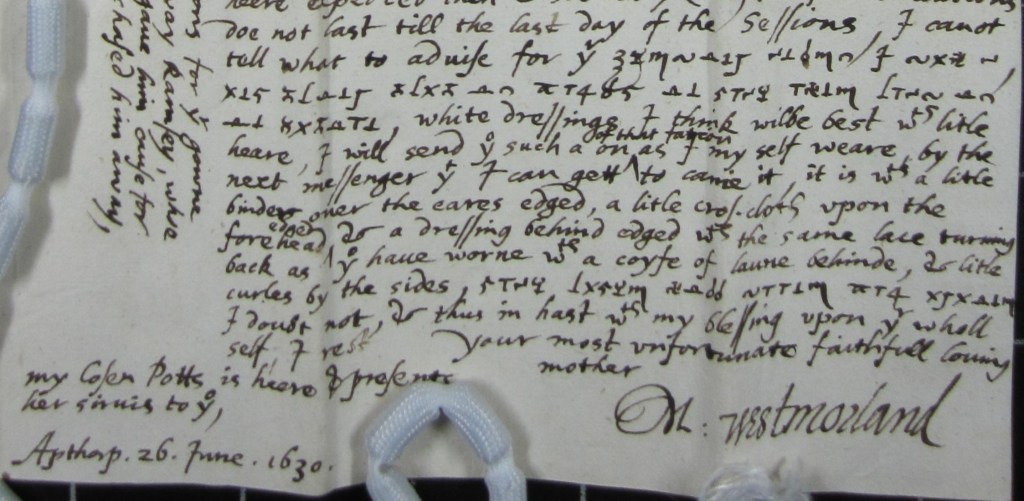
The same letter discusses the movements of Jane Drummond, Countess of Roxburghe, and the education of Grace Fane’s younger sisters Rachel, Frances, and Catherine Fane. The suggestion appears to be that if Drummond were appointed a royal governess, it would be an opportunity for Grace’s sisters to be placed with her. One of the sisters could join Grace in Scotland and be a comfort to her.
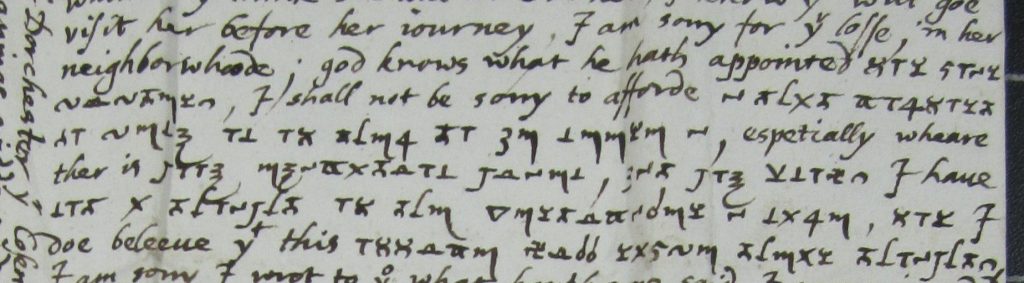
The Countess of Westmorland used her mother Grace Mildmay as a model of fortitude and patience for her daughter, recalling her stories of childbearing; “I beseech you be not dismayed at it if you should not proove with child at this time, remember how harte your good grand-mother ‘my mother’ was, when god tried her patience by withholding soe long the fruit of the woumb from her, & sending her many things els which she could well have been without, I pray god you may never meete with soe many inconveniences as that good woman did, but if you doe, I beseech him to indue you with the like patience & wisdom”.
She hoped that if Grace were pregnant she would return to Apethorpe. She wasn’t an admirer of what she heard of Scottish midwives or the advice of David Arnot, an Edinburgh doctor, and was also sceptical of advice given to her by Dr Leonard Poe in London. She sent a note of her own ‘conceits’ for childbirth and ‘a direction how women should be ordered; both in ther travaile & child-bed’. These don’t seem to survive, but some of her material was included in the Moray recipe books (partly transcribed, here, researchgate).
The Countess of Westmorland consulted Richard Napier in April 1627 apparently in the belief that her daughter was pregnant.3 She continued to argue for Grace to return to Apethorpe if she became pregnant. Her line of reasoning isn’t always very clear, especially when expressed in the cipher, as in this letter of 22 April 1631.
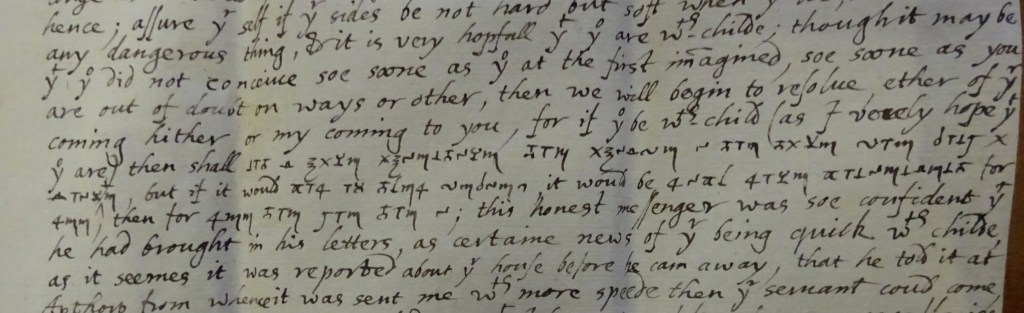
“… assure yourself if your sides be not hard but soft when you lie, it cannot be be any dangerous thing, & it is very hopfull that you are with childe, though it may be that you did not conceive soe soone as you at the first imagined, soe soone as you are out of doubt on ways or other, then we will begin to resolve, ether of your coming hither or my coming to you, for if you be with child (as I verily hope that you are) then shall NOT I DARE ADVENTER TOE ADVISE U TOE TAKE FOR LONGE JOURNE, but if it would COM ON THEM SELUES it would be MUCH MORE CONVENIENT for MEE, then for MEE TOE GOE TOE U; this honest messenger was soe confident that he had brought in his letters, as certain news of your being quick with childe, that he told it at Apthorp, from whence it was sent me, with more speede than your servant could come for that occation with a very joyfull hart, which hart will always be ready (as sad as it is) to receive such news ioyfull, …”
The Countess of Westmorland began her April 1631 letter with news of the death of the Marchioness of Winchester from complications following an abcess in the mouth, which I’ve described in another post.
An earlier letter from March 1627 has a line of extra plain text near the address, which was a mystery to me until I worked out the code in all six letters, and realised this was an attempt at deciphering text from the letter of April 1631.
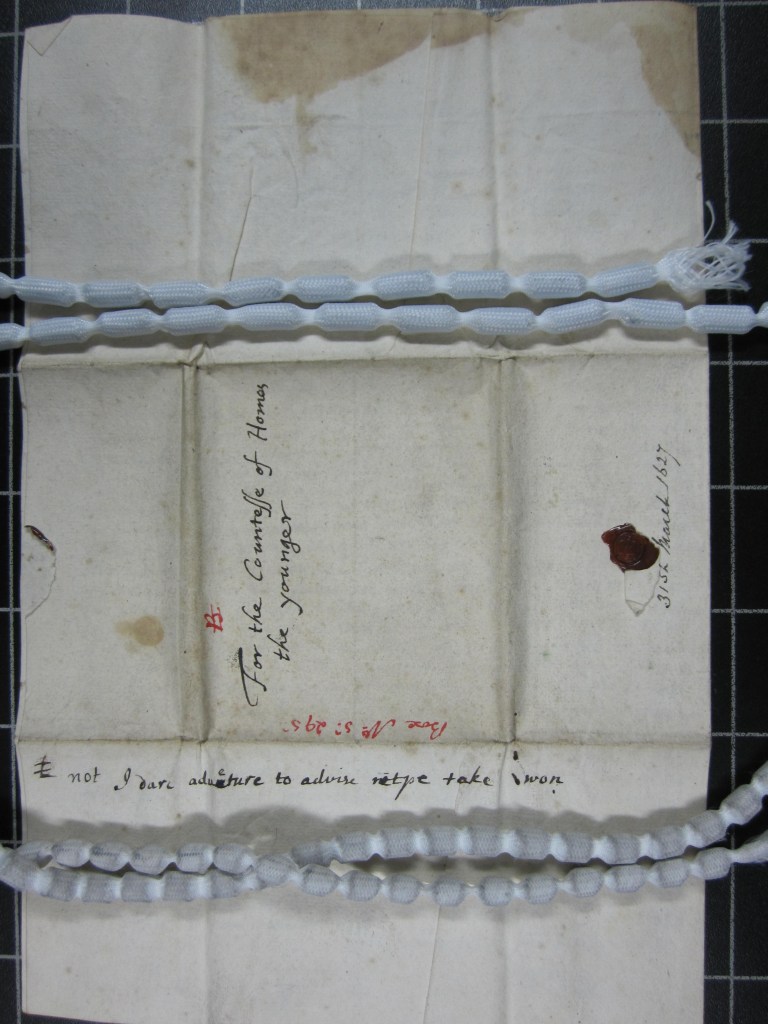
It seems interesting that this working out is jotted on an older letter, and was presumably an accident. Grace wrote forwarding notes on other letters, but this doesn’t much look like Grace Fane’s own handwriting, who might be expected to write “I” just like her mother does, (see a letter and a note in Grace Fane’s hand below).4 Possibly she had a clerk at Dunglass Castle who read and deciphered her mother’s letters for her, or perhaps some later reader took an interest in these letters.
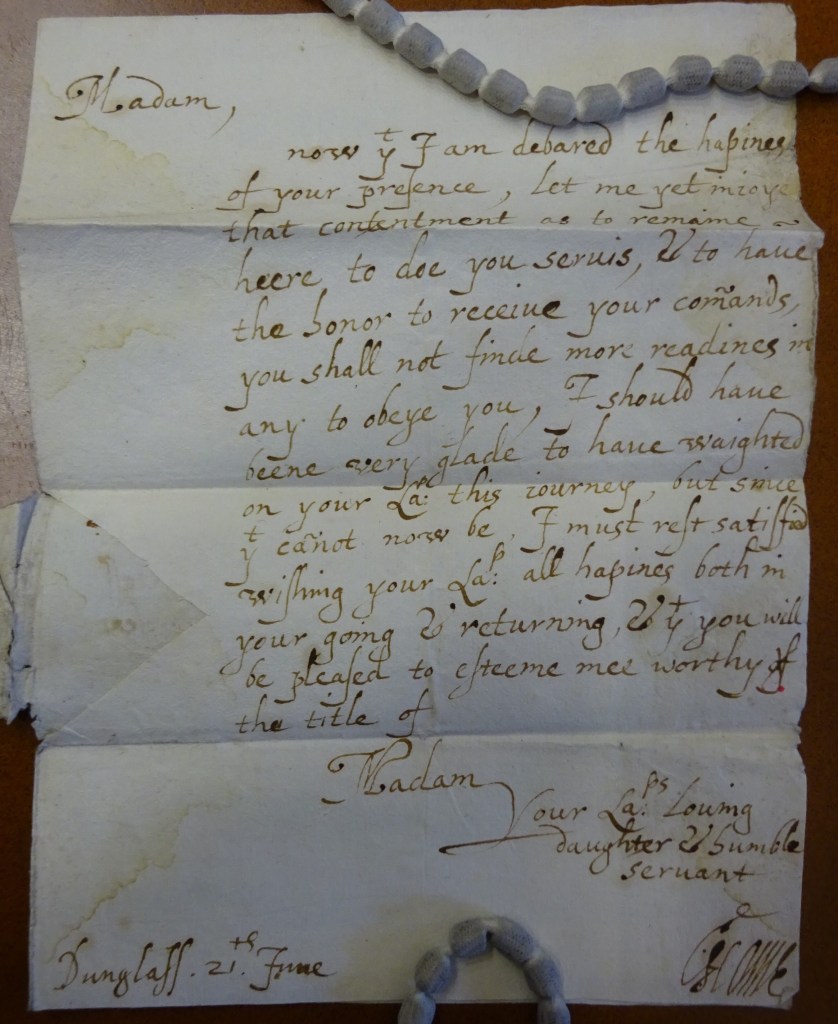
Although some of the cipher text seems intended to conceal material not intended for Grace’s mother-in-law, Mary Sutton Dudley, Countess of Home, the Countess of Westmorland asked Grace to forward some of her letters “safe to my sister Homes”. One letter has a note from Grace to her mother-in-law, excusing herself for not presenting the letter in person.
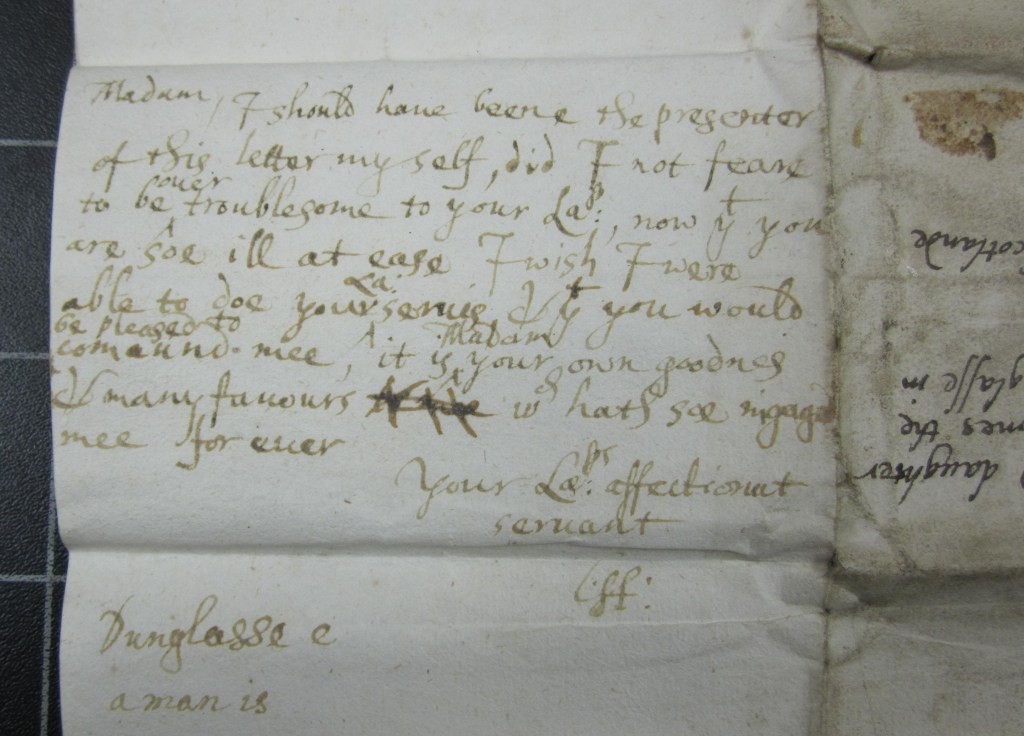
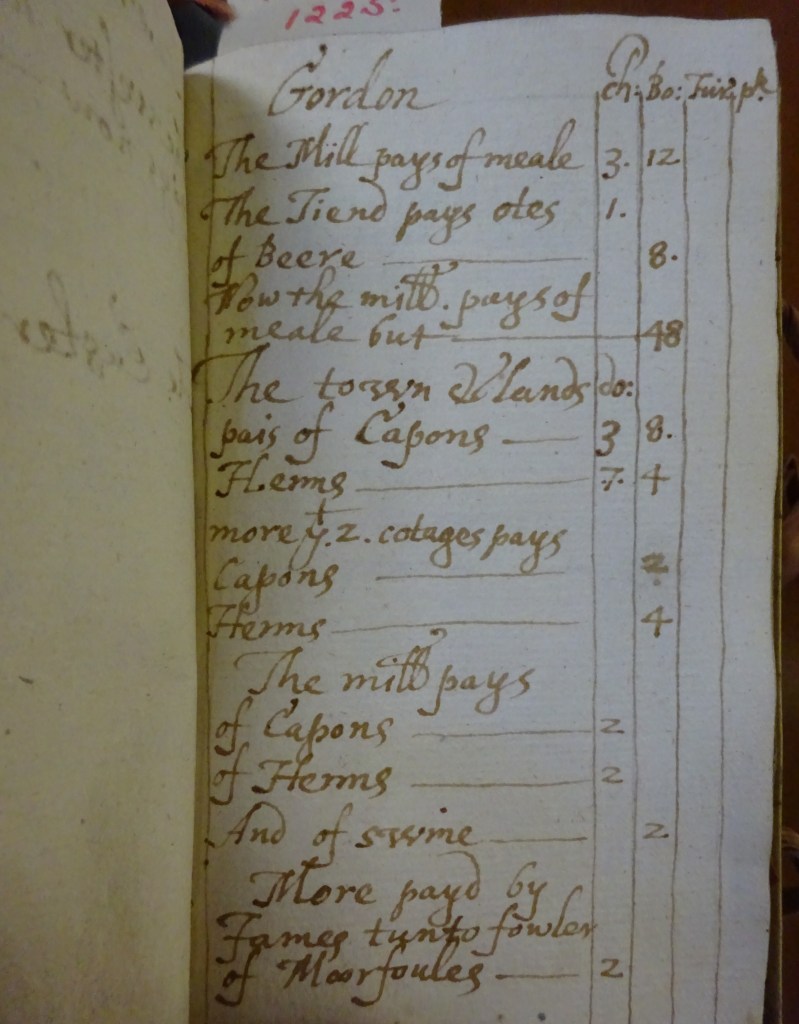
Grace Fane, Countess of Home, copied out a rental of the barony of Home, giving another example of her handwriting.
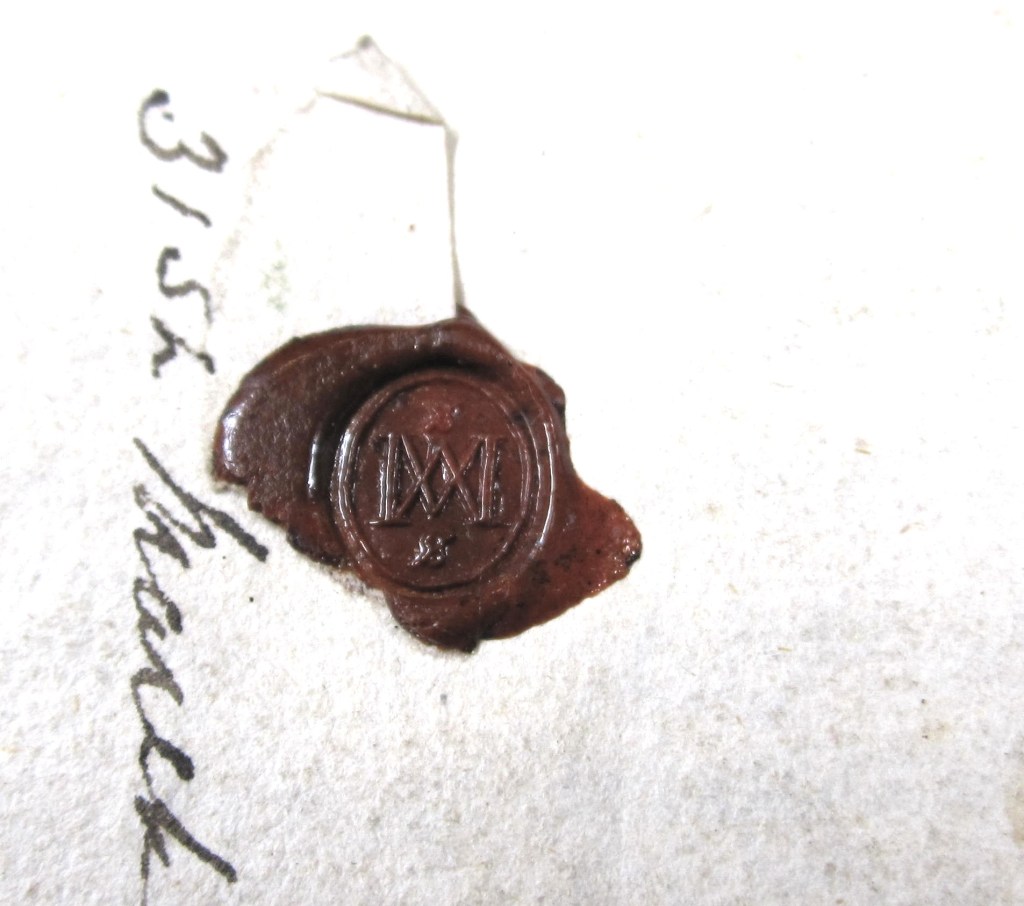
The seal on the Countess of Westmorland’s letter of 31 March 1627 is a double M monogram between two ‘S’ fermesse.
A transcript of the six letters is here, on researchgate
- Paige Donaghy, Mola, False Conception, and False Pregnancy in British Medicine, 1550-1850 (Boydell, 2026), pp. 18, 38-41. ↩︎
- Suggested by Lady Westmorland’s coded postscript, 28 April 1630, “I wonder the things I sent you from London are not yet come to you, MY LADY HOMES HATH NOT WRITEN ANY SUCH LETTER TOE MEE AGAINST YOUR IOURNEY hither AS U WRITE SHEE SAYD SHEE WOULD”, (NRAS 217, 5:302). Other passages in the letters are openly critical of the dowager Countess of Home. After Grace’s death, the countesses went to court in Edinburgh over her executry, see Westmorland’s letter to Windebank, Calendar State Papers Domestic, Charles I: 1635, vol. 8, p. 610: TNA SP14/305 f.210., and Scots Peerage, 4 (Edinburgh, 1907), p. 467. ↩︎
- Lauren Kassell, Michael Hawkins, Robert Ralley, John Young, Joanne Edge, Janet Yvonne Martin-Portugues, and Natalie Kaoukji (eds.), ‘CASE63615’, The casebooks of Simon Forman and Richard Napier, 1596–1634: a digital edition, https://casebooks.lib.cam.ac.uk/cases/CASE63615, accessed 8 October 2026. ↩︎
- Marion O’Connor notes the similarities in handwriting and the ‘distinctive ampersand’ used by the Countess of Westmorland and her daughters, “Entertainments and Poems by Lady Rachel Fane”, Malone Collections, XVII:175 (2016), pp. 158-9, and see, Caroline Bowden, “The Notebooks of Rachael Fane: Education or Authorship?”, in Victoria E. Burke and Jonathan Gibson, Early Modern Women’s Manuscript Writing (London: Ashgate, 2004), p. 167. ↩︎

