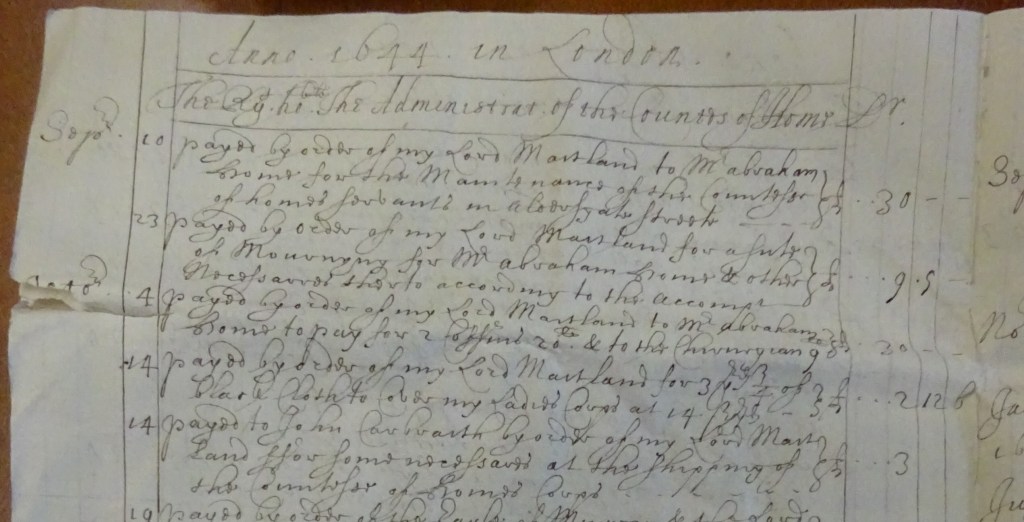
When Mary Dudley, Countess of Home, died in London in March 1644, her body was shipped to Dunglass for burial and £300 sterling was allocated for her monument, according to her will. Settling the will was a convoluted and protracted process, in part because her son-in-law John Maitland, Earl of Lauderdale was declared delinquent, and there was an attempt to claim he was not a beneficiary, and any legacies received were for his daughter. His possessions were seized, at Aldersgate or Lauderdale House, Highgate, on 30 September 1648, by officers of the Committee of Haberdasher’s Hall.1
The countess’ will had divided her furnishings between her daughters Margaret Home, Countess of Moray, and Anne (or Anna) Home , Lady Maitland and later Countess of Lauderdale. Margaret was to have the furnishings of houses in Scotland, and Anne, the houses in or near London. The sisters proceeded with this “division”, despite the incomplete executry. The Countess of Home had nominated Margaret’s daughter Mary Stewart as executor, she renounced her rights, and thereafter the sisters acted (informally) as the ‘Right Honourable Administratrices’.2
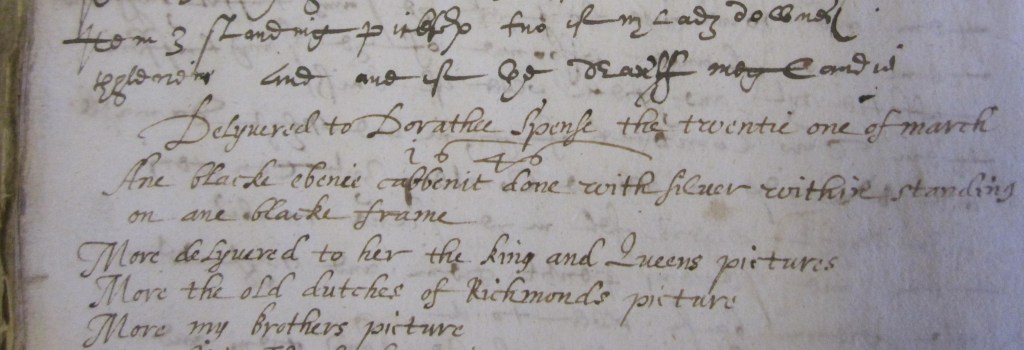
The Countess of Home had been a frequent traveller between Edinburgh and London, and Norwich (where her mother Theodosia Dudley and sister Margaret Hobart lived), and tended to move some of her favourite things around with her. Margaret, Countess of Moray, wrote some memoranda on the correct allocation of such items between the sisters. The location of objects in existing inventories counted for the “division” not their actual location. The “division” took place, and notes added to an inventory of Moray House in Edinburgh’s Canongate record a variety of items shipped from London and received by the housekeeper Dorothy Spence in March 1646.
Margaret Home wrote a memorandum about her mother’s cabinets to help the “division”. It is based in part on her recollections and also on an inventory of a house in London’s Aldersgate, which became known as Lauderdale House. That inventory is lost. Other papers give snippets of information about the house. Nicholas Stone provided a mantelpiece for a drawing room. The Countess of Home had him in mind for her tomb at Dunglass, though there is no monument there now. The memorandum mentions the tapestry in the “farthest new drawing chamber”, presumably complementing the new mantlepiece.
The memorandum is addressed to “my Lord”, possibly her husband, but intended for her brother-in-law John Maitland, Lord Maitland, later Duke of Lauderdale. He took charge of the Aldersgate House with the chaplain Abraham Hume, paid the servants, and organised shipments to Scotland. The financial details were accounted by Robert Inglis, who had managed the Countess of Home’s income, and now made his account to the “Administratrices”.
Margaret Home noted that a cabinet decorated with mother of pearl within contained ‘many sillke slips of my mothers oune workinge’. Other cabinets and boxes were made of ebony with silver within, red and yellow wood, spreckled wood, and “sundry coloured woods”, some with walnut stands. A little spreckled wood dressing box contained “a good quantity of ambergris and civet and other sweet things”. The Edinburgh inventory describes this as a “red speckled east Indian box”.
A marble table at the Highgate House (Lauderdale House) was probably used in a banqueting room, it was to be included in the “division”. An opal butterfly kept in the green velvet cabinet was a jewel, and as such was to be treated differently as the sisters interpreted the will.
A similar paper regarding the “division” (5:467) compares the contents of two cabinet rooms or closets at Moray House and Aldersgate, and includes three sets of silver picture hooks for 48 small paintings, “all thease huiks ar to be equallie devydit”. A third paper itemises ten cabinets and other pieces “divided” at Aldersgate on 8 March “1644” (really 1645 or 1646) giving slightly different descriptions, explaining that the ebony cabinet had “silver picktors on the drawers with a frame to it.”
The “Caniget” is Moray House in Edinburgh, “Fleurs” may be a predecessor of Floors Castle, the late Maureen Meikle suggested Fleurs Farm, well known to coastal walkers between Eyemouth and Coldingham. Following the death of Margaret, Countess of Moray, died in 1683, the lawyer Hugh Paterson of Bannockburn made an inventory of the Canongate house, which includes several items listed in the earlier papers, discussed below.
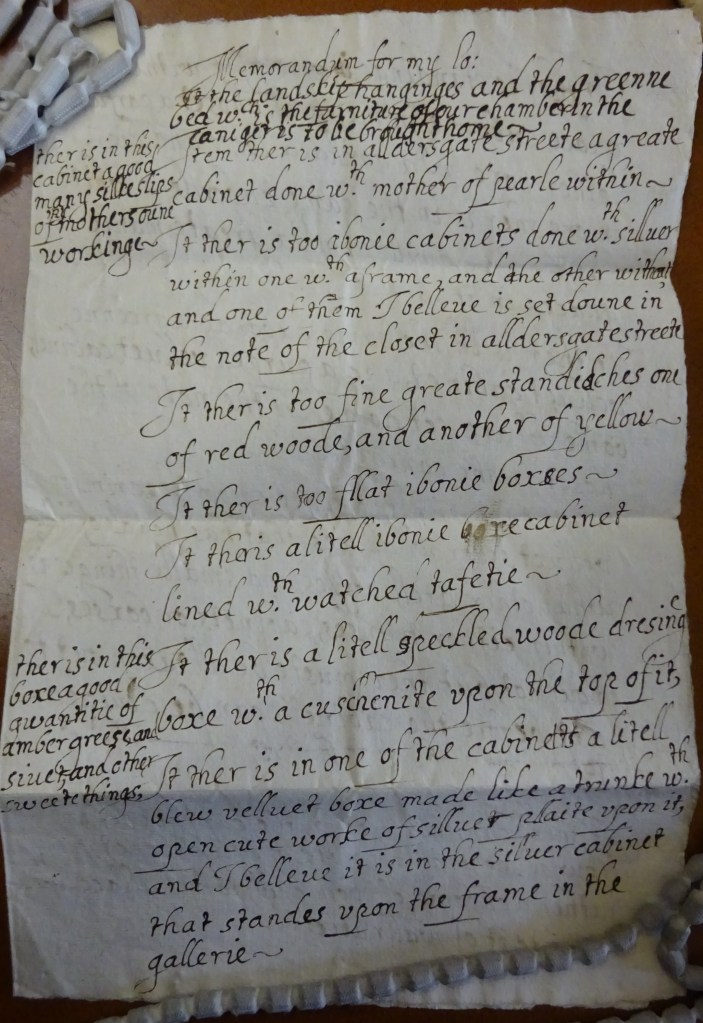
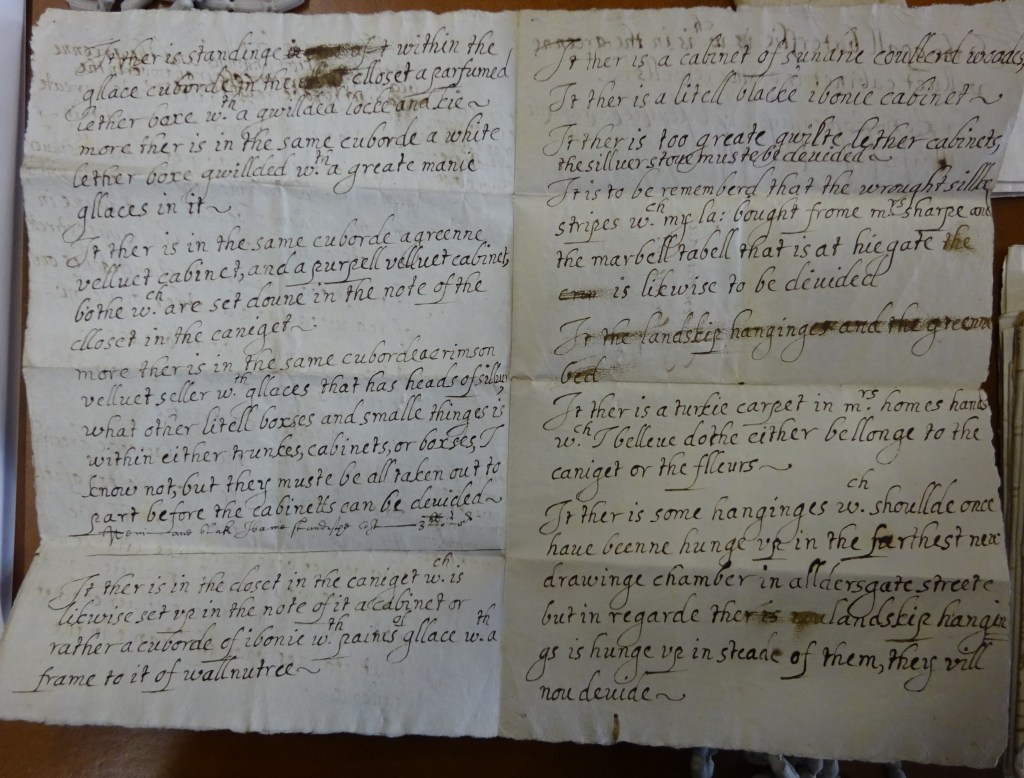
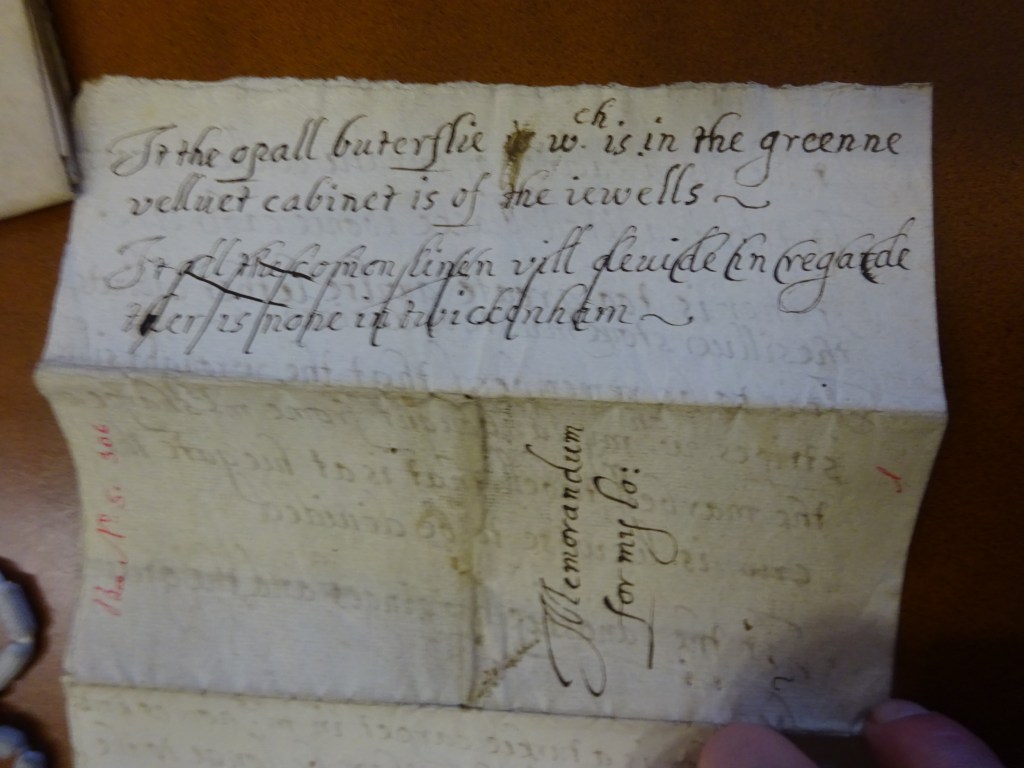
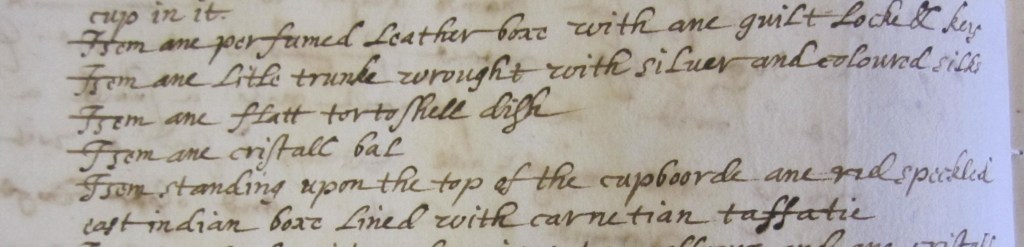
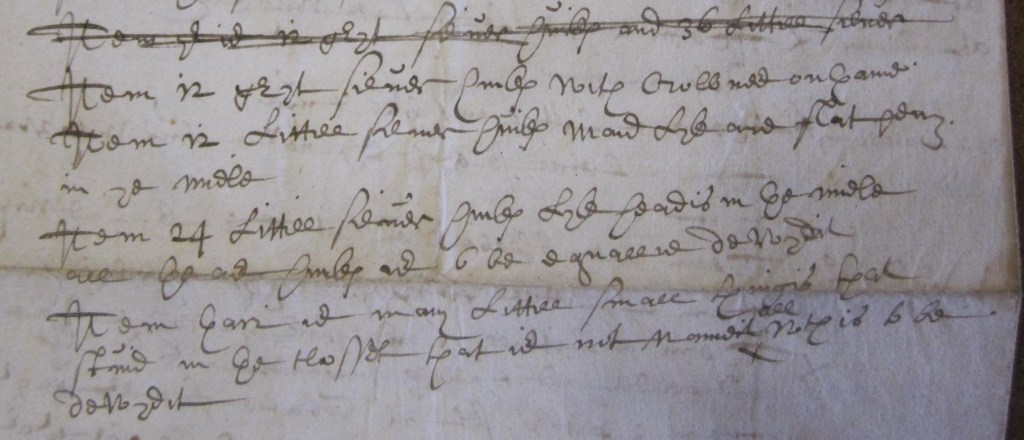
Hugh Paterson’s inventory of Moray House, 1683
In May 1683, after the death of Margaret Home, Countess of Moray, her grandson Charles Stuart, the housekeeper Anna Forrest, and the lawyer Hugh Paterson of Bannockburn made an inventory of Moray House.3 Charles Stuart described the inventory taking in his letters to his father in London. The 1683 inventory mentions cabinets and also a collection of books listed in older inventories.
In the press at the back of the house there was a silver perfuming pot in three pieces, chased and engaved. A “cypress chest” in the back closet contained five pretty silver sconces, lace, and embroidery for chairs “wrought with a neadle”. These may have been the “silk slips of my mother’s working” mentioned in the division papers. Hugh Paterson put old rental and compt books in this chest and 14 old “whyte” books in French. There were 42 books in a glazed cabinet in another closet which looked onto the garden, and a tortoiseshell cabinet “not yet opened”.
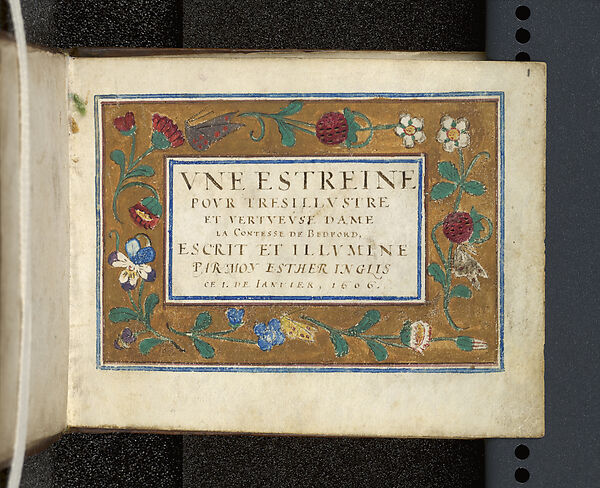
The old 1630s inventory of Moray House mentions the 42 books, and, out of the cabinet, Plutarch’s Lives in French and “theister” or “thaster”, a work by the calligrapher Esther Inglis in French.4 The 14 French books at Moray House in 1683 were probably those listed with their titles in an inventory of Donibristle House made around 1642.
The Donibristle list includes the Plutarch and Esther Inglis: Item a french dictionarie, Item a French book tragicall histories, Item a french historie of plantes, A book of letters, History of Clorind, A little book of emblems, Item a book wreatten by Easter Inglische, Item the first part of Astrea in frensche, +Plutarchs morals, A book of letters, Item a litle frenche dictonar, Item ane italian dictionar, Item ane frensche bible with silver and guilt claspes, Item a book of a converted Jesuit, Item the historie of Ariana.5

The Earl of Home had been in France, and performed some diplomatic duties, accompanying Sully in London in 1603. There had been a French schoolmaster in the household in Scotland. If the work by Esther Inglis was not made for them, possibly it was obtained from Lucy Countess of Bedford, a first cousin of Mary Dudley, Countess of Home. Mary had married the Earl of Home in the Countess of Bedford’s London house on the Strand in July 1605.6 The National Library of Scotland has a manuscript presented by Esther Inglis to the Countess of Bedford. The Countess of Home noted in her inventories that she had bought some furnishings from “Harington House” in London, mementos which carried the family heraldry.
On 15 May 1683, Charles Stuart wrote to his father that when the inventory was made, the glass cabinet of books was locked, “‘I would have sent you an inventur of my La[dy]’s books in the Closett in the Cannongaitt but thay are lockt up in the glas Cabinett, I did sie them and you have the number of them sent in the Inventur but I could not cum to them to knoue what books thay are I cannot yit find the key to opin the tuo cabinets that I did writ of befor but I shall Indevor yit to find them”.7

According to the 1683 inventory, an olive cabinet stood in the main bed chamber with the overmantle painting of the Five Senses. A carpenter Patrick Maislet had made a new frame for the picture in November 1663. A sweetmeat cupboard (currently stored in the wardrobe) belonged in the passage room where Anne Home, Countess of Lauderdale, had played the virginals as a child.8
At least two of the old rental and compt books that Hugh Paterson placed in the cypress chest on 5 May 1683 survive, a rental of the Home lands written by Grace Fane, Countess of Home, and an account book annotated by Mary Dudley, Countess of Home, which includes payments to the mason William Wallace for building Moray House, and details of silk thread issued to her housekeepers to embroider pillowcases.


- Bulstrode Whitelock, Memorials of the English affairs from the beginning of the reign of Charles the First to the happy restoration of King Charles the Second, 2 (Oxford, 1853), p. 412: Details of the executry are held by the National Library of Scotland, ‘Papers concerning the Tweeddale and Lauderdale families’, MS.14547, with the associated charters ‘Deeds relating to the executry of the Countess of Home and her property at Aldersgate, Highgate, Richmond Park and Barsted’, Ch. 11314-11332, while inventories of furnishings and memoranda are held with the papers of the Earls of Moray, NRAS 217. ↩︎
- Calendar State Papers Domestic, Charles I, 1644–1645 (London, 1890), p. 518: Subsequently, it was claimed that one William Dudley was the administrator, but his administration was declared void in 1658, and the will was proved, (NLS MS.14547). In 1661, the haberdasher William Geere claimed to have rights to the Highgate House, and the court documents narrate the story of the administration, (TNA C10/61, 47). ↩︎
- NRAS 217 Box 5 No. 558, Hugh Paterson’s inventory of Moray House, 5 May 1683. Charles Wemyss transcribed this inventory during his PhD research. ↩︎
- NRAS 217 box 5 no. 5, an inventory of Moray House, Edinburgh, started in 1631, for “thaster” as “the Esther”, see Marie-Louise Coolahan & Mark Empey, “Women’s Book Ownership and the Reception of Early Modern Women’s Texts”, in Leah Knight, Micheline White, Elizabeth Sauer, Women’s Bookscapes in Early Modern Britain: Reading, Ownership, Circulation (Michigan, 2018), 234, 238: Michael Pearce, ‘Vanished Comforts’, University of Dundee PhD thesis (2016), p. 282. ↩︎
- NRAS 217 Box 5 no. 1, an inventory of Donibristle House, Fife, made in the 1640s. ↩︎
- British Library, Stowe MS 574 f.66v., the wedding was celebrated by Peter Alibond, vicar of St Michael’s, Chenies. ↩︎
- NRAS 217 Box 6 no. 123, Charles Stuart to his father, the Earl of Moray, Edinburgh 15 May 1683. ↩︎
- The sweetmeat cupboard and virginals beside Anne Home’s bedchamber are mentioned in the 1630s inventory, Michael Pearce, ‘Vanished Comforts’, University of Dundee PhD thesis (2016), p. 280. ↩︎


Certainly both Floors Castle and Fleurs farm are marked as Fleures on Blaeu’s maps of 1654. The Maitland connection makes me think that Floors Castle is perhaps more likely.
There was also a Fleurs in Morayshire (maybe Banffshire) too – Adamsone of Fleuires is mentioned in the mid-17th century in The Council Register of the Burgh of Aberdeen – and in Ayrshire, East Lothian, Fife and two in Renfrewshire.
LikeLiked by 1 person