William Schaw was master of work to James VI and Anna of Denmark, and chamberlain of her Dunfermline estates. He was in charge of royal buildings, signing accounts and receipts, and was probably the designer of the 1594 Chapel Royal at Stirling Castle.1
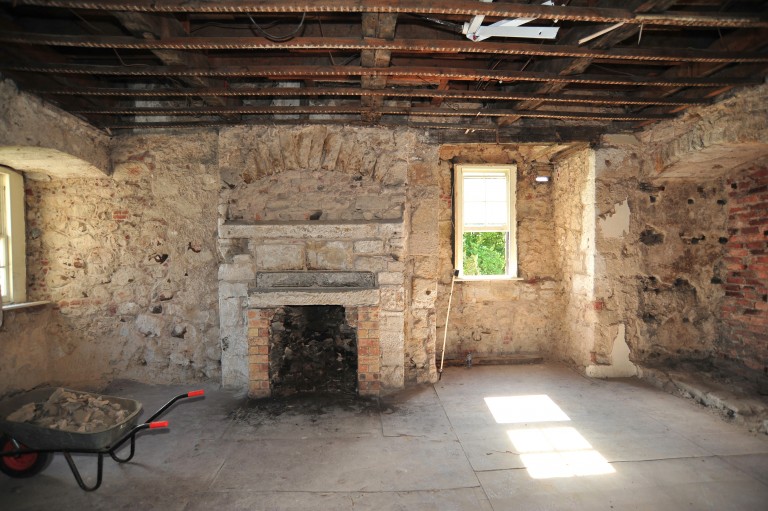
Schaw was responsible for refurbishments at the Prince’s Tower at Stirling around the time of the birth of Prince Henry, where dendrochronology has shown that the floors were renewed at this time.2 Schaw also supervised the construction of new buildings at Dunfermline Palace for Anna of Denmark (long since demolished), and the alteration and augmentation of older monastic accommodation.3
Schaw put his name on some practical advice for stone masons, including hints on health and safety and working at heights. Some of this material was published by William Fraser in 1859. David Stevenson traced connections between these working masons and modern freemasonry.5
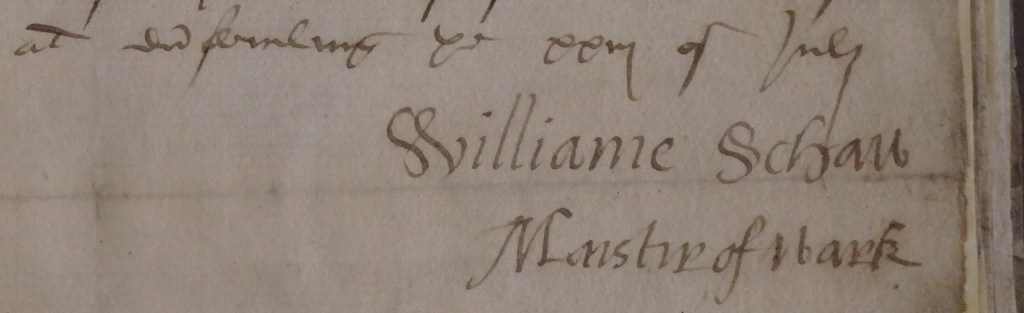

King James and Anna of Denmark gave Schaw a gold salamander set with diamonds as a hat badge for a New Year’s day gift in 1595, supplied by the goldsmith and accountant of the king’s English subsidy, Thomas Foulis.6 Schaw helped the queen’s goldsmith Elias Le Tellier in a legal case resulting from a feud with a rival craftsman.7 Beyond what is written on his tomb at Dunfermline Abbey,8 other biographical details are sparse. Schaw died in 1602 months after receiving a wound from the rapier of Francis Mowbray.9
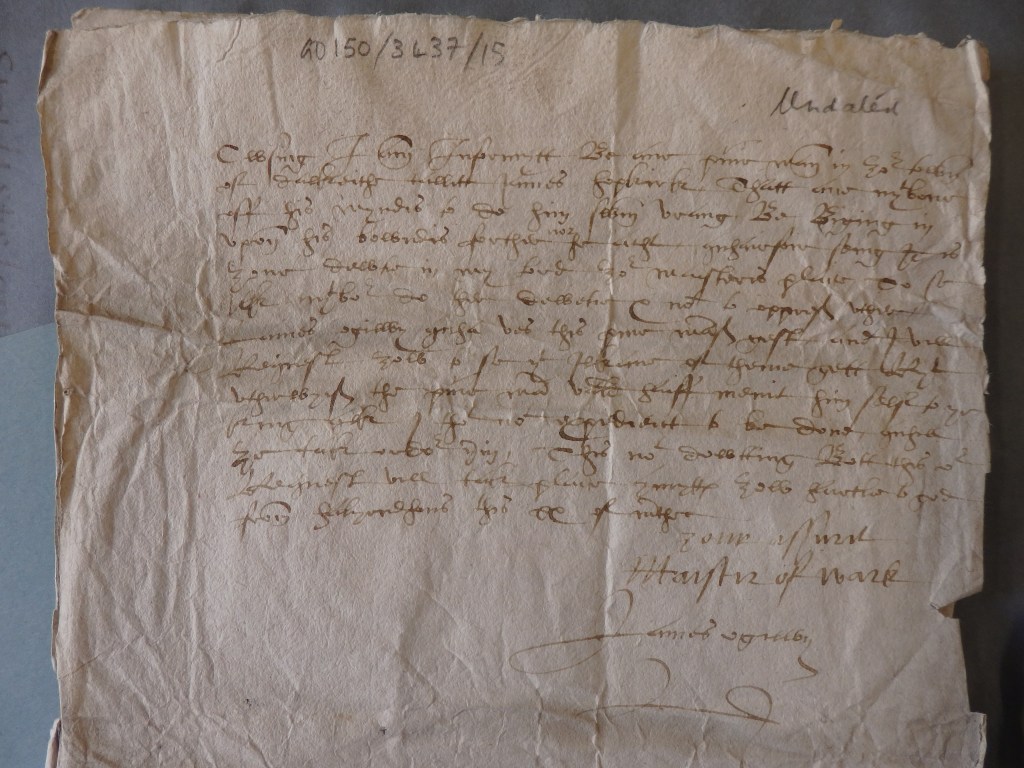
William Schaw had a cousin, Michael Schaw, who worked as chamberlain for the Earls of Morton at Aberdour Castle and Dalkeith Palace. The National Records of Scotland has a letter from William Schaw (co-signed by James Ogilvy) to Michael Schaw concerning a property at Dalkeith (NRS GD 150/3437/15). This is perhaps the only surviving letter written by William Schaw, and concerns what we would now recognise as a N.I.M.B.Y planning dispute and sound advice on neighbourly duty.
In essence, Willliam Schaw asks Michael Schaw to resolve a dispute in Dalkeith about a new building, at the instance of James Hopkirk in Dalkeith, as related to him by James Ogilvy. The complainers might otherwise petition the king. William Schaw writes in favour of James Hopkirk in Dalkeith, whose property was threatened by his neighbour’s extension. As Hopkirk and his neighbour are both tenants of the Earl of Morton in Dalkeith, Cousin Michael, as the earl’s factor, can sort this out without going to law or petitioning the king. The letter reads:
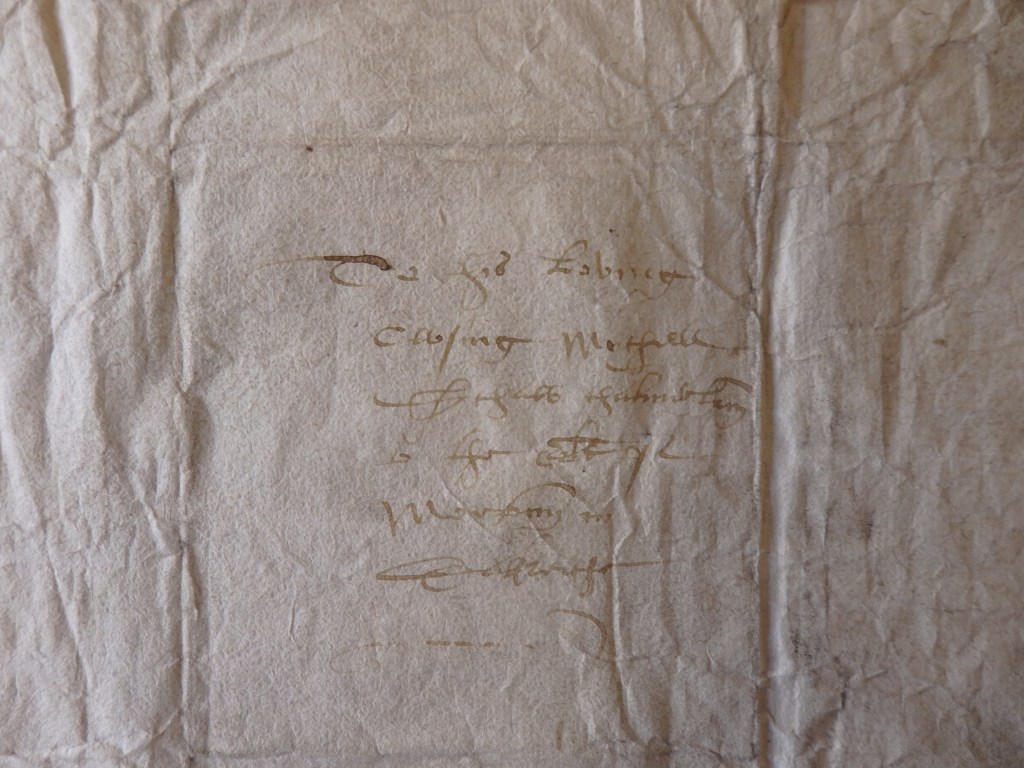
“To his Loving cwsing Mychell Schaw chalmerlain to the erle of Mortoun in Dalkeith
Cwsing,
I am informytt be ane puir man in your town of Dalkeith callit James Hopkirk that ane nyghbour off his myndis to do him swm wrang be biging in upon his bowndis forther nor he acht, quhairfoir seing it is your dewtie in my lord your maisteris [Earl of Morton’s] plaice to se ilk nyghbour do thir dewetie & not to oppress uthirs, James Ogilvy quha wes this puir mans gest and I will Request yow to se ilkane of thame get Rycht utherwyis the puir man wald haiff menit himself to the King quhilk I thocht nocht expedient to be done quhill ye tak ordour therin, This nocht dowtting bott this our Request will tak place, Comytts yow hartlie to god from Halyrudhous this xx of merche,
Your assurit
Maistir of Wark
James Ogilvy.”
Or in more modern garb:
To his Loving cousin Mychell Schaw chamberlain to the Earl of Morton in Dalkeith
Cousin,
I am informed be a poor man in your town of Dalkeith called James Hopkirk that a neighbour of his minds to do him some wrong by building in upon his bounds further than he ought, wherefore seeing it is your duty in my lord your master’s [Earl of Morton’s] place to see each neighbour do their duty & not to oppress other, James Ogilvy who was this poor man’s guest and I will Request you to see each of them get Right, otherwise the poor man would have come himself to the King, which I thought not expedient to be done till you take order therein, This not doubting but this our Request will take place, Committs you heartily to god from Holyroodhouse this 20 of March,
Your assured
Master of Wark
James Ogilvy
- Ian Campbell and Aonghus Mackechnie, “The ‘Great Temple of Solomon’ at Stirling Castle”, Architectural History, 54 (2011), pp. 91-118. ↩︎
- Gordon Ewart and Dennis Gallagher, With Thy Towers High: The Archaeology of Stirling Castle and Palace (Historic Scotland, 2015), p. 146: Anne Crone, Stirling Castle Palace Dendrochonological Analysis (Historic Scotland: SPARC/SCRAN, 2008), pp. 8,12, 22: Marguerite Wood, Extracts from the burgh records of Edinburgh, 1589-1603 (Edinburgh, 1927), p. 113: A treasury payment to William Schaw for work at Stirling Castle was recorded in November 1593, NRS E21/70 f. 83r. ↩︎
- Aonghus Mackechnie, “The Royal Palace of Dunfermline”, Richard Fawcett, Royal Dunfermline (Edinburgh, 2005), pp. 119-126. ↩︎
- Picture, HES, from Steven J. Reid, The Prince in the Tower: James VI and I’s Childhood at Stirling Castle ↩︎
- David Stevenson, Origins of Freemasonry (Cambridge, 1988) p. 27: William Fraser, Memorials of the Montgomeries, 2 (Edinburgh, 1859), pp. 239-244. ↩︎
- Miles Kerr-Peterson & Michael Pearce, “King James VI’s English Subsidy and Danish Dowry Accounts, 1588–1596”, Miscellany of the Scottish History Society, XVI (Woodbridge, 2020), pp. 13–14, 85. ↩︎
- Winifred Coutts, The Business of the College of Justice in 1600 (Stair Society, 2003), p. 70: National Records of Scotland, CS7/186 f.120v. and CS7/190 f.12r. ↩︎
- The Schaw Monument: Church Monuments Society. ↩︎
- Jamie Reid-Baxter, “Politics, Passion and Poetry in the Court of James VI: John Burel and his surviving works”, Sally Mapstone, L.A.J.R. Houwen, Alan A. MacDonald, A Palace in the Wind: Essays on Vernacular Culture and Humanism in Late-Medieval and Renaissance (Peeters, 2000), pp. 199–200. ↩︎
 Objects and the Archive