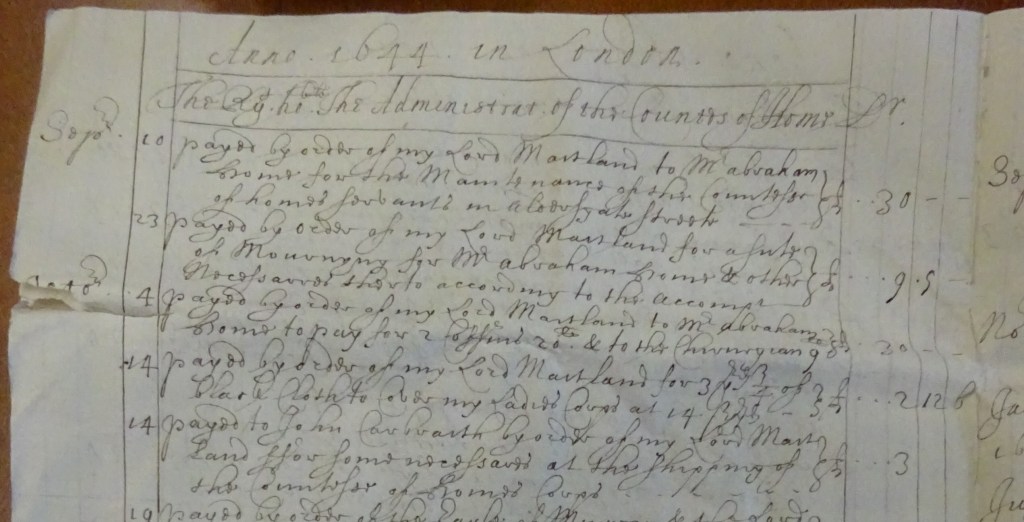
When Mary, Countess of Home, died in London in March 1644, her body was shipped to Dunglass for burial and £300 sterling was allocated for her monument, according to her will. Settling the will was a convoluted and protracted process, in part because her son-in-law John Maitland, Earl of Lauderdale was declared delinquent, and there was an attempt to claim he was not a beneficiary, and any legacies received were for his daughter. His possessions were seized, at Aldersgate or Lauderdale House, Highgate, on 30 September 1648, by officers of the Committee of Haberdasher’s Hall.1
The countess’ will had divided her furnishings between her daughters Margaret, Countess of Moray, and Anne (or Anna), Lady Maitland and later Countess of Lauderdale. Margaret was to have the furnishings of houses in Scotland, and Anne, the houses in or near London. The sisters proceeded with this “division”, despite the incomplete executry. The Countess of Home had nominated Margaret’s daughter Mary as executor, she renounced her rights, and thereafter the sisters acted (informally) as the ‘Right Honourable Administratrices’.2
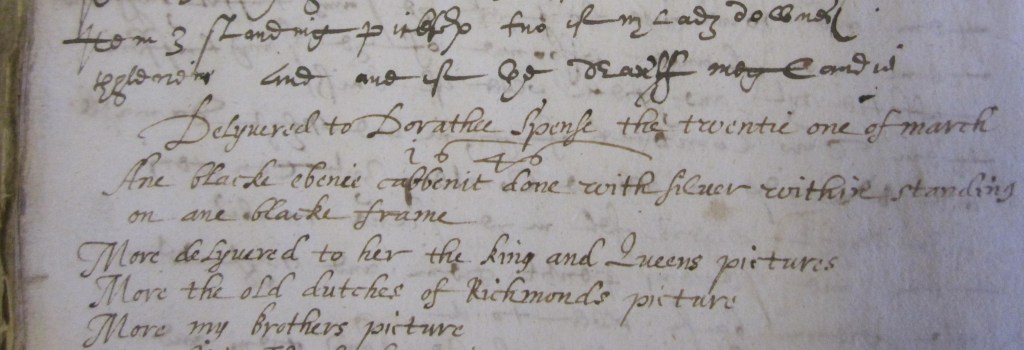
The Countess of Home had been a frequent traveller between Edinburgh and London, and Norwich (where her mother Theodosia Dudley and sister Margaret Hobart lived), and tended to move some of her favourite things around with her. Margaret, Countess of Moray, wrote some memoranda on the correct allocation of such items between the sisters. The location of objects in existing inventories counted for the “division” not their actual location. The “division” took place, and notes added to an inventory of Moray House in Edinburgh’s Canongate record a variety of items shipped from London and received by the housekeeper Dorothy Spence in March 1646.
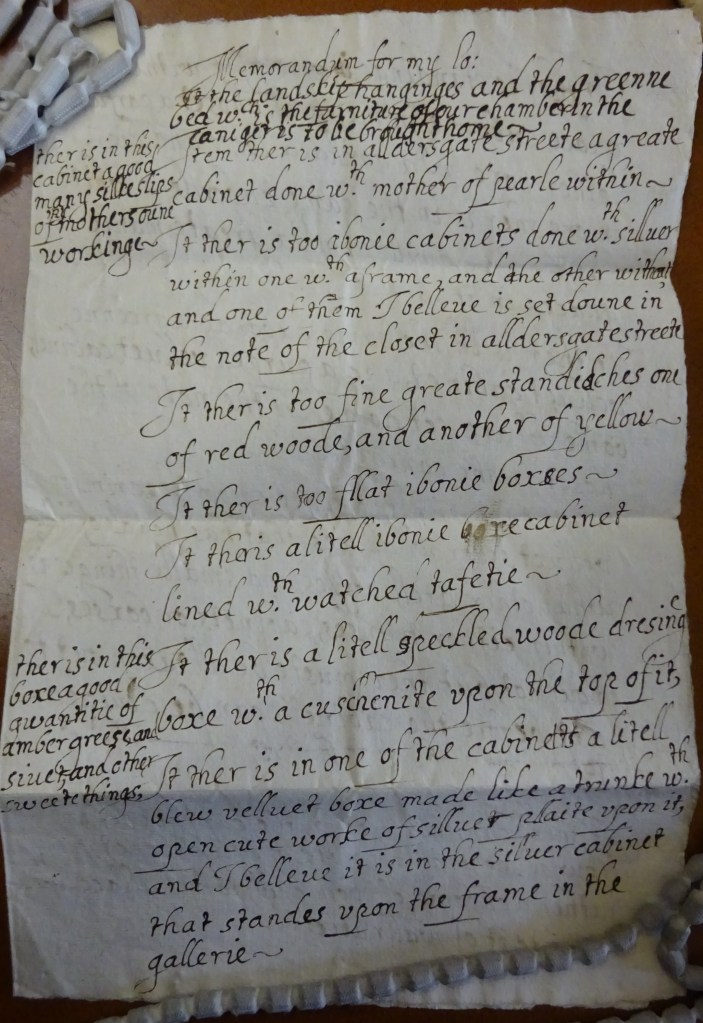
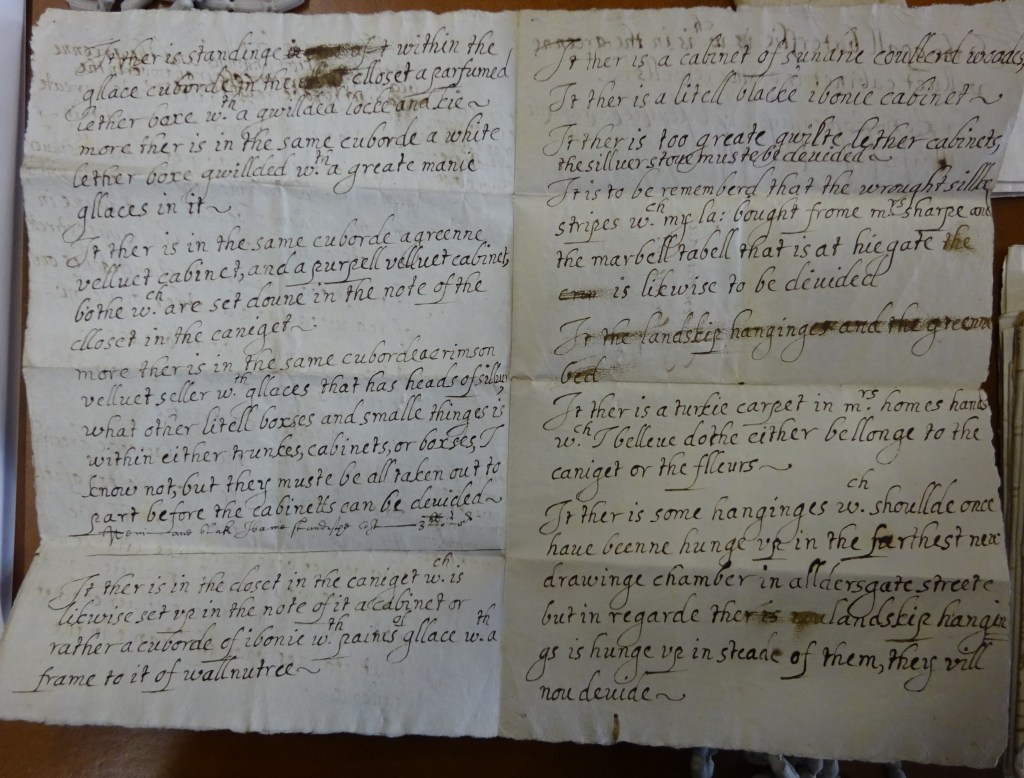
Margaret Home wrote a memorandum on her mother’s cabinets to help the “division”. It is based in part on her recollections and also on an inventory of a house in London’s Aldersgate, which became known as Lauderdale House. That inventory is lost. Other papers give snippets of information about the house. Nicholas Stone provided a mantelpiece for a drawing room. The Countess of Home had him in mind for her tomb at Dunglass, though there is no monument there now. The memorandum mentions the tapestry in the “farthest new drawing chamber”, presumably complementing the new mantlepiece.
The memorandum is addressed to “my Lord”, possibly her husband, but intended for her brother-in-law John Maitland, Lord Maitland, later Duke of Lauderdale. He took charge of the Aldersgate House with the chaplain Abraham Hume, paid the servants, and organised shipments to Scotland. The financial details were accounted by Robert Inglis, who had managed the Countess of Home’s income, and now made his account to the “Administratrices”.
Margaret noted that a cabinet decorated with mother of pearl within contained ‘many sillke slips of my mothers oune workinge’. Other cabinets and boxes were made of ebony with silver within, red and yellow wood, spreckled wood, and “sundry coloured woods”, some with walnut stands. A little spreckled wood dressing box contained “a good quantity of ambergris and civet and other sweet things”.
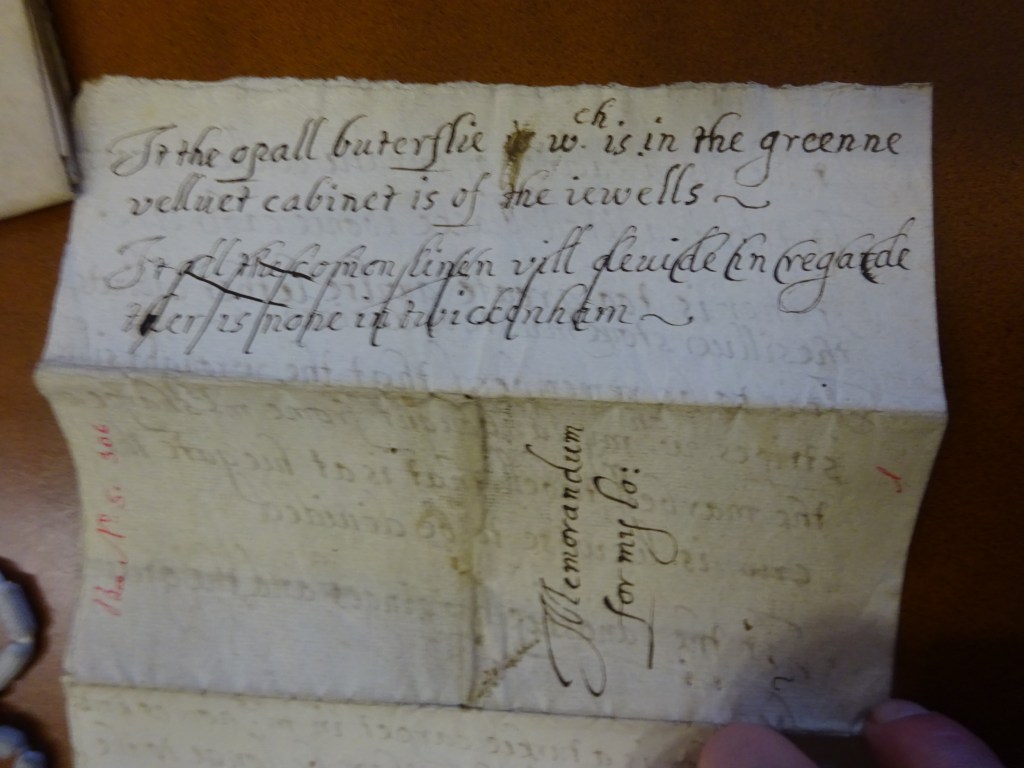
A marble table at the Highgate House (Lauderdale House) was probably used in a banqueting room, it was to be included in the “division”. An opal butterfly kept in the green velvet cabinet was a jewel, and as such was to be treated differently as the sisters interpreted the will.
Pictures of the memorandum below. The “Caniget” is Moray House in Edinburgh, “Fleurs” may be a predecessor of Floors Castle, the late Maureen Meikle suggested Fleurs Farm, well known to coastal walkers between Eyemouth and Coldingham. Pictures of the memorandum below.
- Bulstrode Whitelock, Memorials of the English affairs from the beginning of the reign of Charles the First to the happy restoration of King Charles the Second, 2 (Oxford, 1853), p. 412: Details of the executry are held by the National Library of Scotland, ‘Papers concerning the Tweeddale and Lauderdale families’, MS.14547, with the associated charters ‘Deeds relating to the executry of the Countess of Home and her property at Aldersgate, Highgate, Richmond Park and Barsted’, Ch. 11314-11332, while inventories of furnishings and memoranda are held with the papers of the Earls of Moray, NRAS 217. ↩︎
- Calendar State Papers Domestic, Charles I, 1644–1645 (London, 1890), p. 518: Subsequently, it was claimed that one William Dudley was the administrator, but his administration was declared void in 1658, and the will was proved, (NLS MS.14547). In 1661, the haberdasher William Geere claimed to have rights to the Highgate House, and the court documents narrate the story of the administration, (TNA C10/61, 47). ↩︎
 Objects and the archive
Certainly both Floors Castle and Fleurs farm are marked as Fleures on Blaeu’s maps of 1654. The Maitland connection makes me think that Floors Castle is perhaps more likely.
There was also a Fleurs in Morayshire (maybe Banffshire) too – Adamsone of Fleuires is mentioned in the mid-17th century in The Council Register of the Burgh of Aberdeen – and in Ayrshire, East Lothian, Fife and two in Renfrewshire.
LikeLiked by 1 person