Lady Mary or Marie was a daughter of Anne Gordon, Countess of Moray. A record of her mother’s income and expenditure survives in a series of accounts covering a part of the 1620s and 1630s. The accounts have a lot to say about Lady Mary, her parrot, wool bought for a frame used for a textile hobby, a stamp and ink, her clothes and clothes bought for her dwarf companion.
Suppliers in Edinburgh included several (named) women who made perling, the haberdasher Inglish Bess, who also sold shoes, and an honest aged woman.
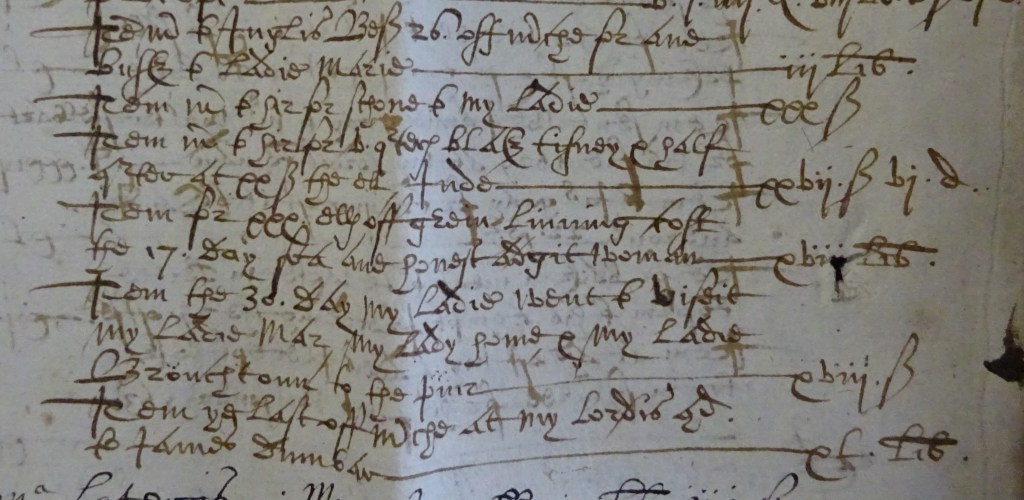
Item, mor to hir for shone [shoes] to my Ladie _ xxx s.
Item, mor to hir for v quarters blak tisney & half quarter at xxs the ell Inde _ xxvij s vj d.
Item, for xxx ells of grein linning cost the 17. day fra ane honest adgit woman _ xviij lib.,
Item the 3rd day my Ladie went to visit my Ladie Mar, my Ladie Home & my Ladie Brouchtoun, to the puir _ xviij s.
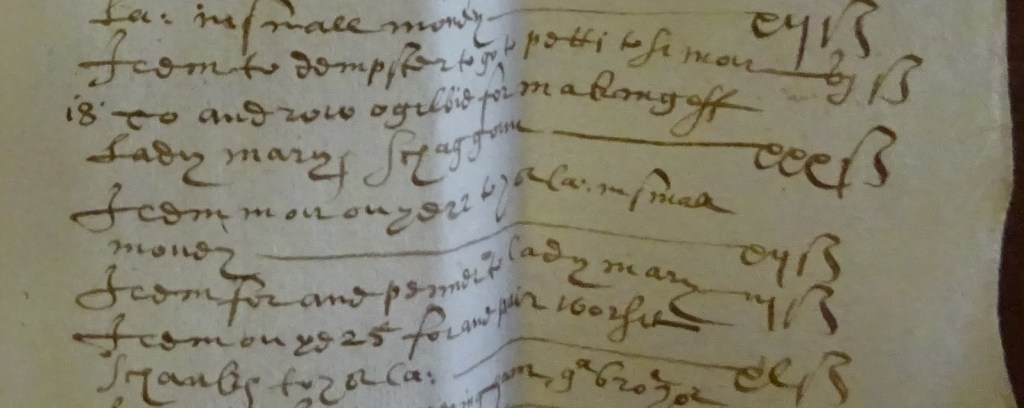
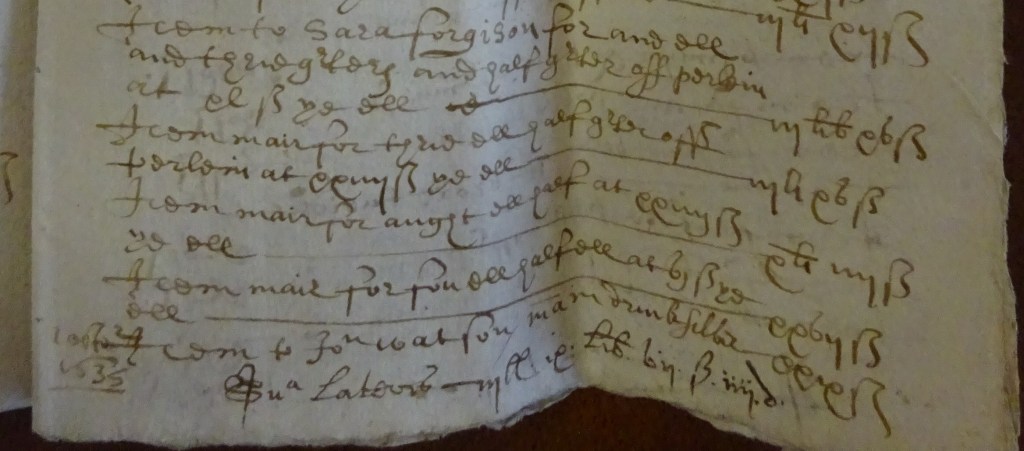
In the accounts “my lady” is Anne Gordon, Countess of Moray. She gave gifts to the poor at the gates of friends in Edinburgh, a useful index to sociability in the early modern town. Lady Mary seems to be the Mary Stewart or Stuart (1616-1663) who married James Grant of Freuchie. The National Museum of Scotland has a portrait of Lady Grant wearing coral or red cornelian beads.2

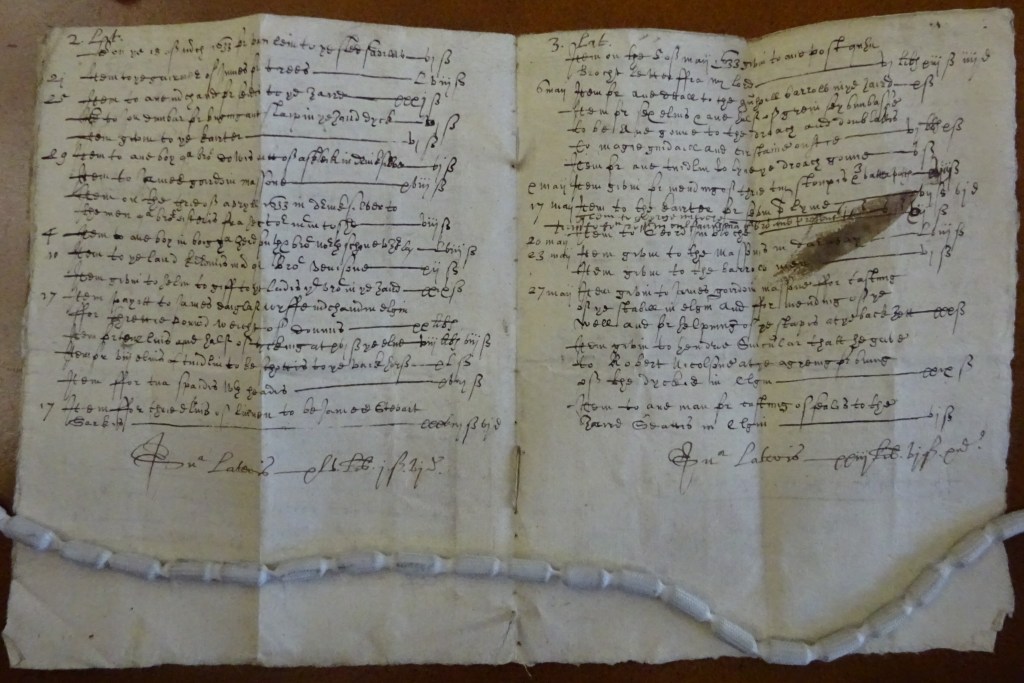
The Moray accounts detail Lady Mary’s journey as a teenager between a lodging in Leith and Elgin in November 1629. A man was paid to carry her on the rocks at Queensferry. William Fraser, researching the Grant family papers, described her similar journey north in a “chariot” and sedan chair in 1661, taking easy stages, supposing that she was not then in “robust health”. Taken together, it may be that she had some lifelong mobility issue or could not ride a horse.3
Anne Gordon’s accounts usually refer to Lady Mary’s companion as the “droach”. The Moray papers mention a dwarf servant Meg Candie who resided at the Canongate House of her brother’s mother-in-law Mary, Countess of Home. It seems that Lady Mary’s companion was another woman, Christian Stewart, who perhaps had previously been in royal service.
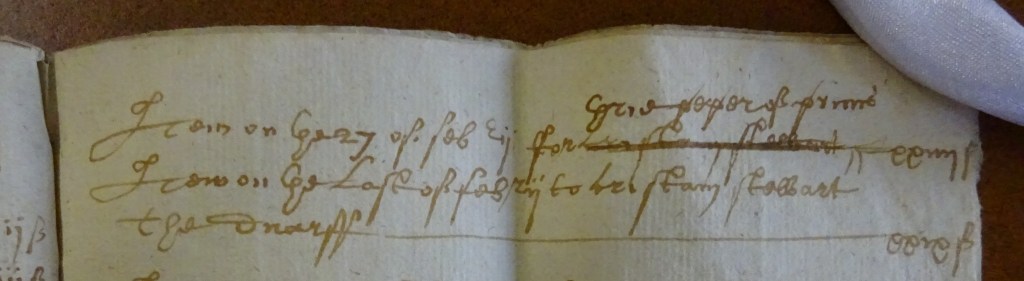
These accounts represent an income from dowry lands in Fife and Menteith, and seem to have been prepared for an audit of some kind in 1638. They are now Moray Papers NRAS 217, Box 4 nos. 822-835.
- For a consideration of perling in early modern Edinburgh, see Cathryn R. Spence, “A Perl for Your Debts?: Young Women and Apprenticeships in Early Modern Edinburgh”, Janay Nugent and Elizabeth Ewan, Children and Youth in Premodern Scotland (Boydell, 2015), pp. 32-46. ↩︎
- Diana Scarisbrick, “Lady Mary Stewart”, Rosalind K. Marshall & George Dalgleish, The Art of Jewellery in Scotland (Edinburgh, 1991), p. 34. ↩︎
- William Fraser, Chiefs of Grant (Edinburgh, 1883), pp. 285-286. ↩︎
 Objects and the Archive