William Fowler (died January 1572), an Edinburgh merchant, served as a treasurer of the French revenues of Mary, Queen of Scots.1 He was also a textile merchant, and his registered will lists his merchant stock of fabrics and ready made items such as hats, bonnets, belts, and “counterfeit pearls for masking”.2 I’ve transcribed much of his will with some comparable textile stocks from other testaments, which you can read here.
In 1582, his son, the poet William Fowler, who was later a secretary to Anna of Denmark, came to London seeking a debt Mary owed to his father and enlisting the help of the French ambassador Michel de Castelnau, Sieur de Mauvissière.3 The debt, which wasn’t listed in the 1572 will, involved the French revenue. Fowler senior may have paid out more to Mary than he received. As Fowler senior was a textile merchant he could have been owed money by Mary for merchandise, but one of the younger Fowler’s letters of May 1583 to Francis Walsingham explains that his mother Janet Fokart had previously written for repayment to the French administrators of Mary’s dowry, including the Archbishop of Glasgow, Péguillon, and René Dolu, to no avail. She was “in despair to recover it” and now advised her son to abandon his suit,4
Some details of William Fowler senior and the French revenue in the account of George Wishart of Drymme have recently been published by the Scottish History Society.5 Wishart worked for the Comptroller, John Wishart of Pitarrow, as a sub-collector, collecting and distributing sums from Mary’s revenue. The Comptroller joined the Chaseabout Raid, a rebellion against Mary and her new husband Lord Darnley, causing some disruption to crown finance. By some chance, Wishart of Drymme’s preliminary account survived.
In the account, George Wishart included sums of money which he had received in 1564 which were “neither of the property nor yet of the collectory”. This section includes payments from William Fowler, which would seem to be allocations made from Mary’s French income, revenues from her dowry lands.
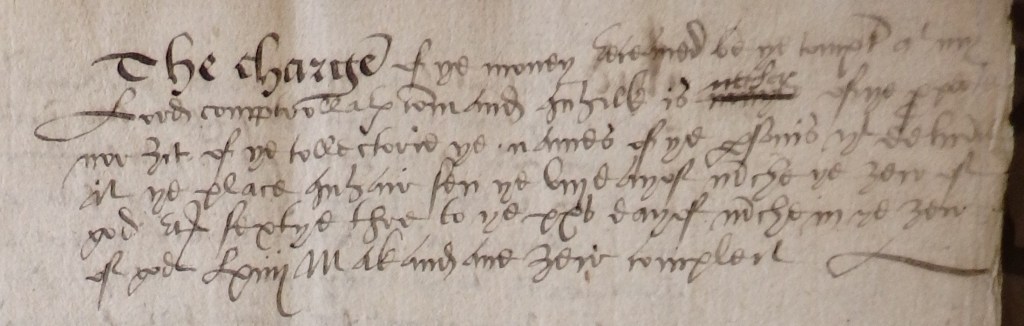
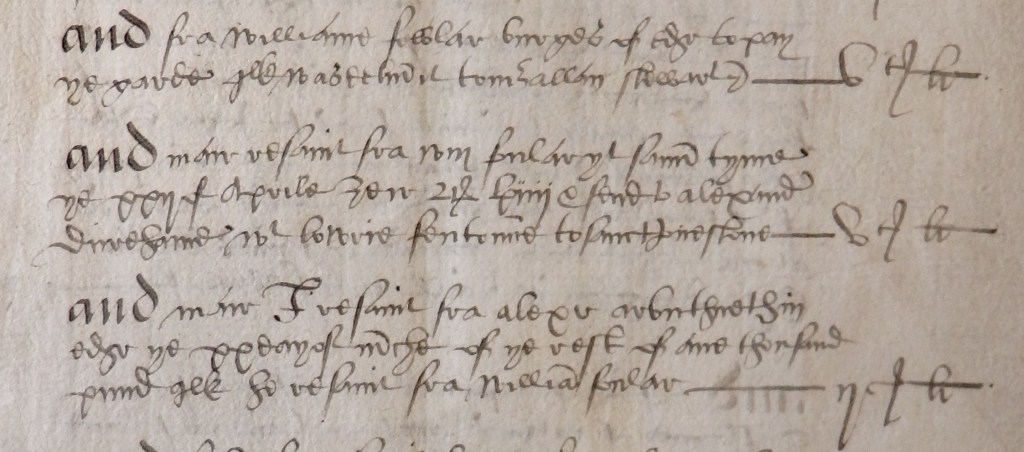
Fowler delivered £500 Scots, which was given to Alan Stewart, quartermaster of her guard. Another £500 was sent to Alexander Durham, the finance officer of Mary’s household, to help cover her expenses in Perth in April 1564. Wishart received £200 from Fowler, the “rest” or final payment of £1000, the £800 having been delivered in a previous accounting period.6 These are the only details of Fowler’s involvement in crown finance, he does not appear the Exchequer Rolls or Accounts of the Treasurer, except as a supplier of “tock”, a lightweight fabric used in masque costume.7
John Knox felt that household expenses and the cost of the guard weighed heavily on money that might otherwise have been used for the stipends of kirk ministers, claiming “the gaird and the effairis of the kytcheing wer so gryping that the mynisteris stipendis could nocht be payit”.8 Wishart’s account shows that at least some of the expense of the guard was met with Mary’s own money.
As Fowler’s receipts from France might easily fall behind the sums he advanced for the expenses of Mary’s guard and household, he could become “superexpended”, and leave a legacy of unpaid debt that his hopeful son might try to claim from the French ambassador in London. This is the context of the poet’s involvement and correspondence with Francis Walsingham.9 The administration and mismanagement of Mary’s dowry in the 1580s was a focus of intrigue.10
Some confusion is added by older writers who identify William Fowler with Thomas Fowler, the executor of Margaret Douglas, Countess of Lennox, and describe the old debt as if it were only a pretext contrived for the poet’s introduction to the French ambassador rather than his entrée.11 At the same time, another individual was using Mary’s old debts as a cover story. In October 1582, Robert Bowes wrote to Walsingham that a man called John Masterman carried letters from the Duke of Lennox in Scotland to Castelnau’s house. Masterman, presumably older than Fowler, pretended to visit Castelnau to claim wages owed to him by Mary.12
Mary distrusted William Fowler at first, warning Mauvissière about him as early as December 1582, soon after his arrival in London. In May 1583, she considered he could be a useful source of information for the French ambassador and might even be a worthwhile recipient of a pension.13
- A good general idea of Mary’s French income can be gained from her letter to Du Verger 29 April 1574, translated by Agnes Strickland, Letters of Mary Queen of Scots, 1 (London: Colburn, 1842), pp. 162-182. ↩︎
- Margaret H. B. Sanderson, Mary Stewart’s People (James Thin, 1987), pp. 94-96: National Records of Scotland CC8/8/3, pp. 718-731. ↩︎
- Sebastian Verweij, The Literary Culture of Early Modern Scotland (Oxford, 2016), p. 79: Alessandra Petrina, Machiavelli in the British Isles: Two Early Modern Translations of The Prince (Ashgate, 2009), pp. 73-74: William Craigie, Works of William Fowler, 3 (Edinburgh: STS, 1940), pp. x, xv. ↩︎
- William K. Boyd, Calendar State Papers Scotland, 6 (Edinburgh, 1910), pp. 250 no. 276, 480 no. 495, TNA SP52/31 f.56. François Beaucaire de Péguillon, Bishop of Metz, had visited Edinburgh to discuss Mary’s French income in August 1562, Labanoff, Lettres de Marie Stuart, 2 (London: Dolman, 1844), pp. 448-449, see Rosalind K. Marshall, Queen Mary’s Women (John Donald, 2006), p. 48, and Alexander Wilkinson, Mary Queen of Scots and French Public Opinion (Palgrave Macmillan, 2004), pp. 29-30. ↩︎
- Michael Pearce, “Account of George Wishart of Drymme”, Miscellany of the Scottish History Society, 17 (Boydell, 2025), p. 15. ↩︎
- Margaret H. B. Sanderson briefly describes a loan of £1000 involving Fowler and other parties and the treasurer of the marquis d’Elboeuf, Mary Stewart’s People (James Thin, 1987), p. 93 citing NRS RoD, 5, f.53. ↩︎
- Michael Pearce, “‘Maskerye claythis’ for James VI and Anna of Denmark”, Medieval English Theatre, 43 (Cambridge: Brewer, 2022), p. 113: Accounts of the Treasurer of Scotland, 11 (Edinburgh, 1916), p. 466. ↩︎
- Gordon Donaldson, Accounts of the Collectors of Thirds of Benefices, 1561-1572 (Edinburgh: Scottish History Society, 1949), p. xxv. ↩︎
- Jade Scott, Captive Queen: The Decrypted History of Mary, Queen of Scots (Michael O’Mara, 2024), p. 186: Allison L. Steenson, The Hawthornden Manuscripts of William Fowler and the Jacobean Court (Routledge, 2021), p. 29. ↩︎
- Leo Hicks, An Elizabethan problem: Some aspects of the careers of two exile-adventurers (New York: Fordham, 1964), pp. 187-195. ↩︎
- Phyllis M. Handover, Arbella Stuart: Royal Lady of Hardwick and Cousin to King James (London, 1957), p. 56, in part perhaps following Conyers Read who presents the debt as a fact enabling Fowler’s introduction to Castelnau, after he began working for Walsingham, Conyers Read, Mr Secretary Walsingham, 2 (reprint Archon Books, 1967), p. 377, and see the footnote Labanoff, Lettres, 5, p. 361. John Bossy makes no mention of the debt in Under the Molehill: An Elizabethan Spy Story (Yale, 2001). ↩︎
- Bowes Correspondence (London, 1842), p. 218. ↩︎
- George Lasry, Norbert Biermann and Satoshi Tomokiyo, “Deciphering Mary Stuart’s lost letters from 1578–1584”, Cryptologia, 47:2 (February 2023), pp. 157, 161, 170, 172, 179. ↩︎

